All species › Lamiales › Bladderwort family › Pinguicula macroceras
Pinguicula macroceras
A butterwort whose range falls on the map into two pieces separated by thousands of kilometres of ocean: Japan, Korea and Kamchatka on one side, the Aleutians and the west coast of North America on the other. Pinguicula macroceras is the North Pacific counterpart of our own P. vulgaris, and as the name says it is marked out by a long spur.


Identification
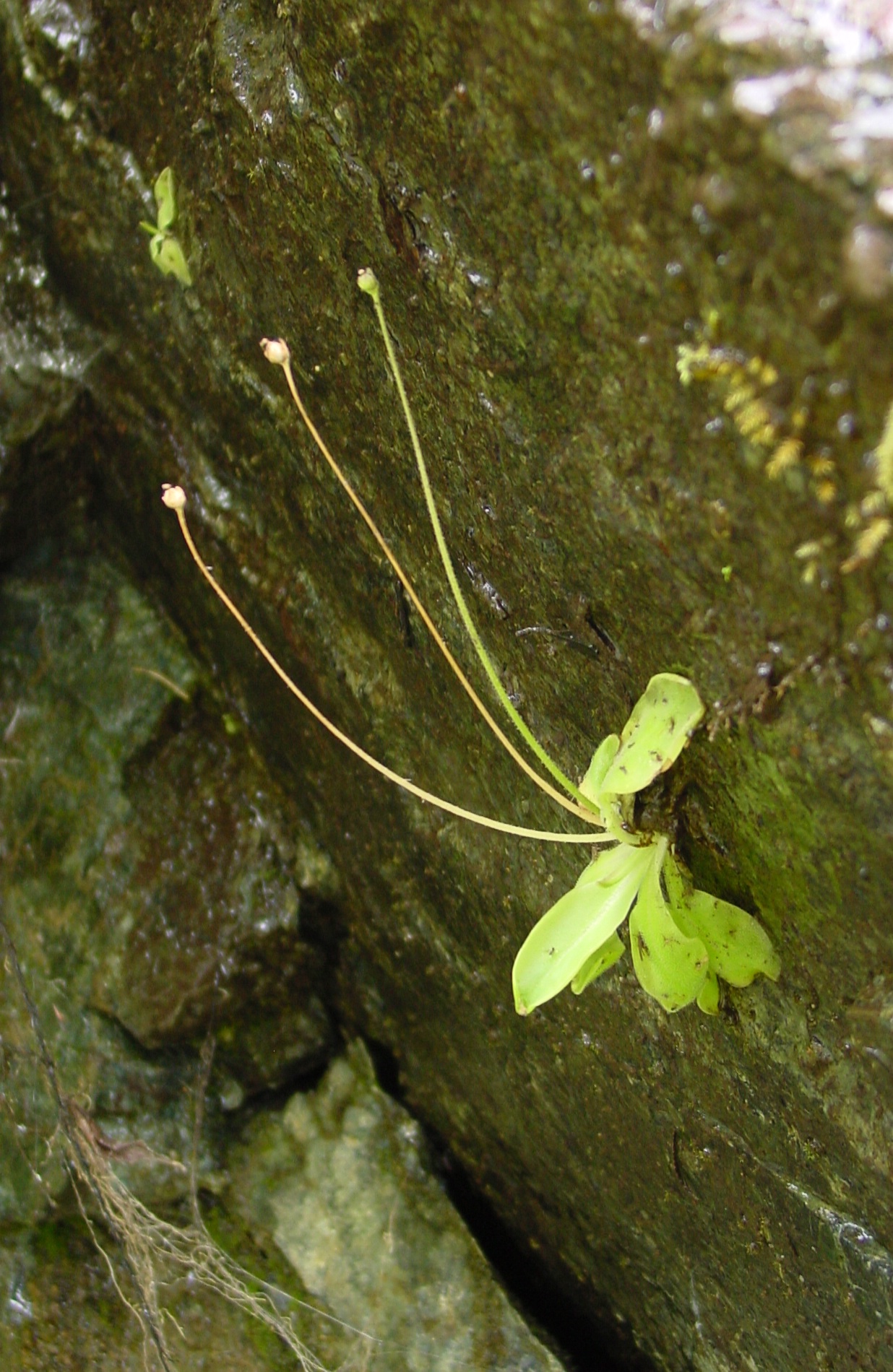
A flat rosette of yellow-green, obovate to oblong leaves twenty to fifty-five millimetres long and seven to eighteen wide, with upturned margins — for a butterwort a substantial plant. One to three or more scapes rise from the centre, two and a half to fifteen centimetres tall, exceptionally twenty-one, each with one flower. The flower is twelve to twenty-seven millimetres long, up to thirty including the spur, purple-blue, pink or rarely whitish, with a white throat patch. The spur is straight and cylindrical and varies greatly in length, from one to eleven millimetres; on the larger plants it is conspicuously long, and that is what the epithet refers to. The plant overwinters as a winter bud.
Similar species
The closest relative is Pinguicula vulgaris, which occurs in Europe and northern Asia and sometimes appears within the range of this species; the spur of P. vulgaris is shorter and more pointed, the flower usually smaller. Japan also holds P. ramosa, with a branched scape and a white flower of at most eleven millimetres, while P. algida and P. spathulata in Siberia are both far smaller with whitish flowers. In North America confusion with P. vulgaris is possible in Alaska and Canada; there the length of the spur decides. A yellow-green rosette more than three centimetres across with a blue-purple flower on a long scape is a safe bet in the North Pacific region.
The trap and how it works
A flypaper trap of the classic butterwort kind, but with a considerable area: a full-grown rosette five centimetres across catches hundreds of small insects in a good season. The stalked glands carry the sticky droplet, the sessile glands beneath act as soon as prey is lying there, and the margin then rolls slowly upward so that the digestive fluid stands in a shallow dish. In the seepage habitats the species occupies, midges and small flies swarm in dense clouds just above the wet surface in summer — exactly at rosette height. By late summer an old leaf lies black with remains.
Habitat and ecology
Wet, seeping rocks and flushed slopes (R1), open ground above the treeline and in the subalpine belt (R5), and boggy mountain pasture and spring mires (W6). In the northwestern United States the species also grows on ultramafic rock: the famous serpentine fens of the Siskiyou Mountains, where it stands together with the cobra lily Darlingtonia californica (R3). Everywhere the site is permanently wet, nutrient-poor and open, in a cool climate, from sea level in the north to the mountains further south.
Distribution and elevation
A North Pacific distribution round the ocean: North Korea, Kamchatka and northern and central Japan, and on the other side the Aleutians, Alaska, British Columbia and south into California. The species is therefore not endemic and occurs on two continents. In Japan it ranges from lowland gorges at a few hundred metres to the high mountains; in North America from the coast into the ranges of Oregon and California. Our species list names North America and Japan, which is right, though Kamchatka and Korea then fall outside the picture.
- Recorded (quarter-degree cells)
Forms and variation
Within this species local units are recognised in North America; the best known is the form of the serpentine fens on the Oregon–California border, which stays small and has a short spur and is treated by some authors as a separate subspecies. The species also varies greatly in flower size and spur length — the quoted one to eleven millimetres is a remarkable spread for one species — and that variation is partly tied to the site. The boundary with P. vulgaris is not sharp everywhere in northeastern Asia. Natural hybrids have been described where the two grow together.
Where and when to see it
Search along water on cool slopes. In Japan the best places are gorges and stream valleys with wet rock walls; in the northwestern United States they are the serpentine fens, where the species stands among the pitchers of the cobra lily and its blue-purple flower stands out at once. The rosette is large enough to find without flowers, but the flower is what you see from a distance. Go in early summer, soon after the snow has gone. Seepage slopes are easily trampled; stay on the edge and use binoculars to scan the slope.
Conservation status
The species is assessed as Least Concern on the global IUCN Red List and is not in CITES. That fits a range encircling the whole northern Pacific, much of it in thinly settled or protected country. The picture is not favourable everywhere, though. In Japan many sites are small and isolated and under pressure from waterworks, forestry and ever more abundant deer stripping the vegetation; in California and Oregon the serpentine fens are limited in extent and sensitive to changes in the water regime and to mining. The broad assessment therefore says something about the species as a whole, not about every population.
Scientific name
Pinguicula macroceras | Pallas ex Link, 1820
Named by Peter Simon Pallas, validly published by Johann Heinrich Friedrich Link in 1820, in Jahrbuch der Gewächskunde 1(3): 54. The original type material was destroyed during the Second World War. The species occurs along the Pacific coast of North America. The name derives from the Greek makros (large, long) and keras (horn), referring to the flower's notably long spur.
World Checklist of Vascular Plants (WCVP), via Plants of the World Online (POWO), Royal Botanic Gardens, Kew.