All species › Lamiales › Bladderwort family › Pinguicula laueana
Pinguicula laueana
Red is a rarity in this genus, and Pinguicula laueana is its best-known example: a butterwort with a bright scarlet to crimson flower on a long slender scape, from the Sierra Mixe in Oaxaca. The species was only described in 1989 and is known in the wild from a few places, high in the cloud-forest country around Cerro Zempoaltépetl.


Identification
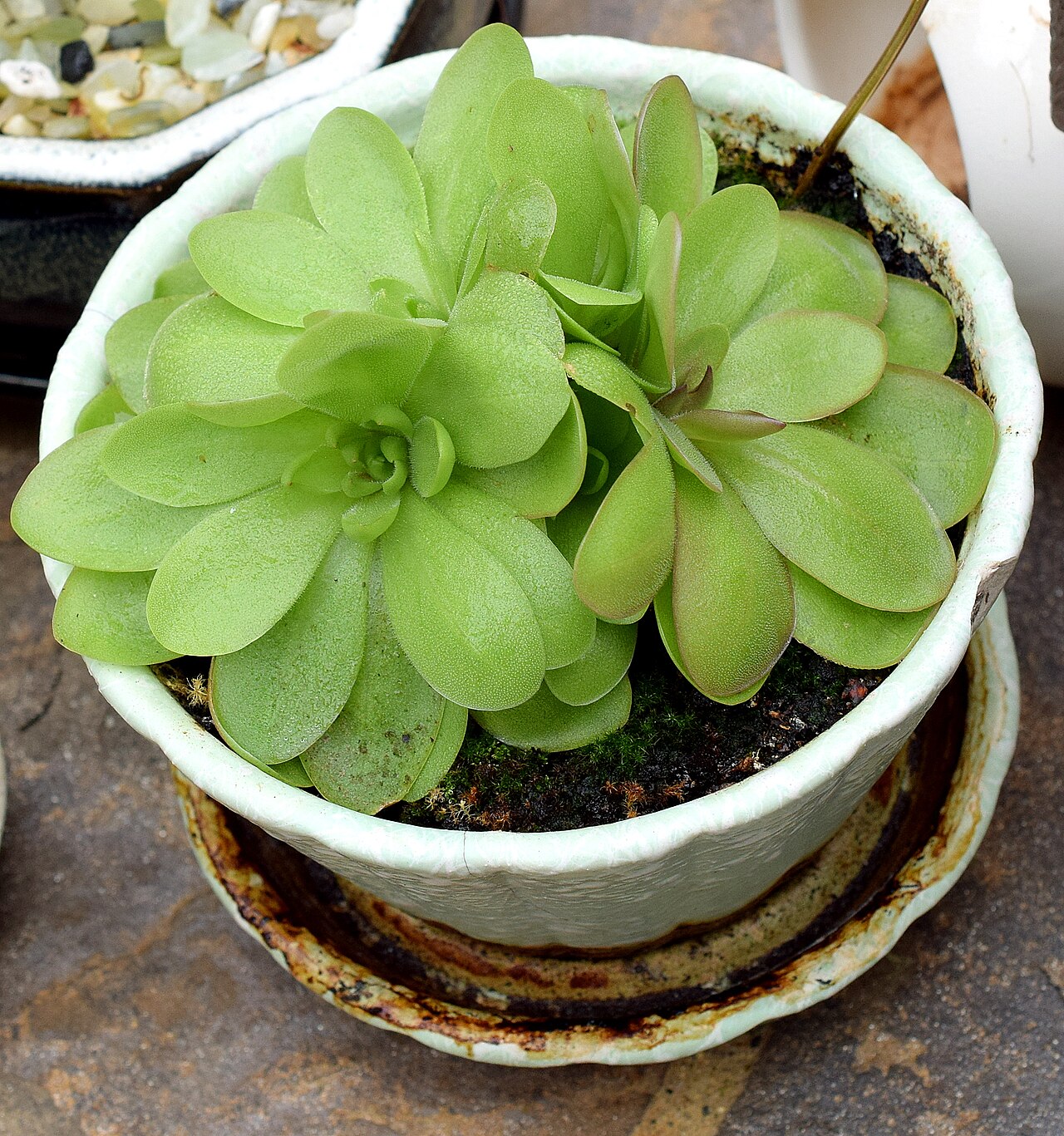
A rosette that changes greatly through the year. The winter leaves are small, about 2 cm long and half to nearly one centimetre wide, thick and fleshy. The summer leaves reach about 5 cm long and 2.5 cm wide, spread flat with a glistening glandular coating; a well-grown plant then measures well over a decimetre across the rosette. Slender scapes 15 to 20 cm tall rise from the centre. The flower is the character: bright red to deep crimson, with a cream or pale throat mark, a lower lip about 20 mm long and a slender, slightly curved spur four to four and a half centimetres long — almost twice the length of the flower itself. Flowering April to August.
Similar species
In the field the red flower with its very long spur is virtually unmistakable. The only other red Mexican butterworts are Pinguicula utricularioides from eastern Oaxaca, much smaller and with a spur of only 5 to 8 mm, and the deep red forms of P. elizabethiae, which grows further north in Hidalgo and Querétaro. Out of flower P. laueana resembles many other Mexican species; then the Sierra Mixe locality is the best hold. Hybrids with P. moranensis have been described from the same area and have a pink to rose-red flower.
The trap and how it works
A flypaper trap on a flat, fairly large leaf, working almost year round in a humid mountain climate. The stalked glands hold the prey with a droplet of mucilage; as soon as the animal makes contact the sessile glands release enzymes and the leaf margin begins rolling slowly inward, forming a shallow bowl in which the digestive fluid stays. Because the plant grows in cloud forest, where it stays damp for long stretches, that fluid is washed away less quickly than at a dry site. The catch consists mainly of small flies swarming in the shade around moss and ferns.
Habitat and ecology
The upper slopes of the Sierra Mixe, in and around cloud forest, on mossy rocks, shaded banks and steep roadside cuttings with water seeping down them (R1, B1). It is a cool, permanently humid environment with much mist; even in the dry season low cloud regularly banks against the slopes. The plants grow in thin cushions of moss on rock or earth, rarely in true soil. Competition from grasses and herbs is limited by the steep, shallow site: whatever grows there must make do with a few centimetres of moss and humus.
Distribution and elevation
Endemic to Mexico and, as far as known, to the Sierra Mixe in Oaxaca, around Ayutla and Cerro Zempoaltépetl. Our species list names Oaxaca, which is correct. The range is small and the number of reliably published sites limited; elevation falls in the upper montane belt, roughly between eighteen hundred and twenty-two hundred metres, locally higher. Within that small area the species seems bound to particular walls and banks rather than spread over the whole massif.
- Recorded (one-degree cells)
Forms and variation
In the wild, flower colour differs between populations from a bright, almost orange-red to a deep crimson with a purple cast; the pale throat mark is distinct in some plants and faint in others. That variation is gradual and no wild varieties have been described. What is sold in the trade as separate clones lies outside this guide. More important for the field observer are the natural hybrids with P. moranensis, which occur at mixed sites: those plants have a pink to rose-red flower with a spur of intermediate length.
Where and when to see it
Go between April and August, when the red flowers stand above the moss; they are visible from a long way off and betray the rosettes that otherwise disappear beneath them. Search along the upper bends of mountain roads and on shaded mossy cuttings, not out in open grassland. Watch for mist: the best moments are early in the morning, when the glandular coating is full of condensation. Take no plants and pull no moss loose — the site is shallow and recovers slowly.
Conservation status
Not assessed for the global IUCN Red List and not listed in CITES. What is known deserves attention: the range is very small, the species was only described in 1989, and the red flower in particular has made it highly sought by collectors. In addition the cloud forest of the Sierra Mixe is under pressure from logging, road building and expanding farmland, and steep roadside banks are both growing place and first casualty of maintenance. Population data are lacking. The plant is common in cultivation and easily propagated, so the trade has no reason at all to draw on wild plants.
Scientific name
Pinguicula laueana | Speta & Fuchs, 1989
Described by Franz Speta and Franz Fuchs in 1989, in Phyton (Austria) 29(1): 93–103. The type locality lies in the Sierra Mixe, in the Mexican state of Oaxaca, near Ayutla and not far from Cerro Zempoaltépetl. All cultivated plants derive from the same site, discovered by the German plant collector Alfred B. Lau; the species epithet likely honours him, although this is not explicitly stated in the original description.
World Checklist of Vascular Plants (WCVP), via Plants of the World Online (POWO), Royal Botanic Gardens, Kew.