All species › Lamiales › Bladderwort family › Pinguicula immaculata
Pinguicula immaculata
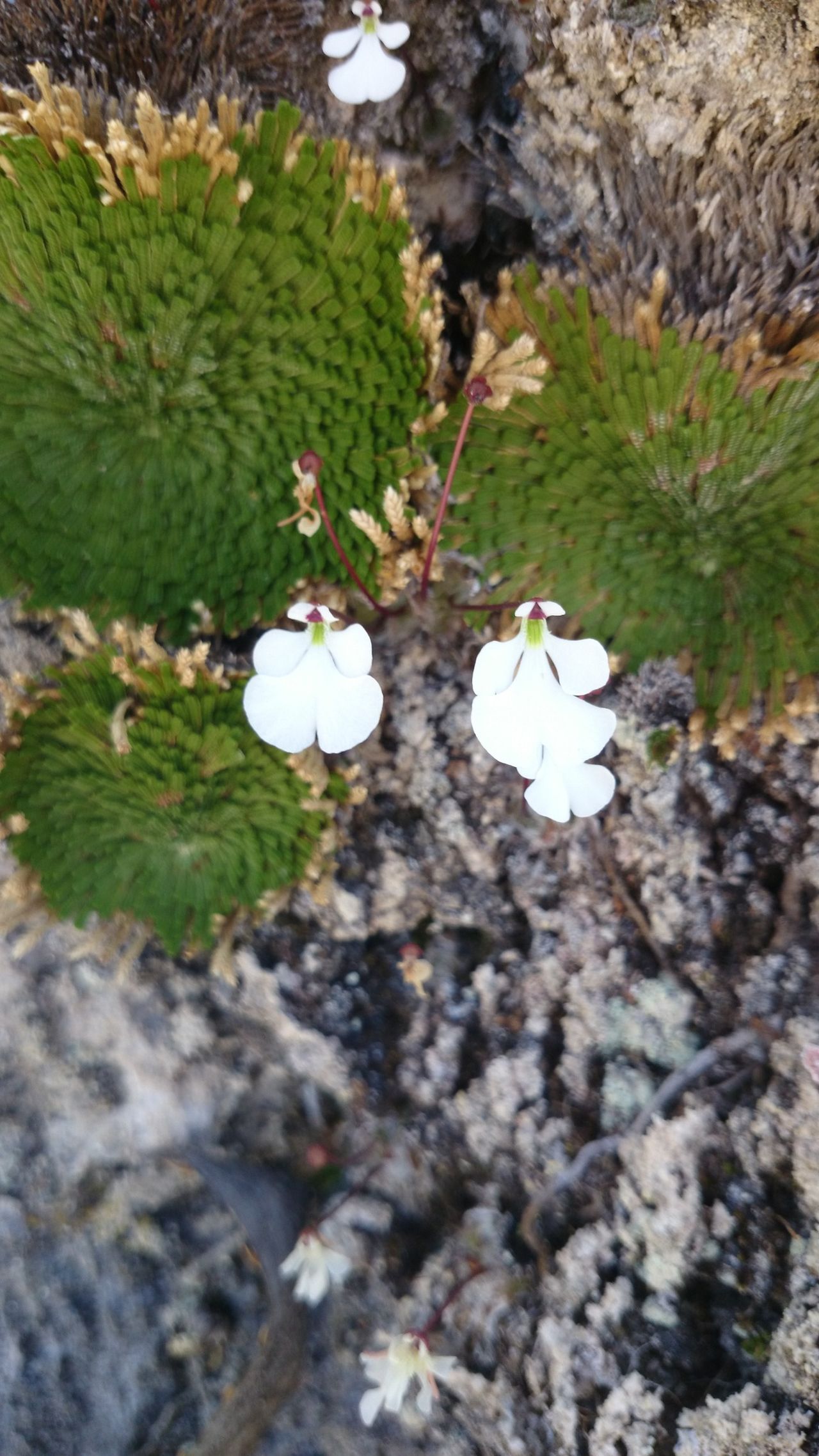
One of the smallest carnivorous plants in Mexico: a rosette barely a centimetre across with a pure white flower, on the gypsum cliffs of the country's north-east. Pinguicula immaculata was described in 1992 by Zamudio and Lux from plants in Nuevo León, and owes its name to the unmarked white corolla.
Identification
The winter rosette consists of narrow fleshy leaflets 4 to 8.5 mm long and 1 to 3 mm wide; the summer rosette of slightly broader leaflets 4 to 9 mm long and 3 to 5 mm wide. The whole plant therefore stays under two centimetres. The scape reaches 1.5 to 6 cm and carries one flower 10 to 20 mm long including the spur of 3.5 to 9 mm. The corolla is white, with a yellow-green mark at the base of the lower lip — otherwise unmarked, hence the epithet. The flowers come from the winter rosette, in the cool months. The fruits are small erect capsules that stay among the leaflets after flowering and split open in dry weather; the seed is dust-fine and is carried over the gypsum slope by wind and running rainwater. Seedlings are hardly distinguishable from moss protonema with the naked eye.
Similar species
Pinguicula rotundiflora grows on the same gypsum slopes between Rayones and Galeana and has a pale lilac to pink flower with broad rounded lobes. The small gypsum dwellers of San Luis Potosí — P. esseriana, P. ehlersiae, P. debbertiana — all have a coloured flower and lie further south besides. A pure white flower with only a yellow-green throat mark, on a plant under two centimetres, is distinctive enough in this area. Out of flower, field identification is practically impossible.
The trap and how it works
A flypaper trap on the smallest possible surface. Each leaflet carries stalked glands with a sticky droplet and sessile glands releasing digestive enzymes as soon as something lies on them; the margin bends inward almost imperceptibly. At this scale prey consists almost entirely of springtails, mites and the very smallest flies and midges that keep to the damp gypsum. On the winter rosette, with its fleshy nearly glandless leaflets, catching stops. That a plant of these dimensions bothers with carnivory is telling in itself: on gypsum, nitrogen is so scarce that even a few dozen springtails a season contribute measurably to next year's flowering. The ratio of catch to return is probably better here than in many a larger species.
Habitat and ecology
Gypsum cliffs and slopes in submontane scrub, where the plants sit in the grit among Selaginella and other small xerophytes (R2, D4). The sites lie roughly between thirteen hundred and twenty-two hundred metres, in a dry seasonal climate with short summer rains and heavy night dew. Gypsum is a soil on which almost no competitor survives, and that is precisely what allows a plant of a centimetre and a half not to be crowded out. Where the gypsum ends, the species ends. Characteristic of such gypsum sites is that the accompanying species are largely the same as tens of kilometres away: gypsum soils select so strictly that they produce a comparable, impoverished plant community everywhere, with much bare ground between. That bare ground is exactly what this butterwort needs.
Distribution and elevation
Endemic to Mexico and known from Nuevo León, between Rayones and Galeana and around Santa Rita. Our species list gives only 'Mexico'; the literature places the species in that small area of the Sierra Madre Oriental. The number of known sites is small and the species has been known only since 1990, which says mainly how easily such a plant is overlooked. The real range is probably somewhat wider than the map now shows.
- Recorded (one-degree cells)
Forms and variation
No wild varieties are distinguished and variation within the species is slight: in all known populations the flower is white with a yellow-green throat mark, and only flower size and spur length differ somewhat. The rosettes turn slightly reddish in full sun and stay green in shade; that is site-dependent. That the species shows so little variation probably relates to its small range and the uniformity of the gypsum soil it grows on.
Where and when to see it
Flowering falls in winter and early spring, coinciding with the pleasantest weather in this part of Mexico. Search north-facing gypsum slopes, among Selaginella mats and in the grit at the foot of gypsum banks. The white flower is the only thing that shows: the plant beneath it is smaller than a fingernail. Sit down, look into the light so the flowers glow against the pale gypsum, and work small patches systematically. Do not walk on the mats — they are thin and recover slowly.
Conservation status
Not assessed for the global IUCN Red List and not listed in CITES. What is known: a small number of sites in one state, all on gypsum. Gypsum quarrying, road building and grazing are routine operations in that area and form the obvious pressure; a plant of these dimensions disappears at the slightest slip or excavation. No population figures have been published and little systematic fieldwork has been done since the description. An assessment here would begin with simply mapping the known gypsum hills.
Scientific name
Pinguicula immaculata | Zamudio & Lux, 1992
Described by Sergio Zamudio and Alexander Lux in 1992, in Acta Botanica Mexicana 20: 39–44. The type area lies in a gorge with gypsum cliffs between Rayones and Galeana, in the Mexican state of Nuevo León, at around 1300 metres elevation. The species name immaculata is Latin for "spotless" and refers to this species' pure white, unmarked flowers.
World Checklist of Vascular Plants (WCVP), via Plants of the World Online (POWO), Royal Botanic Gardens, Kew.