All species › Lamiales › Bladderwort family › Pinguicula balcanica
Pinguicula balcanica
In the mountains of the Balkan Peninsula grows a white butterwort long taken for a southern outlier of Pinguicula alpina. Pinguicula balcanica is a small, low-growing plant of wet mountain grassland, small calcareous fens and seeping slopes, and at four to five centimetres it is among the most modest species in this guide.


Identification
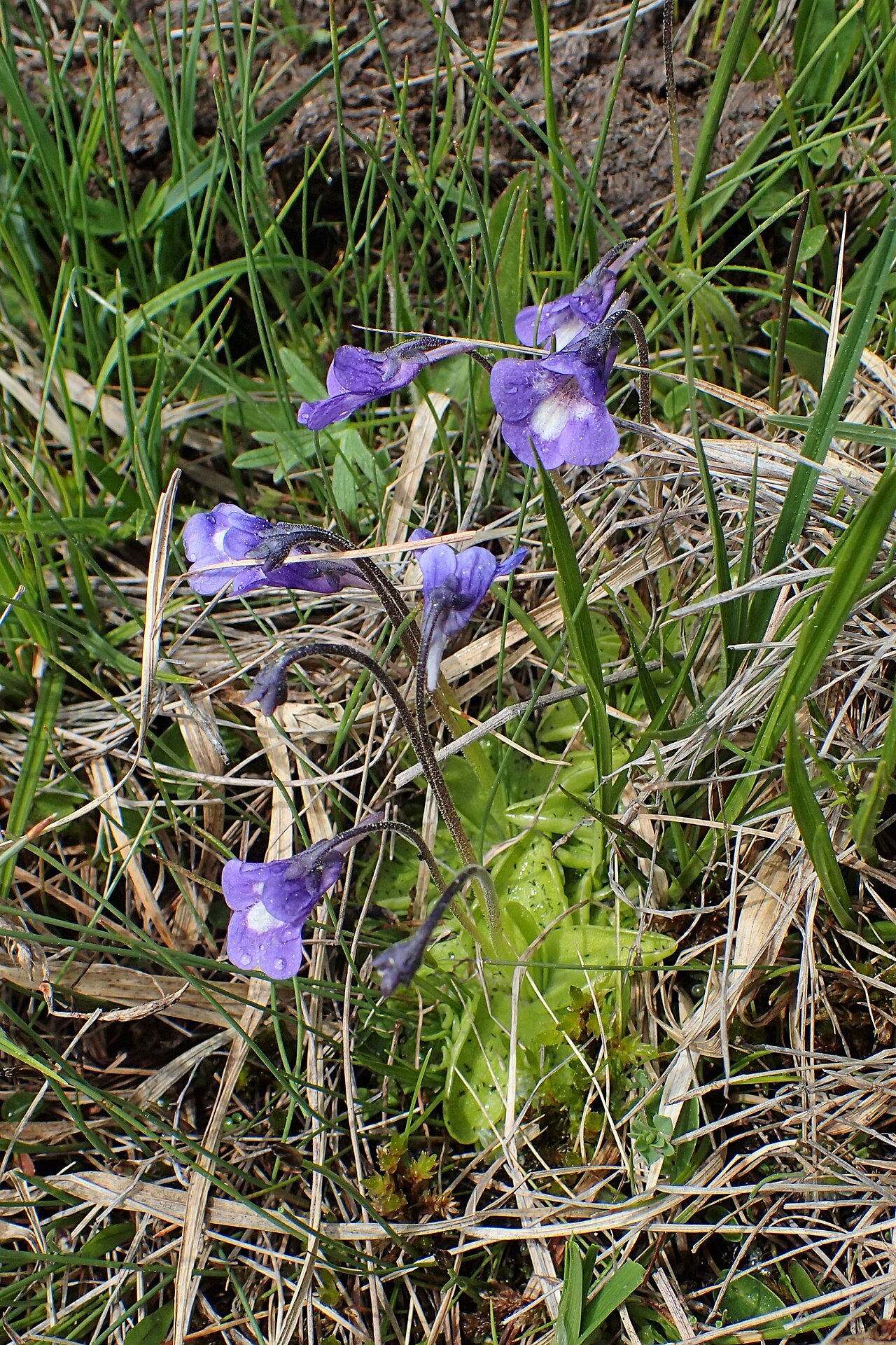
A flat rosette of entire, oblong-ovate leaves, yellow-green to light green, greasy to the touch and with inrolled margins. The flowering stems are short: four to five centimetres, rarely ten, each carrying a single flower that therefore all but rests on the vegetation. The corolla is two-lipped and white to ivory, with yellow markings in the throat pointing inward; the upper lip is two-lobed, the lower three-lobed. The spur is short and straight. Flowering runs from May into August and shifts with altitude: May low in the mountains, July or August at the highest sites. After flowering the plant withdraws into a winter bud.
Similar species
The chief confusion is with Pinguicula alpina, which it closely resembles and which also occurs in parts of the Balkans; P. balcanica is smaller, stays lower and differs in spur and leaf proportions. With Pinguicula vulgaris, which grows in the same mountains, confusion ends as soon as the plant flowers: that has a violet to blue-purple flower with a long pointed spur. The third candidate is Pinguicula hirtiflora, which grows on dripping limestone at lower elevations in the Balkans and is far larger, with a corolla of nearly two centimetres and a long spur.
The trap and how it works
A flypaper trap with no visible rapid movement. The leaf bears stalked glands with a sticky droplet and sessile glands that supply enzymes once prey is lying on them. What sticks is small: midges, gnats and springtails that swarm over a wet mountain lawn. On prey contact the leaf margin rolls over the catch so the digestive fluid does not run off; afterwards the leaf flattens again. The yield is not marginal for this plant but necessary: its sites are flushed and therefore poor, and the lime in the water supplies no nitrogen.
Habitat and ecology
Wet, base-rich mountain ground: small calcareous fens and sedge mires, short-cropped wet mountain pasture, and slopes over which spring water runs. The species tolerates neither drought nor dense, tall vegetation; it grows where the sward stays open because the water washes nutrients away or because stock keeps growth short. In the Bulgarian and Macedonian mountains its centre of gravity is the subalpine belt, with sites above the treeline but also lower down on soaked slopes and along streams.
Distribution and elevation
An endemic of the Balkan Peninsula. In Bulgaria the species is known from the western and central Stara Planina, from Vitosha, from Rila and Pirin, from the western and central Rhodopes and from the western border mountains; beyond that it occurs in the mountains of North Macedonia, Serbia and adjacent countries. The range is thus fairly extensive in length but strongly fragmented in practice: the plant grows only where a wet, base-rich patch survives in the uplands, and such patches can lie tens of kilometres apart.
- Recorded (quarter-degree cells)
Forms and variation
No wild varieties are recognised. The taxonomic history is untidy, though: the Balkan populations were long placed with P. alpina and only later described as a separate species, and the old names still surface in the literature. Within the range it is chiefly plant size that varies with wetness and altitude; plants on open wind-scoured slopes stay small and flower low, plants in sheltered mires grow more generously. The yellow throat markings vary in extent. Where the species grows with P. vulgaris, intermediates have been reported, but these are poorly documented.
Where and when to see it
June is usually the best month in the Bulgarian mountains; higher in Rila and Pirin flowering shifts into July. Search along seeping slopes, flushes and the edges of small mountain mires, not out on the dry pasture. Get low: the flower stands only a few centimetres high and hides completely among sedges. A white flower in a green wet lawn is easy to see close up, but standing upright you will simply walk over it. Take time to look at the rosettes too — without flowers only the glistening glandular coat gives the plant away.
Conservation status
The species has not been assessed for the global Red List, so there is no international category, and CITES does not apply. In Bulgaria it enjoys no legal protection, while being recognised there as an endemic of the peninsula. What is known gives a mixed picture: the number of known localities across the larger massifs is reasonable, but each individual site is small and entirely dependent on a steady flush of groundwater. The risks are the usual ones for such habitats: capping of springs, drainage and fertilising of mountain grassland, and rank growth of short-cropped sites once traditional grazing ends. The absence of an assessment is above all a gap.
Scientific name
Pinguicula balcanica | Casper, 1962
Described by Siegfried Jost Casper in 1962, in Repertorium Specierum Novarum Regni Vegetabilis 66: 105. The species occurs in the mountain ranges of south-eastern Europe, including Albania, North Macedonia and Bulgaria; its southernmost known site, the Vardoussia range in central Greece, was only discovered in 1995. The species name balcanica refers to the Balkan Peninsula, where this alpine species is endemic.
World Checklist of Vascular Plants (WCVP), via Plants of the World Online (POWO), Royal Botanic Gardens, Kew.