All species › Lamiales › Bladderwort family › Pinguicula fiorii
Pinguicula fiorii
The Majella in Abruzzo is a massif of bare limestone, deep gorges and springs that emerge halfway up a rock face. There grows Pinguicula fiorii, a small butterwort described in 1987 and found nowhere outside this single massif.
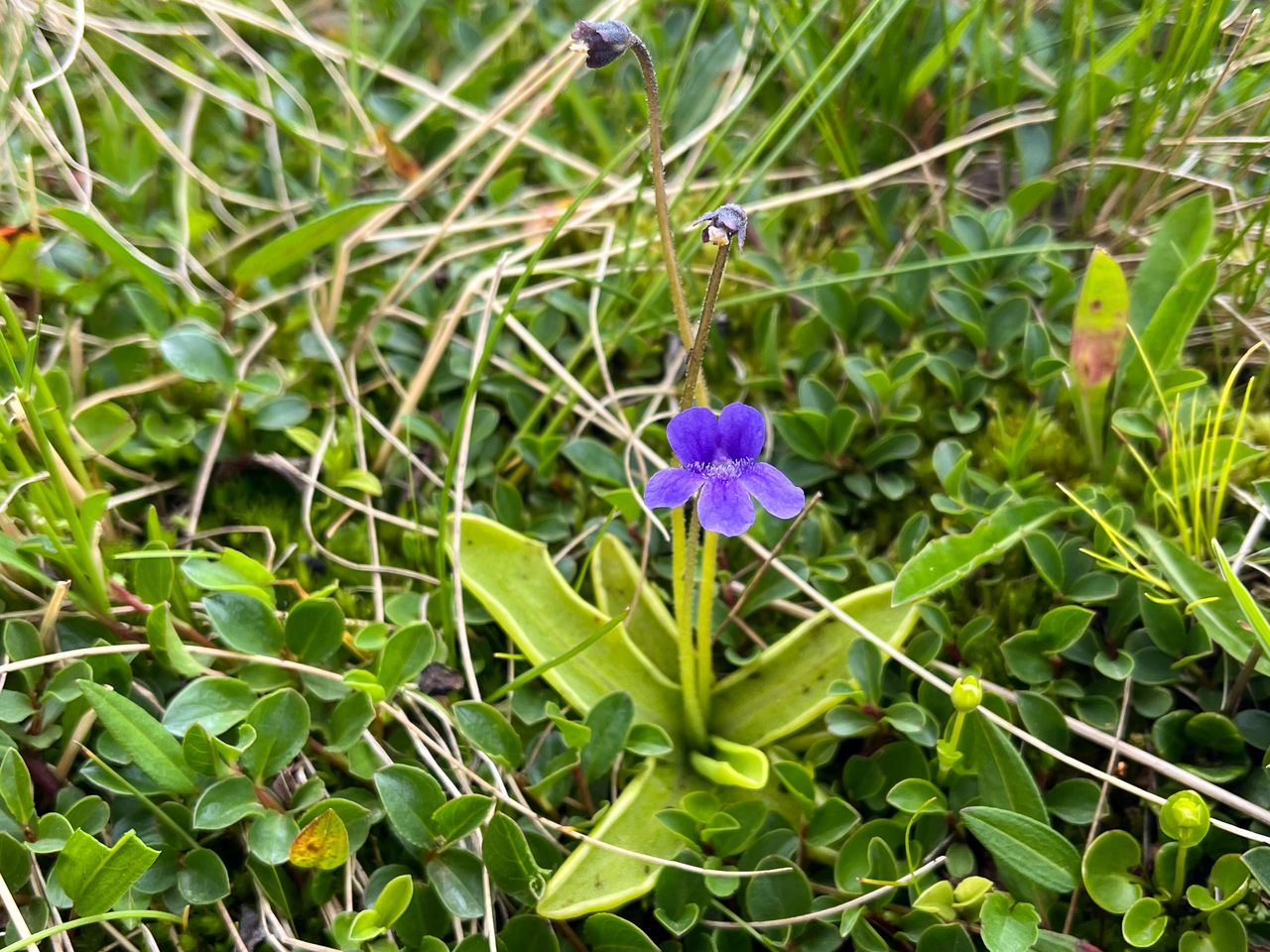
Identification
A flat rosette of entire, oblong-ovate leaves, yellow-green, greasy to the touch and with margins curled upward. Slender scapes rise from the centre, each with a single two-lipped flower. As in nearly all butterworts it consists of a two-lobed upper lip and a three-lobed lower lip with throat markings guiding the visitor inward, and a spur behind. Reliable measurements for plant, corolla and spur could not be traced to a checkable source for this guide, and are therefore not given here. The plant overwinters as a winter bud and appears late in spring, once the snow has gone from the high gullies.
Similar species
Several butterworts overlap in Abruzzo, which makes identification harder here than in the Alps: besides this species, central Italy holds Pinguicula vallis-regiae from the Camosciara and several locally described subspecies of P. vulgaris. These taxa are largely separated on flower and seed characters rather than by eye. For the field-guide reader geography counts: a butterwort on a wet limestone face in the Majella massif is very probably P. fiorii, but the certainty comes from the literature, not the field.
The trap and how it works
A flypaper trap of the classic butterwort type. The upper leaf surface carries stalked glands with a sticky, glistening droplet and, between them, sessile glands that release digestive enzymes only once something is lying on them. Midges, gnats and springtails from the humid air along the wet face stick fast; struggling brings more glands into contact with the prey. The leaf margin then rolls slowly towards the catch so the digestive fluid stands in a shallow gutter. On bare, permanently flushed limestone that is the only way to obtain nitrogen.
Habitat and ecology
Wet limestone rock in the high mountains: dripping faces, spring mouths halfway up a rock band, crevices with meltwater seeping through, and wet scree slopes in the belt above the forest. The species requires a permanent water supply and tolerates neither drought nor competition from taller vegetation. Precisely because the Majella is a limestone massif that swallows most of its rainfall at once, such wet places are rare and sharply bounded: they lie where the water comes back out of the mountain, and outside them the rock is bone dry.
Distribution and elevation
Only the Majella massif in Abruzzo, central Italy, and within it a limited number of sites. The species is a strict endemic of this one massif, which is no exception in the Apennines: the range consists of a series of limestone blocks separated by broad dry valleys, and a plant tied to permanently wet rock cannot cross them. Most of the range lies inside the Majella national park, which is favourable for its protection.
- Recorded (one-degree cells)
Forms and variation
No wild varieties are recognised. The variation noticeable in the field concerns plant size and the number of flowers per rosette, and tracks the wetness and shelter of the site. The taxon itself has been debated in the recent literature: molecular work on the Italian butterworts has considerably rearranged the relationships among the Apennine species, and not everyone draws the boundaries between some of the central Italian taxa in the same place. Cultivars and nursery forms have no place here.
Where and when to see it
June and July are the best time, once the snow has left the higher gullies. Search not on the bare limestone plateau but exactly where water comes out of the mountain: spring mouths, dripping faces under rock bands, the wet strip along a meltwater rill. Look up and sideways rather than down, because the rosettes often sit above eye level in a wet crevice. The Majella is rough country; keep to the waymarked routes and use binoculars rather than climbing the face.
Conservation status
The species has not been assessed for the global Red List, so there is no international category, and CITES does not apply. What is known shapes the picture: the entire range is one limestone massif, the sites are small, separated and wholly dependent on spring water that keeps running all year. Protection here comes mainly from the national park containing the massif. The concerns are drier summers and shorter snow seasons, which reduce spring discharge, and the removal of plants by collectors, a risk with every narrowly bounded Italian species.
Scientific name
Pinguicula fiorii | Tammaro & Pace, 1988
Described by Fernando Tammaro and Loretta Pace in 1988, in Informatore Botanico Italiano 19. The type area lies in the Majella mountains of central Italy, with sites ranging from 750 metres (Valle dell'Orfento) to around 2470 metres elevation (Monte Focalone). The exact origin of the species name fiorii (likely honouring the Italian botanist Adriano Fiori) could not be confirmed with full certainty.
World Checklist of Vascular Plants (WCVP), via Plants of the World Online (POWO), Royal Botanic Gardens, Kew.