All species › Lamiales › Bladderwort family › Pinguicula australandina
Pinguicula australandina
The high-mountain butterwort of the southern Andes, recognised as a separate species only this century. Pinguicula australandina grows in wet alpine pasture between fourteen hundred and twenty-three hundred metres, from Laguna del Maule in Chile into Neuquén in Argentina — a country of volcanoes, meltwater and short summers. The name says exactly where it belongs: the southern part of the Andes.
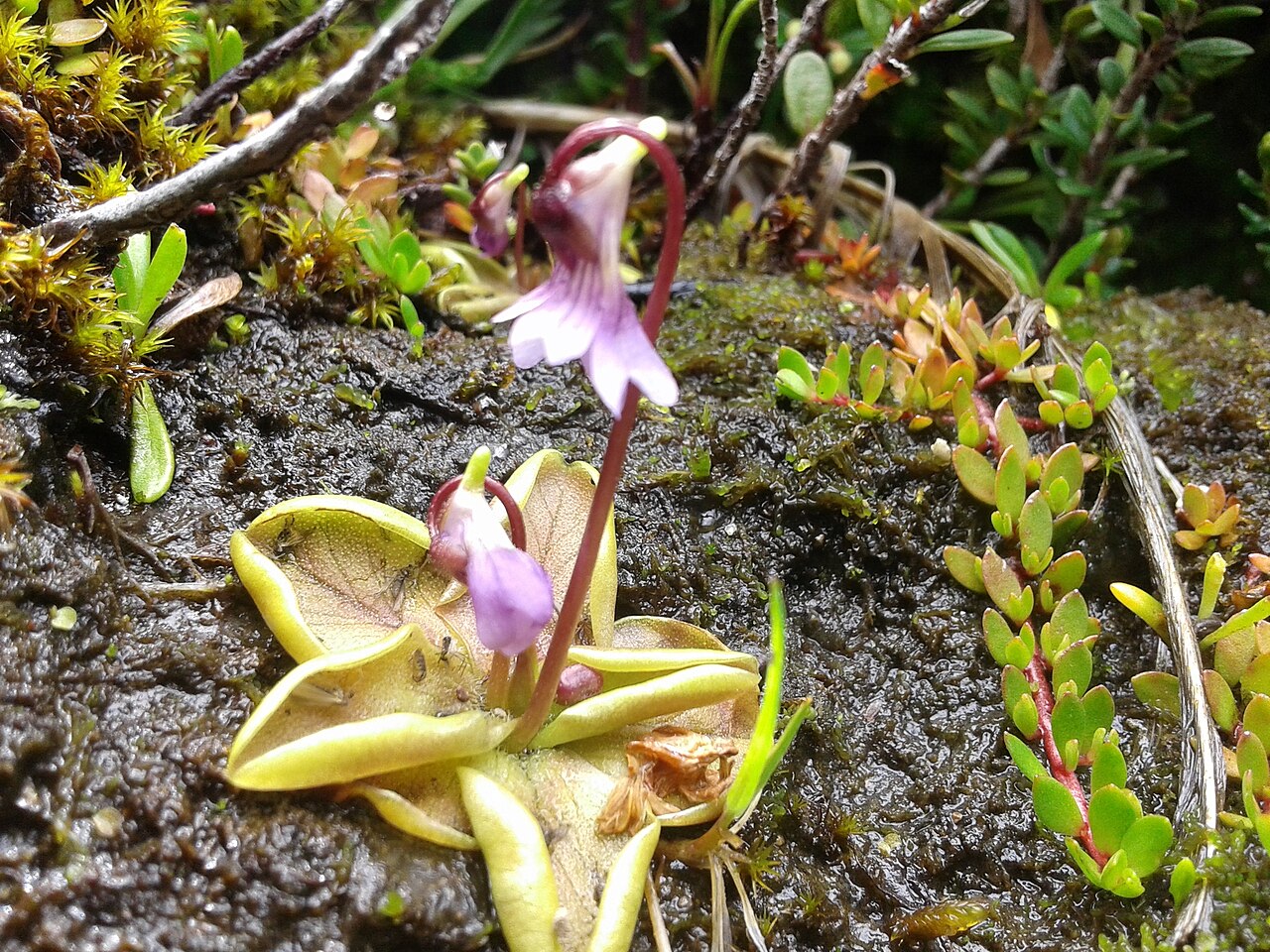


Identification
A compact rosette of four to six leaves fourteen to twenty-two millimetres long, green to brownish green, with a greasy shining upper surface. The scape is two to five centimetres tall and moderately set with glandular hairs — less densely than in P. nahuelbutensis, clearly more than in P. antarctica. The flower is two-lipped and violet, pink or lilac, often with darker veins pointing into the throat; the spur is conical, blunt or slightly pointed, and two to three millimetres long. Flowering runs from January to early March, the middle of the southern summer. After flowering the plant withdraws for the long winter under snow.
Similar species
The three other southern species are the real risk. Pinguicula antarctica, further south and lower, has white flowers of eight to ten millimetres with a saccate spur of at most one and a half millimetres. P. chilensis overlaps in altitude but has blue to whitish flowers; P. australandina is the only one of the four that usually flowers distinctly violet to pink, and that is the quickest field character. P. nahuelbutensis grows in the coastal range, not the Andes, and has a very short scape of at most one and a half centimetres. Out of flower, separating these species is practically impossible.
The trap and how it works
A flypaper trap on an extremely short contract. Above two thousand metres these mountains lie under snow for half the year; what the plant catches in the summer weeks has to carry it through the rest. The stalked glands hold a sticky droplet, the sessile glands beneath release enzymes as soon as prey is on them, and the leaf margin then rolls slowly over the catch so the fluid stays put. The supply in the short Andean summer is surprisingly large: midges and small flies swarm in dense clouds above the meltwater pools and wet pastures. On alpine soil, cold and slow to decompose, that is the fastest route to nitrogen.
Habitat and ecology
Wet alpine pasture and seepages above the treeline between fourteen hundred and twenty-three hundred metres (R5, W6), on ground kept permanently moist by meltwater through the growing season. The sward is short and open, with much bare soil and stone between; there is no shrub layer to cast shade. The climate is severe: fierce sunlight by day, night frost even in summer and a long snow-lie. The sites lie as patches in the landscape, wherever water reaches the surface.
Distribution and elevation
Along the southern Andes between about thirty-six and forty-one degrees south: from Laguna del Maule in Chile to the neighbourhood of Cerro Nireco in Argentine Neuquén. The species occurs on both sides of the divide and is therefore not endemic to one country, although our own species list names only Argentina. Within that area the distribution is strongly fragmented — every wet high pasture is an island, separated by dry stony slopes and deeply cut valleys.
- Recorded (one-degree cells)
Forms and variation
No wild varieties are recognised. Flower colour runs within the species from deep purple through lilac to pink, even within one population, and the veining varies widely; that is ordinary variation and no basis for forms. Plants from the highest, most exposed sites stay smaller and have shorter scapes. No natural hybrids have been described. It is worth knowing that the species concept in this group is young: material formerly filed under P. antarctica or P. chilensis partly belongs here, so older literature must be read with care.
Where and when to see it
Go high, and go in January or February. The plant grows on the wet pastures just above the treeline, where meltwater reaches the surface and the ground still gives under your boots; the dry stony slopes between are wasted time. Look for the violet flowers — they stand out in a landscape that is otherwise mostly yellow and grey. It pays to get down on the ground: the rosettes are small, brownish green and vanish against the soil. And mind the sun: ultraviolet at this altitude is harsh.
Conservation status
The species has not been assessed for the global IUCN Red List and is not in CITES, so it carries no international category. What is known is still young: the species was described only this century, and the picture of its range rests on a limited number of targeted field visits. The range runs over more than five hundred kilometres of Andes and includes sites inside protected areas on both sides of the border. Pressure comes from grazing of the high pastures, from waterworks in the meltwater systems, and from a rising snowline, which reduces the area of wet alpine pasture. The absence of an assessment here mainly means the basic data are still too thin.
Scientific name
Pinguicula australandina | Gluch, 2017
Described by Oliver Gluch in 2017, in Carnivorous Plant Newsletter 46. The type area lies in Neuquén Province in Argentina, near Copahue, at around 1900 metres elevation. The species name australandina combines the Latin australis ("southern") and "Andina" ("of the Andes") and refers to this species' occurrence in the southern Andes of Chile and Argentina.
World Checklist of Vascular Plants (WCVP), via Plants of the World Online (POWO), Royal Botanic Gardens, Kew.