All species › Caryophyllales › Tropical pitcher plant family › Nepenthes sumatrana
Nepenthes sumatrana
A lowland species with a long and tangled history. Nepenthes sumatrana was collected on the west coast of Sumatra in 1856, was then treated in turn as a variety of another species, as a synonym of a New Guinea species and as a species in its own right, and has been generally recognised again only since 1997. For a century and a half after its first collector, hardly anyone knowingly saw it again in the field. It is a vigorous climber with long, narrow leaves and large funnel pitchers that persists only in undisturbed forest.
Identification
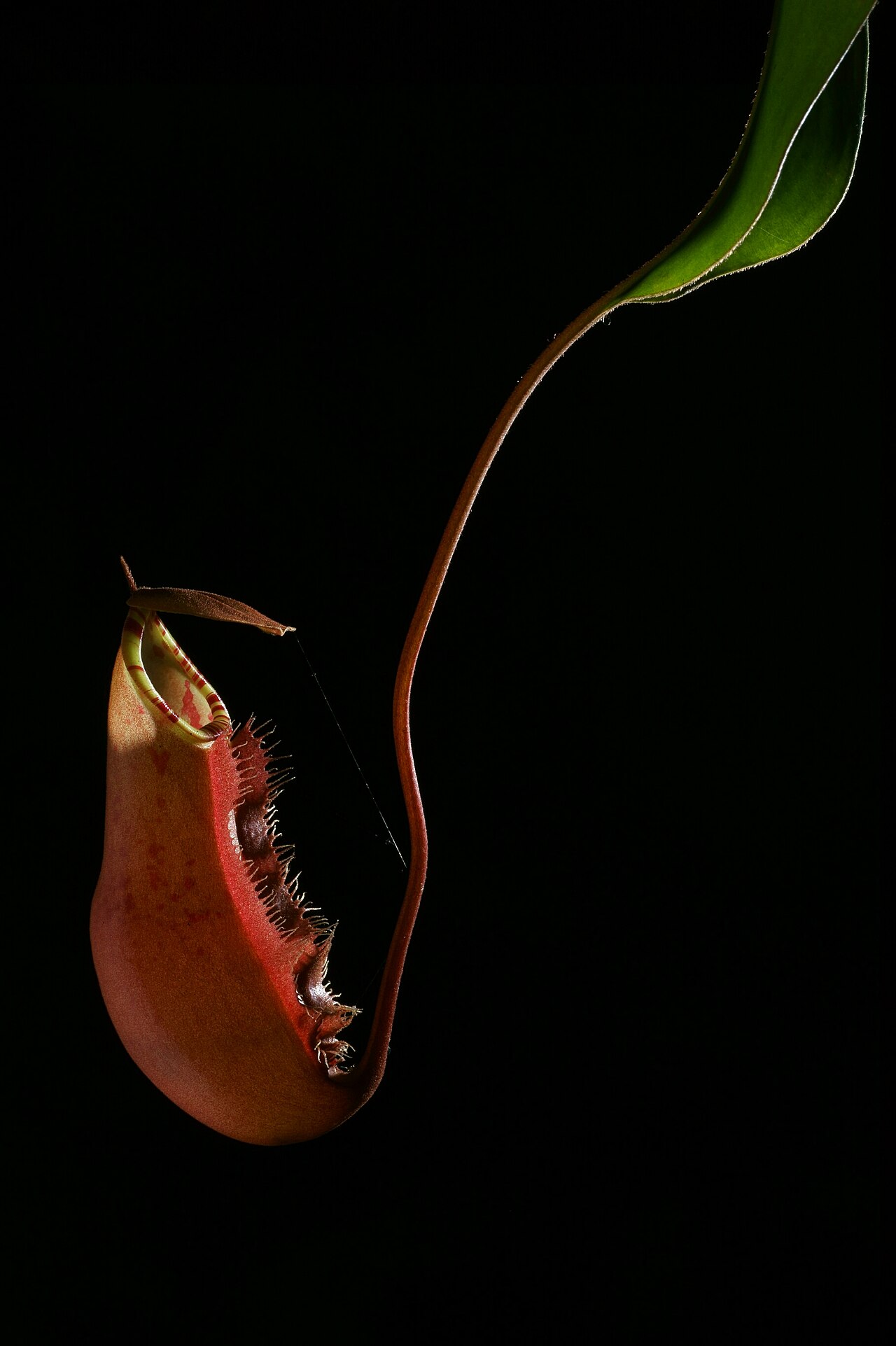
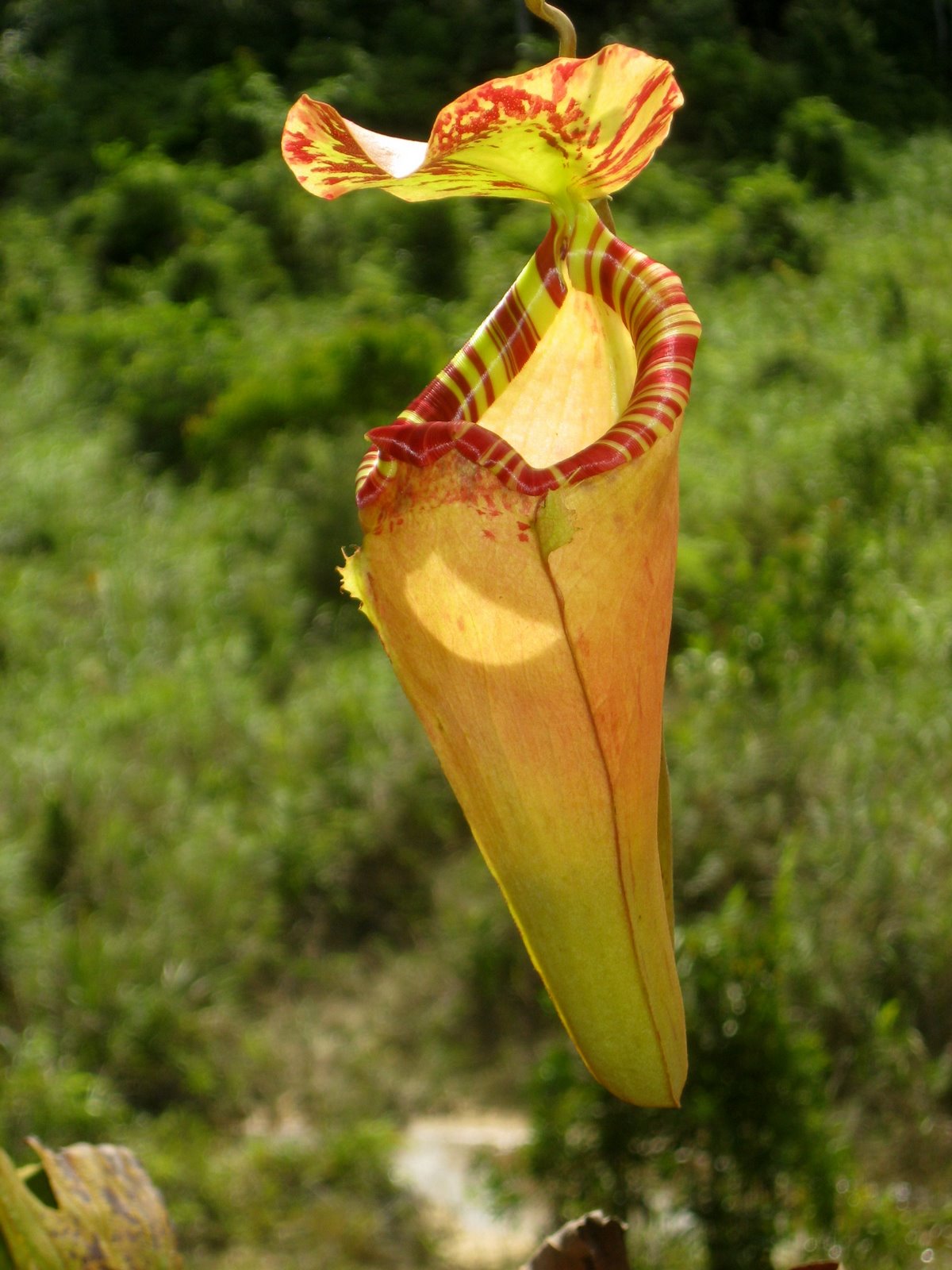
A robust climber with stems to 15 m long and about 9 mm thick, with internodes to 20 cm. The leaves are leathery and stalked, lanceolate to obovate, to 55 cm long but only 9 cm wide, with six to eight pairs of longitudinal veins and a short fringe of brown hairs along the margin; the tendril reaches 60 cm. Rosette pitchers are ovoid to narrowly ovoid-cylindrical, to 10 cm tall. Lower pitchers are wholly ovoid, to 20 cm tall and 10 cm wide, with fringed wings to 6 mm and a cylindrical peristome to 10 mm wide with indistinct teeth. Upper pitchers are the largest: funnel-shaped throughout, to 30 cm tall and 15 cm wide, with the wings reduced to ribs and the front of the mouth raised, as in N. rafflesiana. They give off a sweet, fruity scent.
Similar species
Two species come to mind. Nepenthes rafflesiana has distinct peristome teeth and an elongated neck behind the mouth, and the upper part of its lower pitchers is cylindrical; in N. sumatrana the teeth are indistinct, the neck is absent and the lower pitchers are wholly ovoid. Nepenthes longifolia, with which it was long merged, has rosette tendrils to 110 cm, lower pitchers only a tenth of the tendril length, scentless upper pitchers that are funnel-shaped only below and cylindrical above, no raised front to the mouth, and grows higher, at 300 to 1100 m. In N. sumatrana the tendril is at most 60 cm, the lower pitcher about a fifth of the tendril length, and the upper pitcher smells sweet.
The trap and how it works
A pitfall pitcher in two forms. Lower pitchers stand near the ground, are winged and catch mainly walking animals. The large funnel-shaped upper pitchers hang high in the forest on long tendrils and are clearly aimed at flying insects: their sweet, fruity scent is one of the best field characters, and a funnel widening upwards gives an insect slipping on the smooth peristome little purchase. The peristome is raised at the front, as in N. rafflesiana, so an insect approaching from the front must first cross the nectar-rich rim. Inside, as throughout the genus, lies an acid digestive fluid; no prey data have been published for this species.
Habitat and ecology
Dense, undisturbed lowland rainforest (B2) on sandstone, from sea level to about 800 m. The plant grows on the ground, often on steep slopes, and needs the surrounding vegetation to carry its climbing stems into the canopy; seedlings have also been found on rock faces. It requires moist, shaded conditions and is absent wherever the forest has been logged or converted to farmland. That sets it apart from many other lowland species, such as N. gracilis and N. mirabilis, which profit from open, disturbed ground.
Distribution and elevation
Endemic to Sumatra, Indonesia, in the provinces of North and West Sumatra, mainly in the near-coastal hills of the north-west. The distribution is patchy and still incompletely known. An old collection from inland West Sumatra, once described as a separate species, probably belongs here, but expeditions in 1995 and 2001 found no plants there. Altitude: 0 to 800 m. Because the species is critically endangered, this guide gives no precise localities. The world checklist holds no distribution data under this name; the range given here therefore follows Clarke (2001).
Forms and variation
No varieties or forms have been described. Natural hybrids have been reported with species sharing its range: with N. eustachya, known since before 1990 but reported then under a wrong parent name, with N. gracilis and with N. mirabilis; hybrids with N. beccariana and N. longifolia are suspected but uncertain. The usual contrast between winged, ovoid lower pitchers and wingless, funnel-shaped upper pitchers is strong in this species, and detached upper pitchers are easily taken for another species.
Where and when to see it
This species is listed as critically endangered and does not survive in disturbed ground; every visit to a site counts. Do not seek it out, and do not share localities. Anyone in the lowland forest of north-western Sumatra with a recognised guide or as part of research will know it best by its upper pitchers: large pitchers, funnel-shaped along their whole length, high in the canopy, with a sweet scent you may smell before you see them. Look and photograph from the path; collecting plants or seed from the wild without a permit is prohibited.
Conservation status
The Red List assesses the species as Critically Endangered. Clarke reached the same verdict in 2001 from his own fieldwork: the plant tolerates no disturbance, its range is small and fragmented, and rapid development around the port towns of the west coast is taking the remaining forest. Collecting is a lesser threat because the plants grow on steep, hard-to-reach slopes. Years of confusion with N. beccariana and N. longifolia have hampered targeted conservation. The species is listed in CITES Appendix II.
Scientific name
Nepenthes sumatrana | (Miquel) Beck, 1895
Described by Günther Beck von Mannagetta und Lerchenau in 1895, in his monograph "Die Gattung Nepenthes" (Wiener Illustrirte Garten-Zeitung 20). The species was formally introduced as a variety of N. maxima, but counts as the valid first binomial combination. Holotype (Teijsmann 535), collected by Johannes Elias Teijsmann in February 1856 near Sibolga, on the west coast of Sumatra. The species grows at 0-800 m elevation in lowland forest on sandstone, North and West Sumatra. Named after Sumatra, its island of origin.
World Checklist of Vascular Plants (WCVP), via Plants of the World Online (POWO), Royal Botanic Gardens, Kew.