All species › Caryophyllales › Tropical pitcher plant family › Nepenthes ramispina
Nepenthes ramispina
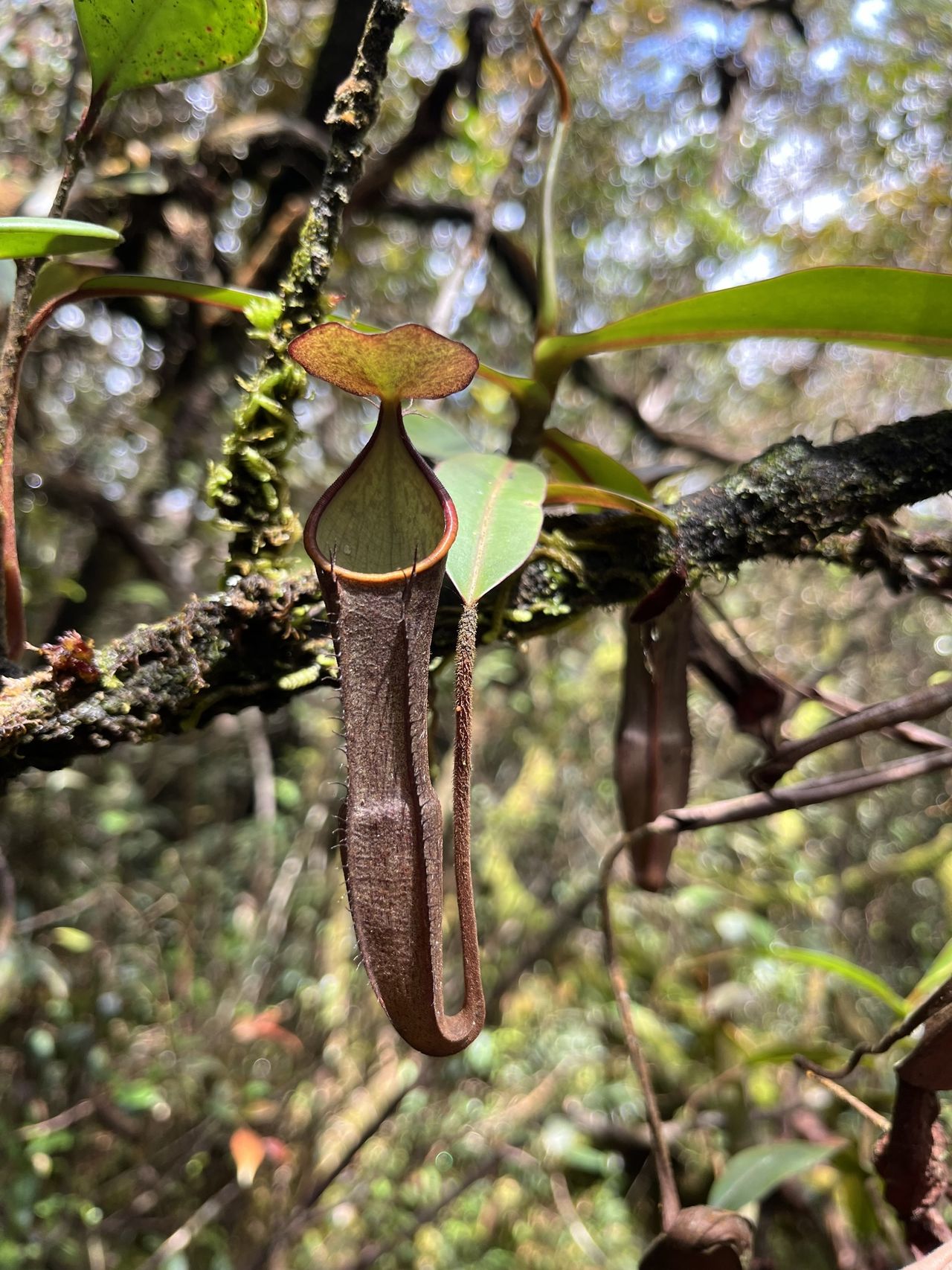
The name says it: 'ramispina' means 'branched spine', and the most peculiar feature of this pitcher plant sits where few people look, behind the lid. In most species a single short spur stands there; in Nepenthes ramispina the spur is split into three to seven branches, like a small brush. Henry Ridley described the species in 1909 from the summit of Ulu Semangkok in Selangor, on the Main Range of the Malay Peninsula. It is a plant of the cool, mossy montane forest, with dark, almost black-green pitchers.
Identification
A climber to five metres with terete stems three to six millimetres thick, sparsely set with branched hairs. The leaves are leathery and sessile, oblong-obovate, to 16 cm long and just over 3 cm wide, with a base clasping at least half the stem and forming two auricles. Lower pitchers are shortly cylindrical, 5 to 10 cm tall, slightly swollen in the lower half, with two fringed wings three millimetres wide. Upper pitchers are long and cylindrical, to 18 and exceptionally 24 cm, usually broadest at the mouth and without wings or with strongly reduced ones. The peristome is strikingly narrow, half a millimetre to one millimetre, with barely visible ribs. The lid is round, often slightly broader than long, without appendages, with the characteristic spur branched three to sevenfold. Lower pitchers are maroon-green to deep blackish green, pale glaucous green inside; upper pitchers purplish green or pale green, with a deep red or pale green peristome.
Similar species
Its closest relative is Nepenthes gracillima of the eastern mountains, and the two were long confused; Ridley's Nepenthes gracillima var. major is in fact this species. According to Cheek and Jebb (2001), ramispina is larger, with broader leaves, longer and slenderer upper pitchers with a branched spur (simple and under three millimetres in gracillima), unrimmed nectar glands of unequal size under the lid, and a hairy stem and midrib. The same montane forest also holds Nepenthes macfarlanei, with dense white hairs under the lid, and Nepenthes sanguinea, with much more robust, pot-bellied pitchers and a broad peristome.
The trap and how it works
A pitfall trap with an exceptionally narrow peristome. Where many pitcher plants have a broad slippery rim, here it is only half a millimetre to a millimetre wide; capture then relies more on the smooth, waxy inner wall, glaucous blue-green in the lower pitchers, on which animals find no hold. Under the lid lie numerous nectar glands, small at the margin and larger toward the centre. The function of the branched spur is unknown. The long cylindrical upper pitchers suit flying insects; the lower ones, with their fringed wings, crawling animals. No specific prey study was found for this species.
Habitat and ecology
Mossy montane forest and ridge vegetation on the Main Range of the peninsula (B1). The available source gives no altitudinal range, so the elevation field is left empty; the type collection comes from the summit of one of the Main Range mountains. It is a humid, cool setting with much moss and frequent mist, where the plant climbs up shrubs and young trees.
Distribution and elevation
Endemic to the Malay Peninsula, and there confined to the western ranges, the Titiwangsa or Main Range. Our own list names the Malay Peninsula; the restriction to the western Main Range is a refinement from the literature. The species grows, among other places, around several well-known hill stations of that range.
- Recorded (one-degree cells)
Forms and variation
No varieties are recognised. Colour ranges from dark maroon- and black-green to pale green, and the peristome from deep red to pale green. Natural hybrids with Nepenthes macfarlanei are known where the two grow together. Because of the long confusion with Nepenthes gracillima, older literature and herbarium material under that name may also concern this species.
Where and when to see it
The hill stations of the Main Range, with roads and walking trails through mossy montane forest, give the best chances. Search ridges and forest edges for slender dark pitchers that look almost black against the green. Anyone who finds a pitcher can look carefully behind the lid: a brush of three to seven small branches where other species have a single spine makes the identification certain. Pick nothing; even along tourist trails pitcher plants have become scarce.
Conservation status
The Red List assesses the species as Vulnerable. Its range is limited to part of the Main Range, and precisely there lie the peninsula's hill stations, with their roads, hotels, agriculture and development plans. Collection of plants along accessible trails also plays a part. As a member of Nepenthes it is listed in CITES Appendix II, so international trade in wild plants requires a permit.
Scientific name
Nepenthes ramispina | Ridley, 1909
Nepenthes ramispina was described in 1909 by Henry Nicholas Ridley, in "The flora of the Telôm and Batang Padang valleys" (Journal of the Federated Malay States Museums 4(1): 1-98, p. 59). Peninsular Malaysia, with records including Mount Tahan (the same mountain as N. gracillima, golf 23); no single, specific type locality could be established more precisely. The specific epithet derives from the Latin "ramus" ("branch") and "spina" ("spine, spur"), referring to characteristics of the plant's structure.
World Checklist of Vascular Plants (WCVP), via Plants of the World Online (POWO), Royal Botanic Gardens, Kew.