All species › Caryophyllales › Tropical pitcher plant family › Nepenthes pitopangii
Nepenthes pitopangii
One of the smallest pitcher plants of Sulawesi, with upper pitchers barely four centimetres tall. Nepenthes pitopangii was described in 2009 by Ch'ien Lee, Stewart McPherson, Greg Bourke and M. Mansur, and named after the Indonesian botanist Ramadhanil Pitopang of Tadulako University in Palu, who collected the type material in 2007. The species stood out because its upper pitchers, unlike those of its relatives, are wholly funnel-shaped and almost as wide as they are tall. It was at first known from a single site, in secondary vegetation within Lore Lindu National Park.
Identification
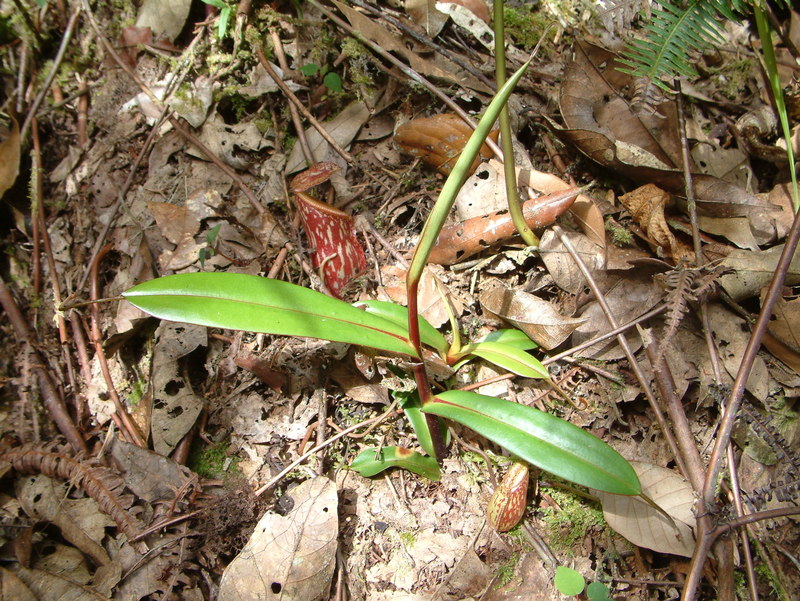
A fairly delicate climber with thin stems of 3 to 5 mm and lanceolate, acute leaves 10 to 16 cm long and 2 to 3.5 cm wide. The lower pitchers are small, to about 6 cm tall and 3 cm wide. The upper pitchers are the point of recognition: wholly funnel-shaped, only 3.8 to 4.5 cm tall but up to 3.7 cm wide, with a narrow, cylindrical peristome of 1 to 3 mm with distinct ribs. The lid is almost round, about 2.9 cm, and held horizontally over the mouth. The inflorescence is strikingly large for so small a plant: a male raceme up to 37 cm long.
Similar species
The closest relative is Nepenthes glabrata, a species of the same mountains with small pitchers too. N. glabrata, however, has much longer, narrower upper pitchers, to 14 cm, with two distinct wings, whereas those of N. pitopangii are short, broad and funnel-shaped. Both belong to the group around Nepenthes tentaculata, which on Sulawesi also includes N. hamata, N. nigra, N. maryae and N. undulatifolia.
The trap and how it works
A small pitfall, built essentially as in the rest of the genus: nectar glands on the peristome and under the lid, a ribbed peristome that turns slippery when wet, and digestive fluid at the bottom. The horizontally held lid shields the wide mouth of the upper pitcher from rain, so the fluid is not diluted too much. With so small a volume it will mainly catch small prey such as ants and small flies, but no prey study has been published. Work on other species of the genus has shown that the peristome works by 'aquaplaning': a thin film of water on the finely ribbed surface makes it so slippery that the adhesive pads of insect feet can no longer grip. The trap therefore works best when it is damp, which in cloud forest is almost always the case.
Habitat and ecology
Mountain forest at 1400 to 1800 m (B1, B5). The type locality was secondary vegetation in submontane forest, a place where the original forest had been disturbed; the second known site is open, low vegetation among stunted trees in mossy mountain forest. The species thus seems to favour open, bright spots, like many small pitcher plants.
Distribution and elevation
Endemic to Sulawesi. Known from Lore Lindu National Park in Central Sulawesi, at around 1800 m, and from a second site on the northern peninsula, at around 1400 m, more than a hundred kilometres away. This agrees with 'Sulawesi' in the guide's own species list. The great distance between the two sites suggests that the species occurs on more, as yet unexplored mountains. Sulawesi lies east of Wallace's Line, in the transition zone between the Asian and Australian floras and faunas, and holds far fewer pitcher plants than Borneo; all the more striking, then, that a large share of the island's species is endemic.
- Recorded (one-degree cells)
Forms and variation
No varieties or wild forms have been described, and with so few populations almost nothing is known about variation. No natural hybrids have been published, though related species with which crossing would be possible grow in the same area.
Where and when to see it
Lore Lindu National Park can be reached overland from Palu and has rangers and some trails in the mountain forest. The species is small and inconspicuous: search open, disturbed places and forest edges for small, broad funnel pitchers in low vegetation. As it is vulnerable and sought by collectors, it is wise not to share localities. In the mountains expect daily rain, cold nights and leeches on the trails, and allow plenty of time: most pitchers are found only by walking slowly and searching the vegetation systematically.
Conservation status
The IUCN Red List assesses the species as Vulnerable. The number of known sites is very small, and despite lying in a national park, plants are threatened by collectors according to the assessment. Disturbance at the park's margins, for farming and timber, also plays a part. As a member of Nepenthes it is listed in CITES Appendix II, so international trade requires a permit. Newly described pitcher plants often quickly become sought after in the trade, and experience with other species shows that this can lead to the plundering of small populations before tissue culture meets the demand.
Scientific name
Nepenthes pitopangii | Lee, McPherson, Bourke & Mansur, 2009
Nepenthes pitopangii was described in October 2009 by Ch'ien C. Lee, Stewart McPherson, Greg Bourke and Muhammad Mansur, in The Gardens' Bulletin Singapore; a detailed description had already appeared in May 2009 in McPherson's Pitcher Plants of the Old World. The holotype was collected on 30 May 2007 by Rahmadanil Pitopang, representing the earliest known herbarium material of this species. Lore Lindu National Park, Central Sulawesi, Indonesia, at approximately 1,800 m elevation; due to the extreme rarity of the species, the precise type locality was deliberately withheld from the formal description, as a conservation measure against plant collectors. The specific epithet honours Rahmadanil Pitopang, curator of Herbarium Celebense at Tadulako University, who collected the holotype specimen.
World Checklist of Vascular Plants (WCVP), via Plants of the World Online (POWO), Royal Botanic Gardens, Kew.