All species › Caryophyllales › Tropical pitcher plant family › Nepenthes glabrata
Nepenthes glabrata
A small, elegant pitcher plant of the mountains of Central Sulawesi, named for its lack of hair: glabrata means 'made glabrous'. The species was collected in 1983 in a logging concession in Central Sulawesi by J.R. Turnbull and A.T. Middleton, who described it in February 1984 in the journal Reinwardtia. It is one of the species that in the 1980s showed how rich the mountains of Sulawesi are in pitcher plants; several more new species have since been described from the island, mostly from the mountains of its centre.
Identification
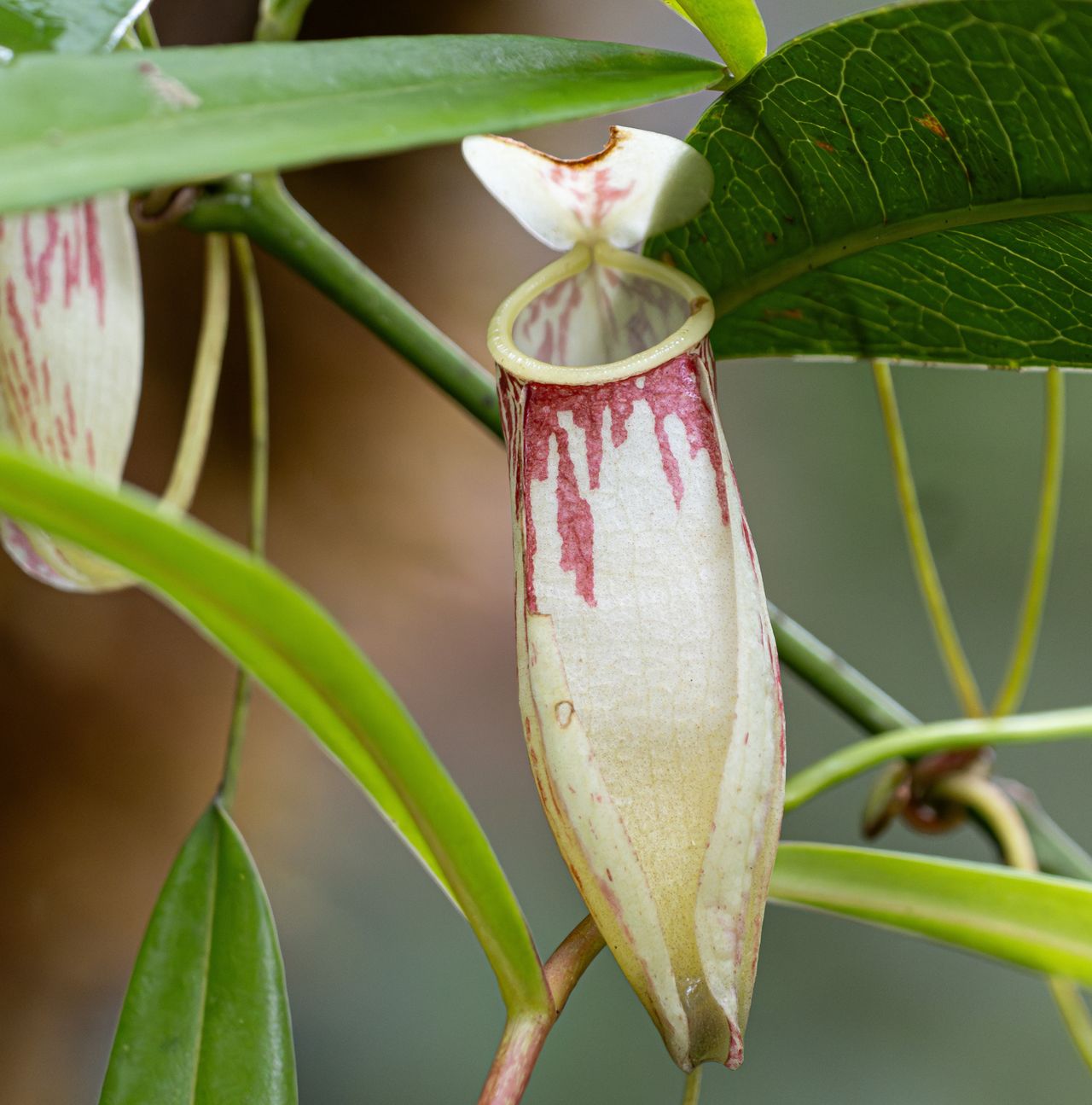
A small climber of two to three metres, with thin stems of 2 to 3 mm and narrow, strap-shaped leaves 8.5 to 12 cm long and usually less than 2 cm wide. The lower pitchers are small and globose. The upper pitchers are shortly cylindrical to slightly funnel-shaped, 7 to 14 cm tall and 2 to 3 cm wide, with two conspicuous, smooth wings without fringes, up to 1 cm wide. The peristome is very narrow, 1 to 2.5 mm, and cylindrical, with indistinct ribs and, unusually for the genus, without teeth on the inner edge. The lid is round, slightly broader than long, about 3 cm. The pitchers are usually green to reddish.
Similar species
The closest relative is Nepenthes pitopangii, which has smaller, wholly funnel-shaped upper pitchers without wings. N. glabrata belongs to the group around Nepenthes tentaculata, with N. hamata and N. nigra, but lacks the long teeth of N. hamata and the dark colour and hairs of N. nigra. The narrow, toothless peristome and the smooth wings of the upper pitchers are together the best characters.
The trap and how it works
A small pitfall with a very narrow peristome. Precisely because the peristome is so narrow, it plays a smaller role as a slide than in species with a broad peristome; the inner wall of the pitcher, with a waxy zone, probably contributes more to retaining prey. The smooth wings down the front of the upper pitchers may serve as a walkway for ants and other climbing insects. Nectar glands lie on the peristome and under the lid. No prey study has been published. The pitcher fluid of many Nepenthes species also holds a small community of its own, of mosquito larvae, mites and other animals living off the captured prey; whether this is also true of this species has not been studied.
Habitat and ecology
Open, tall mountain forest between about 1600 and 2100 m, where the plant grows on the ground and climbs up into low vegetation (B1). This is the humid, mossy mountain forest of Central Sulawesi, with a cool climate and acid, nutrient-poor soils. The plant often grows together with other pitcher plants, which explains why natural hybrids are found relatively often. For a pitcher plant such a habitat is favourable: the constant humidity keeps the pitchers filled and the peristome slippery, while the poor soil supplies little nitrogen and phosphorus, so that the extra nutrition from prey is a real advantage.
Distribution and elevation
Endemic to Sulawesi, in the province of Central Sulawesi, where it occurs on several mountains of the central part of the island. This agrees with 'Sulawesi' in the guide's own species list. The type locality lay in a logging concession, illustrating that these mountain forests are not untouched either. Sulawesi lies east of Wallace's Line, in the transition zone between the Asian and Australian floras and faunas, and holds far fewer pitcher plants than Borneo; all the more striking, then, that a large share of the island's species is endemic.
- Recorded (one-degree cells)
Forms and variation
No varieties or wild forms have been described. Pitcher colour ranges from green to reddish, depending on the amount of light. Natural hybrids have been reported with N. hamata, N. maxima, N. nigra and N. tentaculata, wherever their ranges overlap.
Where and when to see it
The species grows in the uplands of Central Sulawesi, among other places in and around Lore Lindu National Park, which can be reached from Palu. Above about 1600 m, search open places in the mountain forest for small, slender upper pitchers with two broad, smooth wings. Since related species grow in the same area, it pays to examine the pitchers closely: hybrids occur. In the mountains expect daily rain, cold nights and leeches on the trails, and allow plenty of time: most pitchers are found only by walking slowly and searching the vegetation systematically.
Conservation status
The IUCN Red List assesses the species as Least Concern (assessed 2015). It occurs on several mountains, and some populations lie in protected areas. Logging and clearance in the uplands of Central Sulawesi may affect populations locally. As a member of Nepenthes it is listed in CITES Appendix II.
Scientific name
Nepenthes glabrata | Turnbull & Middleton, 1984
Nepenthes glabrata was described on 10 February 1984 by John R. Turnbull and Anne T. Middleton (initially as "N. glabratus") in Reinwardtia 10(2): 107-111. Four days earlier, Shigeo Kurata had already described the same species as "N. rubromaculata", but that name proved invalid — a later homonym of a horticultural hybrid published as early as 1891. The holotype was collected on 31 August 1983 in the Tri Tunggal Eboni Corp. logging concession, Central Sulawesi (1°33'S, 120°55'E), at 1,666 m elevation; the specimen was reportedly deposited at Herbarium Bogoriense, but researchers were later unable to locate it there. The Tri Tunggal Eboni Corp. logging concession, Central Sulawesi, Indonesia (1°33'S, 120°55'E), at 1,666 m elevation. The specific epithet derives from the Latin "glaber" ("hairless"), referring to the mostly glabrous (hairless) nature of the plant.
World Checklist of Vascular Plants (WCVP), via Plants of the World Online (POWO), Royal Botanic Gardens, Kew.