All species › Caryophyllales › Tropical pitcher plant family › Nepenthes mollis
Nepenthes mollis
For almost a century Nepenthes mollis was a riddle: a pitcher plant known from one herbarium sheet without a single pitcher. The Dutch forester Frederik Endert collected a piece of stem with leaves and a male inflorescence on Mount Kemul in East Kalimantan in October 1925, and B.H. Danser described a new species from it in 1928, named for its soft indumentum (mollis, soft). Some botanists later suspected a hybrid. The species was on the list of 'lost species' that the conservation organisation Global Wildlife Conservation set out to rediscover, and in 2019 its rediscovery was announced.
Identification
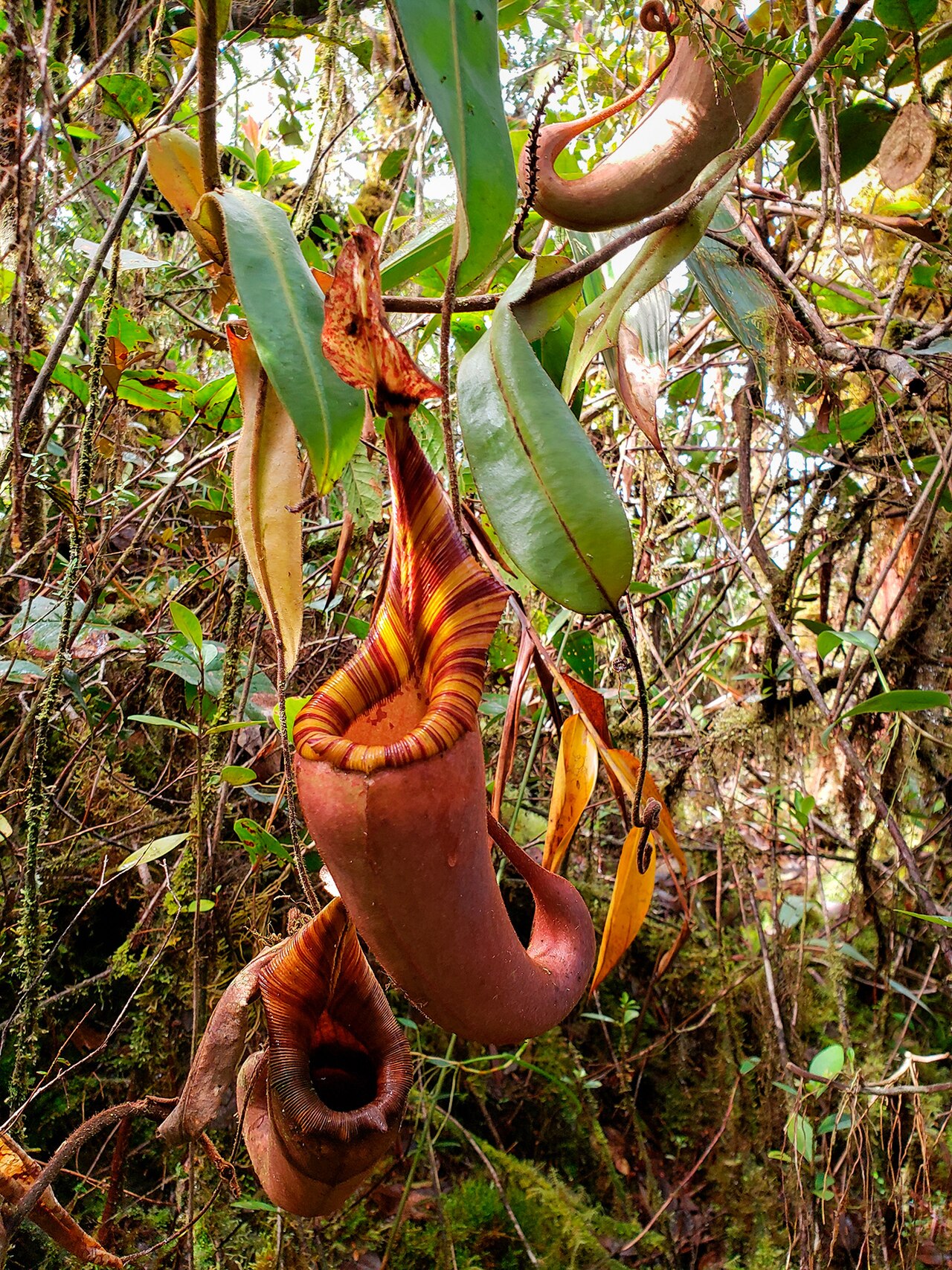
The type material shows a climber with a terete to slightly angular stem 6 to 9 mm thick, and coriaceous, sessile leaves 18 to 20 cm long and only 3.5 to 4.5 cm wide, running down the stem in two wings. The whole plant is densely covered in coarse, brown, spreading hairs, partly short and branched, giving it a velvety look. Pitchers were missing from the original material. After the rediscovery the Kemul plants proved to match the well-known, densely rusty-haired plants known since 2003 as Nepenthes hurrelliana, with narrowly funnel-shaped pitchers, a greatly expanded peristome and a blotched interior. For pitcher measurements, see that species.
Similar species
In 2019 Alastair Robinson and colleagues concluded that N. hurrelliana is a later synonym of N. mollis; this guide still keeps both as separate records. Other hairy mountain species of Borneo, such as Nepenthes chaniana and Nepenthes pilosa, have a hooked appendage under the lid and much longer, softer hairs. Nepenthes hirsuta, mentioned by earlier botanists as a possible relative, is a lowland species with smaller pitchers. The recently described Nepenthes fractiflexa is regarded as its closest relative and is smaller, with zigzag stems.
The trap and how it works
Since the pitchers were unknown at description, Danser could say nothing about the trap. Work on the plants known as N. hurrelliana shows a pitfall with a broad peristome collar drawn out towards the back, carrying nectar glands and turning slippery when wet, and a lid with nectar glands beneath. The pitchers usually hang from epiphytic stems high in the trees and catch mainly flying and climbing insects. No prey study has been published. The pitcher fluid of many Nepenthes species also holds a small community of its own, of mosquito larvae, mites and other animals living off the captured prey; whether this is also true of this species has not been studied.
Habitat and ecology
On Kemul the species grows in dense forest on steep slopes and in mossy forest at around 1800 to 2050 m. In the broader sense, including N. hurrelliana, it occurs between about 1300 and 2400 m, usually as an epiphyte in mossy upper montane forest, sometimes on the ground (B1). It is the classic cloud forest of the high Bornean mountains: permanently damp, acid and nutrient-poor. For a pitcher plant such a habitat is favourable: the constant humidity keeps the pitchers filled and the peristome slippery, while the poor soil supplies little nitrogen and phosphorus, so that the extra nutrition from prey is a real advantage.
Distribution and elevation
Endemic to Borneo. In the old, narrow sense known only from Kemul in East Kalimantan. With N. hurrelliana included, the species extends over several mountains in northern Sarawak, Brunei and south-western Sabah. The guide's own species list gives 'East Kalimantan, Sarawak, Sabah', which fits the broad sense; Brunei is missing from it.
- Recorded (one-degree cells)
Forms and variation
No varieties or wild forms have been described. What is known about variation comes from populations described as N. hurrelliana: the degree of blotching in the pitchers varies greatly. Natural hybrids with Nepenthes lowii and Nepenthes veitchii have been reported from those populations. The earlier idea that N. mollis itself might be a hybrid was abandoned after the rediscovery.
Where and when to see it
Kemul lies in a remote part of the interior of East Kalimantan and can be reached only by long treks. In the broader sense the species is far easier to see on Mulu in Sarawak, where it grows as an epiphyte in the mossy forest above about 1500 m. Look up into the branches and watch for the rusty indumentum.
Conservation status
On the Red List N. mollis is Data Deficient, a verdict dating from when the species was known only from its type material. A full assessment is therefore lacking. What is now known: the species has been refound, and if N. hurrelliana is included it grows on several mountains, partly in protected areas; those plants have been assessed under their own name as Least Concern. As a member of Nepenthes it is listed in CITES Appendix II.
Scientific name
Nepenthes mollis | Danser, 1928
Nepenthes mollis was described in 1928 by Benedictus Hubertus Danser in his monograph "The Nepenthaceae of the Netherlands Indies" (Bulletin du Jardin Botanique de Buitenzorg). The type material was collected on 17 October 1925 by Frederik Endert. Mount Kemul (also spelled Kemoel, Kemal or Kong Kemul), East Kalimantan, Borneo, at approximately 1,800 m elevation, on a steep mountain slope with dense forest cover — the same mountain as N. fusca (golf 22). The name derives from the Latin "mollis" ("soft"), referring to the covering of hairs that characterises this plant.
World Checklist of Vascular Plants (WCVP), via Plants of the World Online (POWO), Royal Botanic Gardens, Kew.