All species › Caryophyllales › Tropical pitcher plant family › Nepenthes klossii
Nepenthes klossii
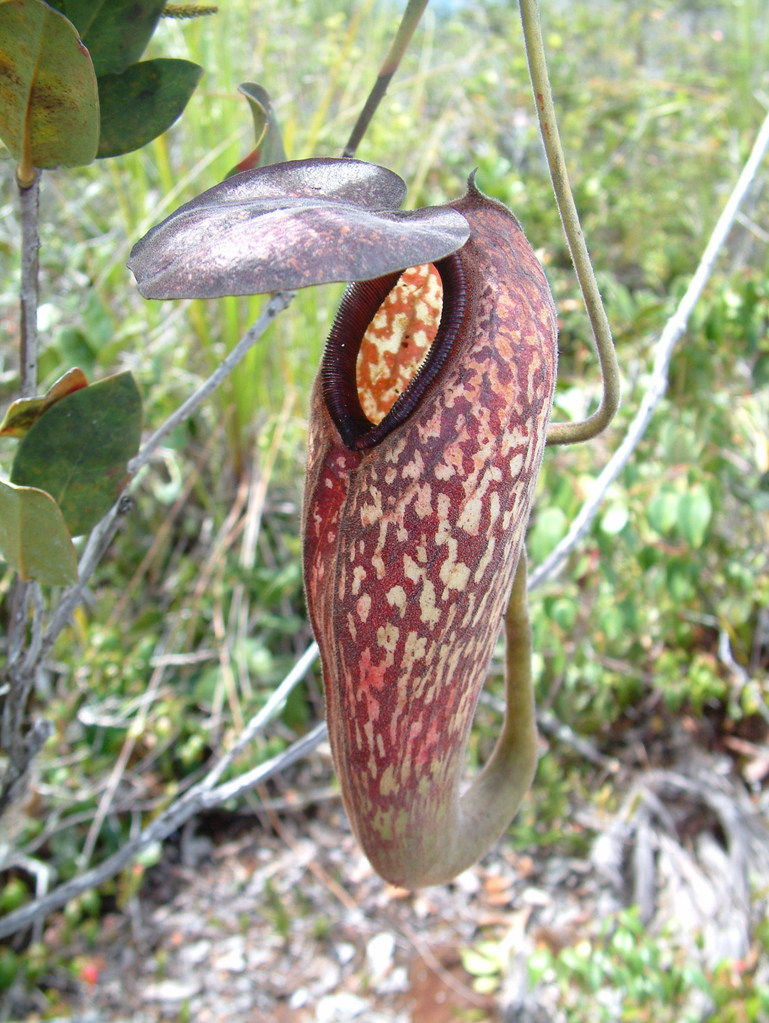
One of the strangest pitchers in the genus: a domed trap with a mouth on the side and pale windows in the wall that light up the interior. Nepenthes klossii was collected in January 1913 by the naturalist Cecil Boden Kloss during the British Wollaston expedition in south-western New Guinea, and described by Henry Ridley in 1916. Ridley remarked on its hairiness and its deep purple lid. For a long time the species remained almost unknown: up to the 2001 Flora Malesiana there were only three collections, and it was Jebb in 1991 who first illustrated the hooded pitcher properly.
Identification
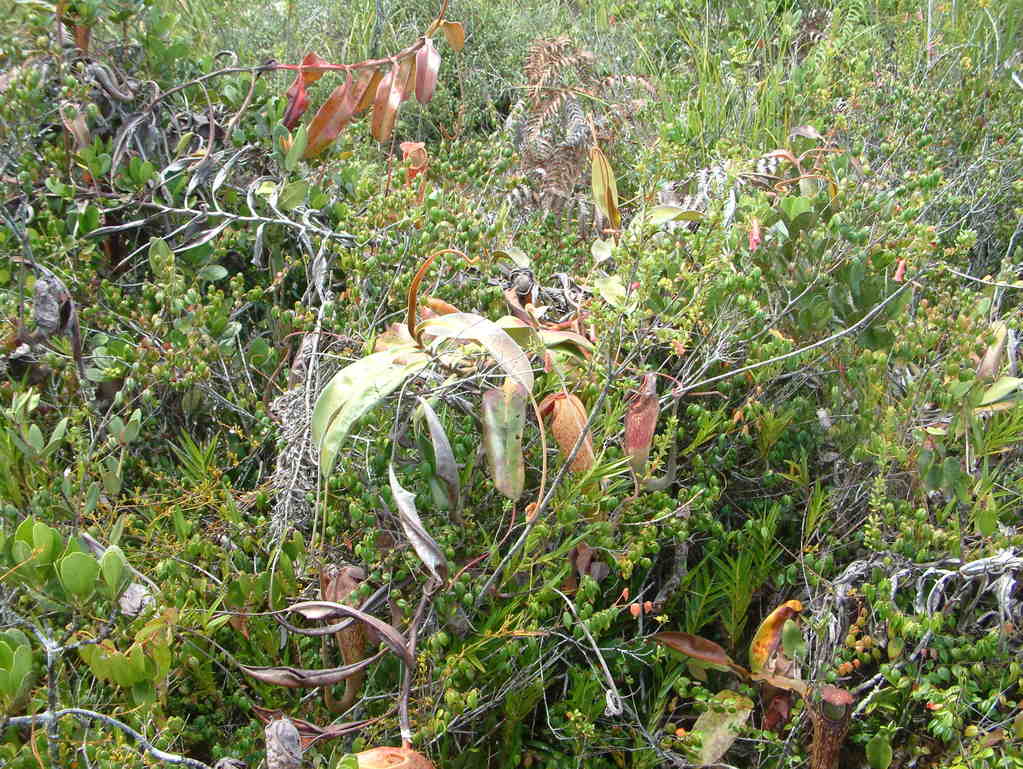
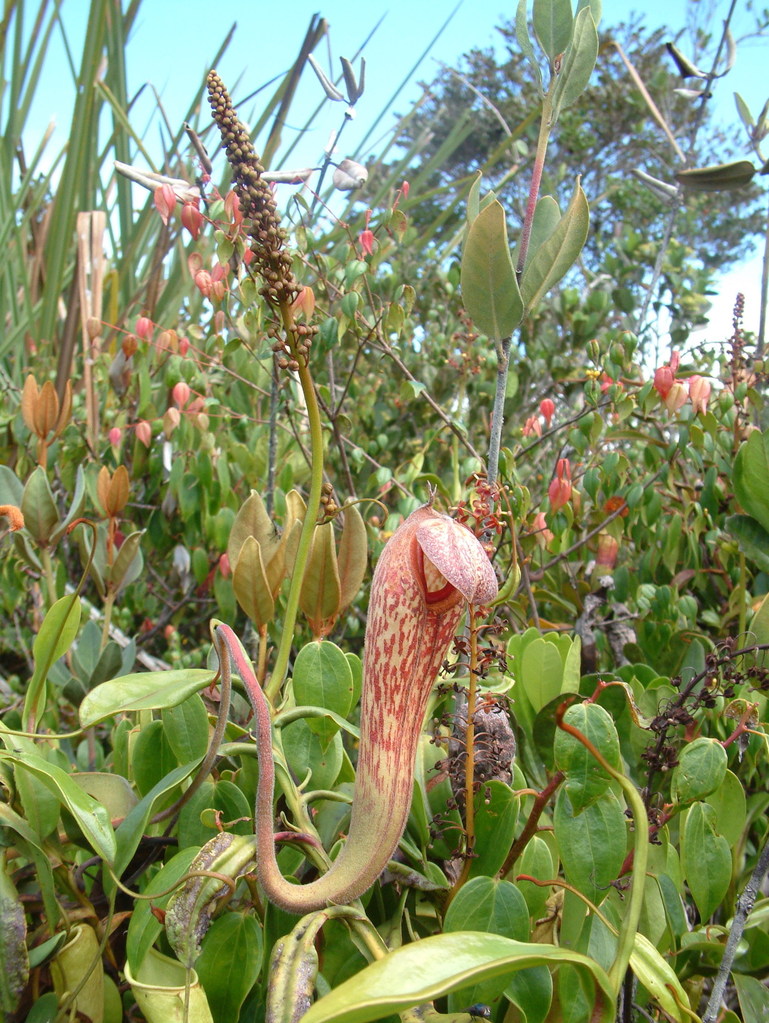
A shrub or possibly a climber, whose height is not recorded in the herbarium data. The stem is triangular, about a centimetre thick. The leaves are leathery and distinctly stalked, with a blade 18 to 25 cm long and 6.5 to 9 cm wide and a winged petiole of about 6 cm. Striking is the dense covering of long, orange-brown, simple or sparingly branched hairs up to one and a half millimetres, mixed with stellate hairs. Upper pitchers are funnel-shaped to cylindrical, about 20 cm tall and 5 cm wide; later observations give up to 26 cm tall and 7 cm wide. The peristome is 3 to 5 mm wide. The lid is almost round, about five by five centimetres, bears two appendages on its underside and a spur of nearly a centimetre. In well-developed pitchers the upper part arches like a hood over the mouth, which consequently faces sideways.
Similar species
In pitcher shape the species most resembles Nepenthes aristolochioides from Sumatra, the only other species with domed pitchers and translucent patches in the wall. The resemblance is due to convergent evolution: the two are not closely related and grow thousands of kilometres apart. Nepenthes klossii also differs in its much larger, stalked leaves. In relationship it is closer to Nepenthes maxima, as the appendages under the lid and the leaf venation suggest. Nepenthes eustachya sometimes forms superficially similar hooded upper pitchers but otherwise differs greatly.
The trap and how it works
A light trap, and thus an exception in the genus. The upper part of the pitcher arches into a dome with pale, almost transparent patches, while the mouth lies on the side. Flying insects that enter the pitcher see the light through the wall and try to fly towards it rather than back to the darker exit; they tire and fall into the fluid. The same principle is known from a few North American pitcher plants, such as Darlingtonia californica and Sarracenia psittacina. According to the available data, prey consists mainly of small flying insects. The lid is deep purple and the inner wall above the glandular zone bluish and pruinose.
Habitat and ecology
Swampy montane forest at high altitude, possibly also grassland, between about 930 and 2000 m (B1, B4). Flora Malesiana gives the habitat as unknown and suggests grassland; later observations speak of wet, swampy forest in the uplands. These are nutrient-poor, permanently wet soils in a cool, damp climate with much cloud. At one known site the species grows alongside a small form of Nepenthes maxima. Little has been published on the exact soil type.
Distribution and elevation
Endemic to the Indonesian province of Papua, in the western part of the central uplands of New Guinea. Our own species list says only 'New Guinea'; that is correct, but the species is confined to a relatively small part of the western, Indonesian half of the island. The known sites are few, and some have not been visited in decades. Because the species is listed as Endangered on the Red List, this guide gives no more precise location than the mountain region as a whole.
- Recorded (one-degree cells)
Forms and variation
No varieties or forms have been described. Putative natural hybrids with Nepenthes maxima have, however, been reported from a site where both species grow together. Lower and rosette pitchers are red with purple speckles on the lid; upper pitchers show the same colour pattern but are larger and have the characteristic hooded shape. In herbarium material the pitchers look yellowish. The three old collections differ in pitcher shape: only the material of the Dutch botanist Eyma clearly showed the hood over the mouth.
Where and when to see it
This species is rare, poorly known and listed as Endangered. There is no responsible way to give a 'where to find it' tip here. Anyone doing research in the uplands of Papua does so with permits, together with Indonesian institutions and local communities, and without taking plants or seed. For those who want to learn to recognise it: in wet montane forest, watch for pitchers with an arched hood and a mouth on the side, and for the dense orange-brown hairs on stem and leaves. Observations are valuable, but do not publish coordinates.
Conservation status
Listed on the Red List as Endangered, based on an assessment from 2000. The species is very rare in the wild and known from only a few sites. The only easily accessible population lies in an area where road building and development were planned; other populations have not been checked in decades, which makes a fresh assessment difficult. As a member of Nepenthes it is listed in CITES Appendix II, so international trade in wild plants requires a permit. Given its rarity and striking pitchers, collection for trade is also a real risk.
Scientific name
Nepenthes klossii | Ridley, 1916
Nepenthes klossii was described in August 1916 by Henry Nicholas Ridley, in his report on the Wollaston Expedition in The Transactions of the Linnean Society of London 9(1). The type material was collected on 26 January 1913 — three years before the formal description — by Cecil Boden Kloss, near an expedition campsite (camp VIb) in south-western New Guinea, at 930-1,170 m elevation; it is held at the herbarium of the Singapore Botanic Gardens. Near expedition campsite VIb, south-western New Guinea, at 930-1,170 m elevation. The specific epithet honours Cecil Boden Kloss, the botanist who collected the original specimen three years before the formal description.
World Checklist of Vascular Plants (WCVP), via Plants of the World Online (POWO), Royal Botanic Gardens, Kew.