All species › Caryophyllales › Tropical pitcher plant family › Nepenthes graciliflora
Nepenthes graciliflora
The most widespread pitcher plant of the Philippines, and at the same time a species that went unrecognised as such for almost a century. Adolph Elmer described Nepenthes graciliflora in 1912 from plants on Mount Guiting-Guiting on Sibuyan. He found it 'apparently quite different from Blanco's species', the Nepenthes alata of 1837, but gave no characters to separate the two, and later botanists such as Merrill and Macfarlane accordingly sank it into Nepenthes alata. Only in 2013, when Martin Cheek and Matthew Jebb revised the alata group, was it recognised again as a separate species.
Identification
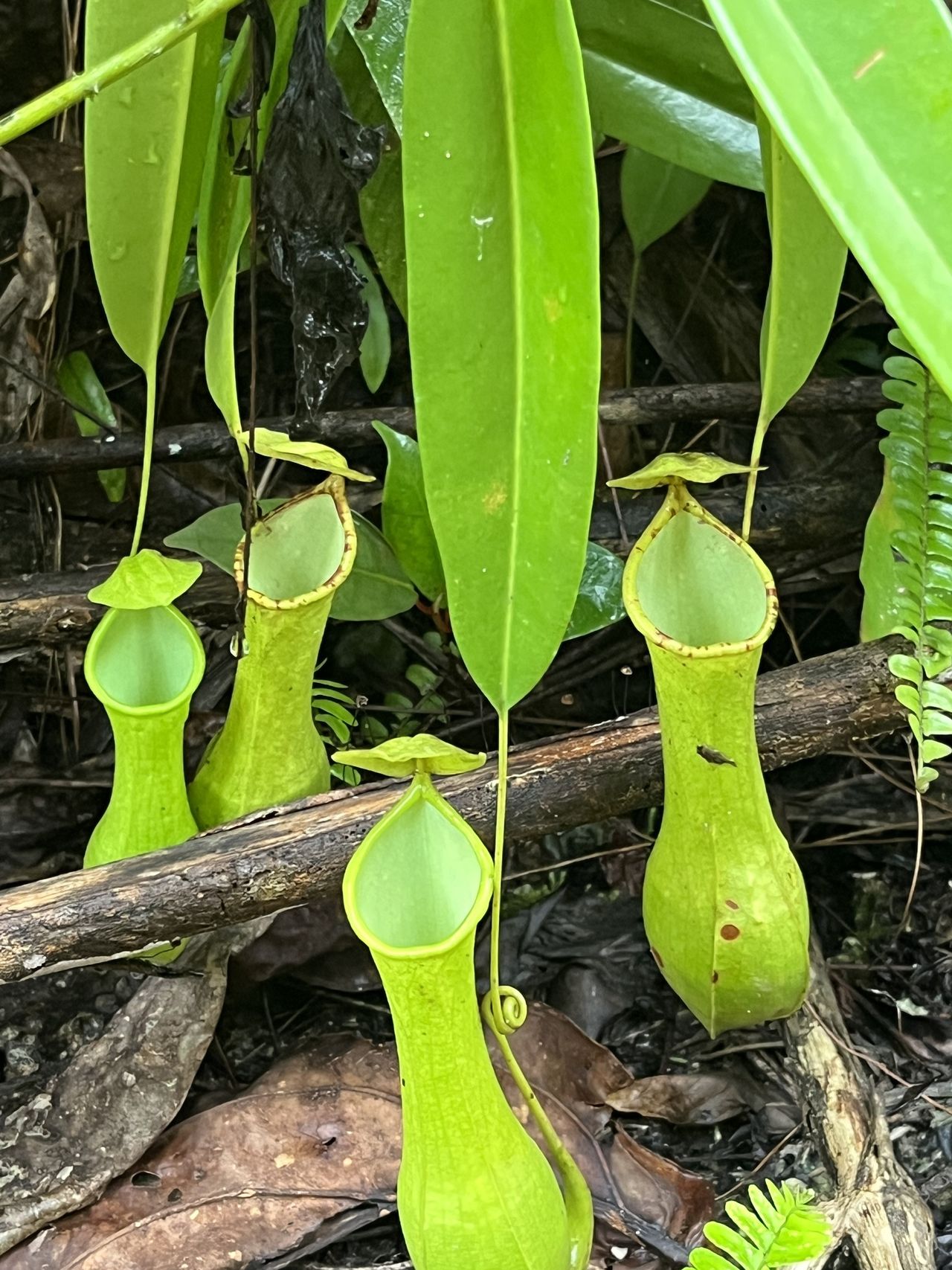
A slender climber of the group around Nepenthes alata, with winged petioles and a ridge on the underside of the lid. The upper pitchers are ovoid-cylindrical, broadest in the lower half and cylindrical above; the peristome is narrow and round in section, with an entire outer margin. The lid carries a symmetrical, non-hooked appendage at its base and has no appendage at the tip. These characters are mainly useful in comparison with related species later split off from it or described alongside it, such as Nepenthes leyte and Nepenthes maximoides. No verifiable measurements of the species as a whole were available for this guide; the size fields are therefore left empty. Anyone wanting to identify it does well to start from island and altitude, and then compare pitcher and lid with the relatives.
Similar species
The main problem is confusion with Nepenthes alata. In Cheek and Jebb's current, narrow concept, Nepenthes alata is a Luzon species, while Nepenthes graciliflora ranges from Luzon to Mindanao; much of what used to be called, and is traded as, 'Nepenthes alata' belongs to this species. It differs from Nepenthes leyte, which has stellate hairs on the outside of the pitcher and two kinds of nectar gland under the lid. Nepenthes maximoides has narrowly funnel-shaped upper pitchers with a broad, lobed peristome and a hooked lid appendage. Nepenthes ultra grows in the lowlands on ultramafic soil. On each island, then, the species has to be told apart from the local endemics of the same group.
The trap and how it works
A slender pitfall of the type usual in the alata group. The narrow, round peristome turns slippery when wet; the lid shields the mouth from rain and carries nectar glands beneath around the basal appendage, so the lure lies right above the mouth. The pitchers are broadest at the bottom, where the digestive fluid stands, and narrow upwards, making escape harder. A species with so large a range and so wide an altitudinal span will have varied prey, but targeted study of the prey of the species in its current circumscription is lacking.
Habitat and ecology
Mossy submontane forest, mostly between 800 and 1280 m (B1); the type collection from Sibuyan comes from 300 m, but the Flora treatment regards that as possibly anomalous. The species also grows on open ultramafic ground (R3): in north-eastern Mindanao it was found on the Red Hills near Claver in open scrub with Nepenthes merrilliana, and on Sibuyan it grows on the slopes of the ultramafic Guiting-Guiting massif. For many herbarium collections reliable habitat and altitude data are lacking.
Distribution and elevation
Endemic to the Philippines, with the largest range of any Philippine pitcher plant. On Luzon it is known from the Zambales range and Mount Mariveles, from the Sierra Madre with San Luis as its northernmost site and Infanta, from Mount Makiling in Laguna and from Sorsogon on the Bicol peninsula. In the Visayas it grows on Mindoro, Sibuyan, Panay, Samar, Leyte and Bohol, and further on Mindanao. Reliable records from Palawan and from several large Visayan islands, such as Cebu and Negros, are lacking. The label 'Mindanao to Luzon' in our species list is therefore correct.
- Recorded (one-degree cells)
Forms and variation
With so large a range, variation in size and colour is considerable, and on top of that comes the unclear boundary with related species: since 2013 several island populations formerly placed under Nepenthes alata or this species have been described as separate species, such as Nepenthes leyte, Nepenthes negros and Nepenthes ultra. Which variation falls within the species and which marks a still undescribed species therefore remains open on some islands. No varieties are recognised.
Where and when to see it
The easiest place on Luzon is Mount Makiling near Los Baños, a well-known, easily walked mountain with a university forest, where the species has long been known. Search mossy forest from about 800 m along the trail for slender, green to red-spotted pitchers hanging from tendrils in the shrubs. On Sibuyan the species grows on the climbing route to Guiting-Guiting, below the zone of Nepenthes sibuyanensis. Because the species may have relatives alongside it on any island, a photograph of the underside of the lid is always useful.
Conservation status
The Red List assesses the species as Least Concern: it has a very large range across many islands and mountains, and occurs in several protected areas. Locally, however, its forest is being damaged by clearance and mining, as in the ultramafic north-east of Mindanao. Like all Nepenthes it is listed in CITES Appendix II.
Scientific name
Nepenthes graciliflora | Elmer, 1912
Nepenthes graciliflora was described in 1912 by Adolph Daniel Edward Elmer, in "Nepenthaceae" (Leaflets of Philippine Botany 4: 1494-1496), part of his series "Two score of new plants". Sibuyan Island, Philippines, where the type specimen was collected at only 300 m elevation. The name is likely formed from the Latin "gracilis" ("slender") and "flos/florus" ("flower"), "slender-flowered" — a straightforwardly descriptive name, though an explicit confirmation of this derivation was not found in the accessible sources.
World Checklist of Vascular Plants (WCVP), via Plants of the World Online (POWO), Royal Botanic Gardens, Kew.