All species › Caryophyllales › Tropical pitcher plant family › Nepenthes fractiflexa
Nepenthes fractiflexa
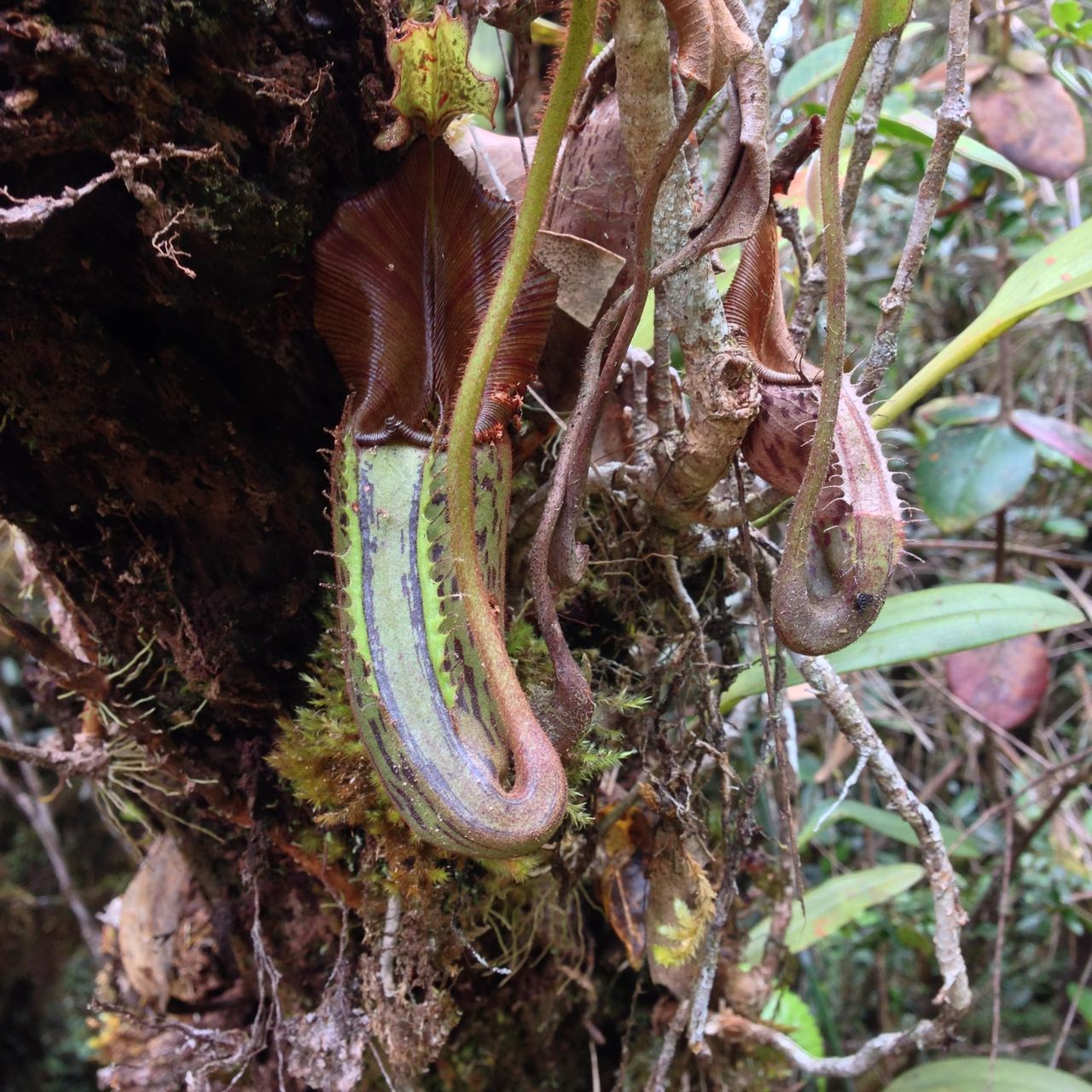
A species distinguished mainly by its architecture rather than its pitchers. Nepenthes fractiflexa was described in 2020 by Michal Golos, Alastair Robinson, Marc Barer and colleagues, and its name, from the Latin fractus, broken, and flexus, bent, refers to the zigzag climbing stems, which change direction at every node. Even more striking to botanists was the inflorescence: it arises not in the leaf axil, as in all other pitcher plants, but halfway along the internode above. The phenomenon is called concaulescence and had never before been recorded in Nepenthes.
Identification
A fairly small climber, clearly smaller than its closest relative Nepenthes mollis. The best field character is the stem: the climbing stems bear their leaves in two rows and bend alternately left and right at each node, forming a zigzag line. The plant also produces many side shoots; the buds in the leaf axils often develop, producing bract-like prophylls up to five centimetres long. Anyone who finds a flowering plant can see the third character: the inflorescence stands not in the axil of a leaf but arises midway along the internode. The available summaries say little about the pitchers; the full description was not consulted for this guide, so measurements are absent.
Similar species
According to the authors the closest relative is Nepenthes mollis, a hairy mountain species which since 2019 also includes the plants formerly called N. hurrelliana. N. fractiflexa is smaller in every respect and differs mainly in its zigzag, two-ranked climbing stems, its many side shoots and the inflorescence arising midway along the internode. Plants without inflorescences and with few side shoots can be hard to recognise; the zigzag stem is then the main clue.
The trap and how it works
The pitchers work as in the rest of the genus: nectar on the peristome and under the lid lures insects, which slip on the wet peristome and end up in the digestive fluid below. Since the plant grows both on the ground and as an epiphyte, it forms both ground pitchers and pitchers hanging in the vegetation. No prey study of this species has been published. Work on other species of the genus has shown that the peristome works by 'aquaplaning': a thin film of water on the finely ribbed surface makes it so slippery that the adhesive pads of insect feet can no longer grip. The trap therefore works best when it is damp, which in cloud forest is almost always the case.
Habitat and ecology
Ridge forest in the mountains between about 1400 and 2150 m, where the species grows both on the ground and as an epiphyte (B1). This is the typical mossy cloud forest of Bornean ridges, with low trees, thick moss and an acid, nutrient-poor soil. The many side shoots and zigzag growth may help it find purchase everywhere in dense, low vegetation, but that explanation is speculative. For a pitcher plant such a habitat is favourable: the constant humidity keeps the pitchers filled and the peristome slippery, while the poor soil supplies little nitrogen and phosphorus, so that the extra nutrition from prey is a real advantage.
Distribution and elevation
Endemic to Borneo, known from Sarawak and Kalimantan, which agrees with the guide's own species list. The species is thus known from mountains on both sides of the border between Malaysian and Indonesian Borneo. As the species was described only in 2020 and many mountains there are barely explored, its range is probably not yet fully known.
- Recorded (one-degree cells)
Forms and variation
No varieties or wild forms have been described, and after so short a time little is known about variation within the species. No natural hybrids have been published. That the species was recognised so late says above all how little the mountains of Borneo's interior have been explored.
Where and when to see it
The sites lie in remote mountains of the interior, reachable by expedition with local guides. On ridges above about 1400 m, look for plants whose stems trace a zigzag and which produce many side shoots; on flowering plants the position of the inflorescence is decisive. Photograph stem and inflorescence together: those are the characters that prove the species.
Conservation status
There is no IUCN assessment of this species (Not Evaluated). The authors provisionally proposed Near Threatened on the basis of the IUCN criteria, but that is not an official assessment. What is known: the species grows on high ridges of little interest for logging, but the number of known sites is limited. As a member of Nepenthes it is listed in CITES Appendix II. Newly described pitcher plants often quickly become sought after in the trade, and experience with other species shows that this can lead to the plundering of small populations before tissue culture meets the demand.
Scientific name
Nepenthes fractiflexa | Golos, Robinson & Barer, 2020
Nepenthes fractiflexa was described in 2020 by Michael Golos, Alastair Robinson and Gilles Barer, in "Nepenthes fractiflexa (Nepenthaceae), a new Bornean pitcher plant exhibiting concaulescent metatopy and a high degree of axillary bud activation" (Phytotaxa 432(2): 125-143). The species is endemic to Borneo and occurs in ridge forest at 1,400-2,150 m elevation, with records from both Sarawak and Kalimantan; the precise type locality could not be established with certainty. The name is formed from the Latin "fractus" ("broken") and "flexus" ("bend"), describing the plant's distinctive distichous vining stems, which bend alternately at the nodes in a zig-zag fashion.
World Checklist of Vascular Plants (WCVP), via Plants of the World Online (POWO), Royal Botanic Gardens, Kew.