All species › Caryophyllales › Tropical pitcher plant family › Nepenthes gantungensis
Nepenthes gantungensis
A pitcher plant of a single summit on Palawan, in the Philippines, discovered in 2010 and described the same year. On the bare top of Mount Gantung, Nepenthes gantungensis forms compact rosettes with sturdy yellow-green pitchers and an often red peristome. Our own species list placed it on Sumatra; that is a mistake, since both the description and the world checklist give only the Philippines. Its taxonomy is not undisputed: some specialists regard it as a form of the related N. deaniana.
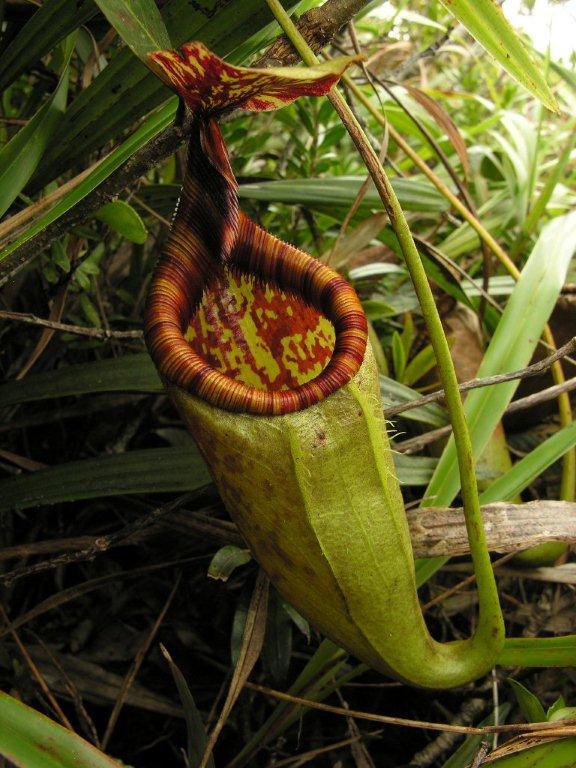
Identification
A plant that forms mainly compact rosettes on the summit but can send long, etiolated stems into the canopy in shaded forest; the stem reaches about 4 m long and 2.5 to 3.5 cm thick. The leaves are leathery, stalked to nearly stalkless, narrowly oblong, 20 to 40 cm long and 6 to 12 cm wide; the tendril reaches 40 cm. Lower pitchers are ovate to urn-shaped, to 20 cm tall and 7 cm wide, with wings to 12 mm bearing filiform fringes, an oval mouth to 6 cm with a distinct neck at the rear, and a peristome to 2 cm wide (3 cm near the neck) whose ribs end in teeth to 4 mm. The lid is elliptic, to 6 × 4.5 cm. Upper pitchers are funnel-shaped, to 25 cm tall, with the wings reduced to ribs. The underside of young tendrils carries a dense layer of red-brown hairs.
Similar species
Its closest relatives are Nepenthes deaniana of Thumb Peak and N. mira, both also from Palawan. N. gantungensis usually has shorter, narrower and more acute leaves, flowers borne singly on pedicels, a generally much longer inflorescence than N. deaniana, a more pronounced peristome, and lower pitchers that are never wholly reddish purple; it also often produces upper pitchers, which its relatives rarely do. N. leonardoi, described in 2011 from a neighbouring massif, has almost the same pitcher shape but nearly black pitchers, more clearly stalked leaves and a shorter inflorescence with musty-smelling flowers.
The trap and how it works
A pitfall of the ordinary kind, with a heavily ribbed peristome. The ribs are up to 2 mm high and 2 mm apart and end at the inner edge in teeth to 4 mm that overhang the mouth: an insect sliding inwards over the wet, slippery ribs finds nothing to hold on to on the inside. The digestive zone lines the entire inner wall. The lid has no appendages and no keel. Lower pitchers in the rosettes sit in the low summit vegetation and catch walking animals; the upper pitchers, which this species produces far more often than its relatives, hang higher and catch flying insects. No prey data have been published.
Habitat and ecology
Low, stunted montane scrub on the summit and ridge of the mountain, between about 1600 and 1784 m, and the adjoining cloud forest (B1). In the open scrub the plant grows on the ground in compact rosettes; where the forest becomes denser and shadier it forms long, etiolated stems that climb into the canopy. Where bamboo comes up it is crowded out. No other Nepenthes grow on the summit, so confusion with neighbours and natural crosses do not arise in the field.
Distribution and elevation
Endemic to Palawan, Philippines, and known there from a single mountain: Mount Gantung, in the municipality of Brooke's Point in the south of the island. The species grows from about 1600 m to the summit at 1784 m and is most abundant above 1650 m. The entire known population numbers several hundred plants. The mountain lies within the protected landscape around Mantalingajan, Palawan's highest massif. Our species list gave Sumatra as its area; that is wrong.
- Recorded (one-degree cells)
Forms and variation
No varieties or forms have been described. The main variation is between growth forms: compact rosettes in open scrub and long, thin climbing stems in shaded forest. Lower pitchers are green to yellow outside, often speckled red to purple inside, with a red, purple or brown peristome and a yellow to orange lid, but never wholly red or purple. No natural hybrids are known, which fits the absence of other species on the mountain. Taxonomically the species is disputed: the Carnivorous Plant Database treats it as a synonym of N. deaniana.
Where and when to see it
The summit of Mount Gantung can be reached only on a trek of several days from the lowlands around Brooke's Point, with permission from local communities and the managers of the protected area, and with guides. Above 1650 m, in the low scrub on the ridge, the rosettes are densest and easy to see among the low shrubs. Keep to the existing trail: the population is small, and trampling the scrub damages both plants and seedlings. Collecting seed and plants is prohibited.
Conservation status
The Red List data used by this guide contain no assessment for this species (Not Evaluated). What is known: the entire species consists of several hundred plants on one summit, and the describing authors therefore recommended the category Critically Endangered. The vegetation is largely intact, but a radio repeater and a building stand near the summit, and large-scale mining takes place on a neighbouring peak. Because the species is also sought after in trade, the small size of the population is the greatest risk. It is listed in CITES Appendix II.
Scientific name
Nepenthes gantungensis | McPherson et al.
Nepenthes gantungensis was described in July 2010 by Stewart McPherson, Alexander Cervancia, Ch'ien C. Lee, Ugis Jaunzems, François Sockhom Mey and Alastair Robinson, in the second volume of McPherson's book Carnivorous Plants and their Habitats. The holotype (S. McPherson SRM 4) was collected on 25 January 2010 in the summit area of Mount Gantung, at 1,754 m elevation, in Brooke's Point municipality on Palawan, Philippines, and is held at the herbarium of Palawan State University, Puerto Princesa City. The summit of Mount Gantung, Brooke's Point municipality, Palawan, Philippines, at 1,754 m elevation — the only known locality for the species. The specific epithet refers to Mount Gantung, the only locality from which the species is known.
World Checklist of Vascular Plants (WCVP), via Plants of the World Online (POWO), Royal Botanic Gardens, Kew.