All species › Caryophyllales › Tropical pitcher plant family › Nepenthes abalata
Nepenthes abalata
The name says it: 'ab alata', away from alata. Plants of this species lay in herbaria for almost a century under the name Nepenthes alata, or before that as 'Nepenthes blancoi', until Martin Cheek and Matthew Jebb, sorting out Blanco's old names in 2013, established that they formed a species of their own. Nepenthes abalata is a lowland species of small islands in the west of the Philippines, and one of the few pitcher plants in the country that grows almost at sea level.
Identification
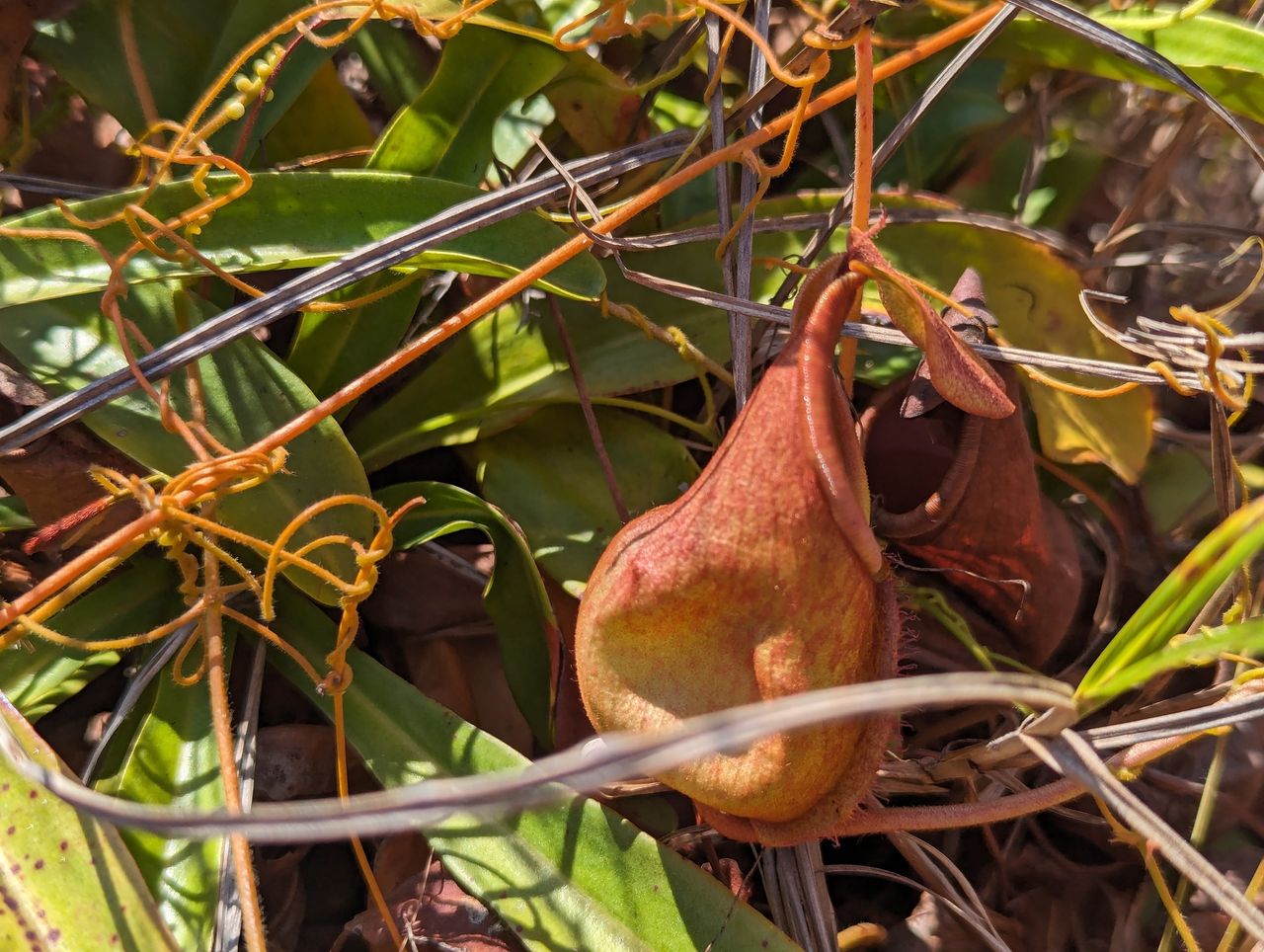
A low subshrub at most half a metre tall. Young plants have an erect stem of 7 to 12 cm with nine to eleven spirally arranged leaves; later the stem becomes procumbent or scrambling. The leaves are thickly leathery, linear to oblanceolate, 14 to 22 cm long and 1.3 to 2.8 cm wide, with an obtuse to notched tip; the lowest quarter is narrow and parallel-sided, clasps half the stem and runs down it in narrow wings. Lower pitchers are ovoid below and cylindrical towards the mouth, about 14.5 cm tall and 6.5 cm wide, with two fringed wings of four to six millimetres. Intermediate pitchers are slimmer, 10.5 to 13.5 cm, with narrower wings. The peristome is rounded, two millimetres wide at the front and up to 6.5 mm at the sides. The lid is ovate, 2.5 cm, with two kinds of nectar gland beneath: small ones, scattered, and about ten large, crater-like glands in a bare ellipse along the midline. The male inflorescence can reach 52 cm with some 160 one-flowered side branches.
Similar species
The difference from Nepenthes alata, with which the species was confused for so long, lies mainly in habit and nectar glands: Nepenthes alata in its current, narrow sense is a climber of Luzon's montane forest, while Nepenthes abalata is a low, erect to procumbent subshrub of sea level, with dimorphic glands under the lid. From Nepenthes graciliflora, the widespread Philippine species of the same group, it differs in habitat and altitude and its short, thick leaves. On the main island of Palawan the lowlands hold Nepenthes philippinensis, a species with long, slender climbing stems and a different leaf shape.
The trap and how it works
A pitfall trap in two forms. Lower pitchers stand on the ground among grass and stones, with broad fringed wings leading walking animals to the mouth, and a peristome narrow at the front and broader at the sides; on the inner margin only the parts near the lid carry minute teeth. Intermediate pitchers hang higher and have narrower wings. Under the lid the small nectar glands offer a diffuse lure, while the large crater glands along the midline probably provide extra nectar right above the mouth. The inner wall is smooth and waxy, and digestive fluid stands at the bottom. Nothing has been published on the prey of this species.
Habitat and ecology
Open, rocky grassland and scrub slopes close to the sea, on non-ultramafic soils, between sea level and about 20 m (B5, B6). It is an unusual habitat for a Philippine pitcher plant: most of the country's species are mountain plants of cloud forest or ultramafic ridges. The combination of sun, poor soil and little competition from trees explains why the species holds on in these bare, windy places.
Distribution and elevation
Endemic to the Philippines, and known from three widely separated islands in the west of the country: Culion in the Calamian group and Cuyo in the Cuyo Islands, both administratively in Palawan province, and Malalison off the west coast of Panay, in Antique province. Herbarium records also mention Manamoc in the Cuyo group. The label 'Palawan' in our species list is therefore right only as a provincial name; the species is not known from the main island of Palawan. The three sites lie about 200 km apart, mostly across sea.
- Recorded (one-degree cells)
Forms and variation
No varieties have been described. Most published variation lies in size: intermediate and lower pitchers differ strongly in shape and width, and the balance between the kinds of nectar gland under the lid varies between collections. No natural hybrids have been reported; few other species of the genus occur on the small islands where it grows.
Where and when to see it
This is one of the few Philippine pitcher plants for which you need not climb a mountain: it grows on open, grassy and rocky slopes right by the coast. Search sunny, bare spots among low scrub and grass and look at the ground: the lower pitchers lie among stones and are easily mistaken for a tuft of grass. Keep in mind that known populations are small; do not trample the plants and take nothing away.
Conservation status
The Red List assesses the species as Least Concern. That differs sharply from the authors' view, who in 2013 rated it Critically Endangered: they knew only one or two plants from each of the three sites, none of them protected, with ongoing damage to the coast, among other things from beach-resort development. The discrepancy shows how little is known about the true size of the populations. Like all Nepenthes the species is listed in CITES Appendix II.
Scientific name
Nepenthes abalata | Jebb & Cheek, 2013
Described by Matthew Jebb and Martin Cheek in 2013, in the article "Identification and typification of Nepenthes blancoi, with N. abalata sp. nov. from the western Visayas, Philippines", Nordic Journal of Botany 31(2): 151–156. The species occurs in the western Visayas, Philippines, on the islands of Culion, Cuyo and Malalison. The name "abalata" means "of/like alata" and refers to the fact that this species was long (incorrectly) lumped together with the widespread and highly variable Nepenthes alata, before being recognised as a distinct species.
World Checklist of Vascular Plants (WCVP), via Plants of the World Online (POWO), Royal Botanic Gardens, Kew.