All species › Caryophyllales › Tropical pitcher plant family › Nepenthes ceciliae
Nepenthes ceciliae
A pitcher plant of Mindanao, in the southern Philippines, one of the richest areas for the genus outside Borneo and Sumatra. Nepenthes ceciliae was described in 2011 by Gronemeyer, Coritico, Micheler, Marwinski, Acil and Amoroso, in the first volume of Stewart McPherson's New Nepenthes; the discovery had been announced online in August that year. The species is named after the Philippine botanist Cecilia Beltran-Amoroso, who died in January 2011 and had worked on the ex-situ conservation of Philippine pitcher plants. It grows on ultramafic soil on Mount Kiamo.
Identification
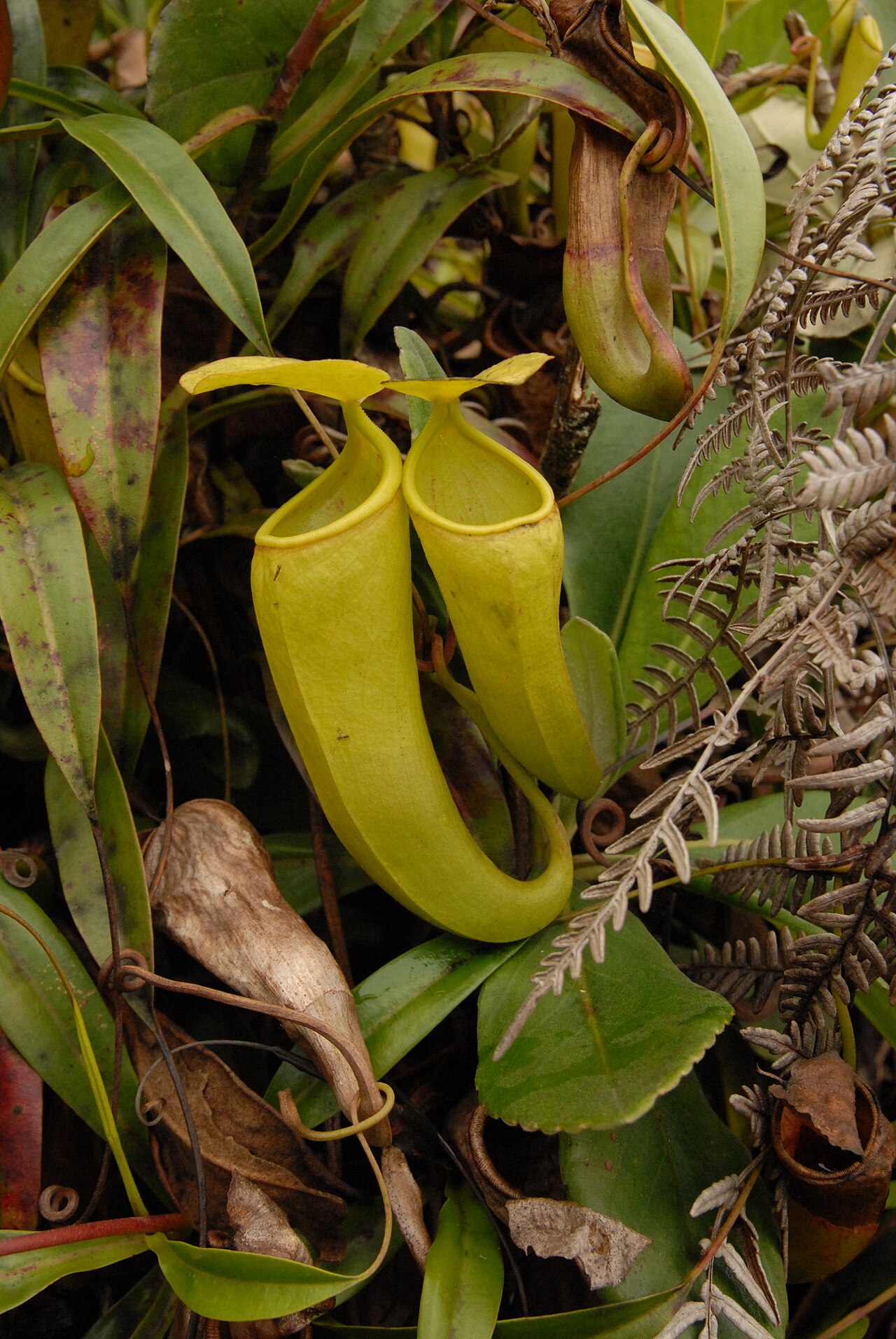
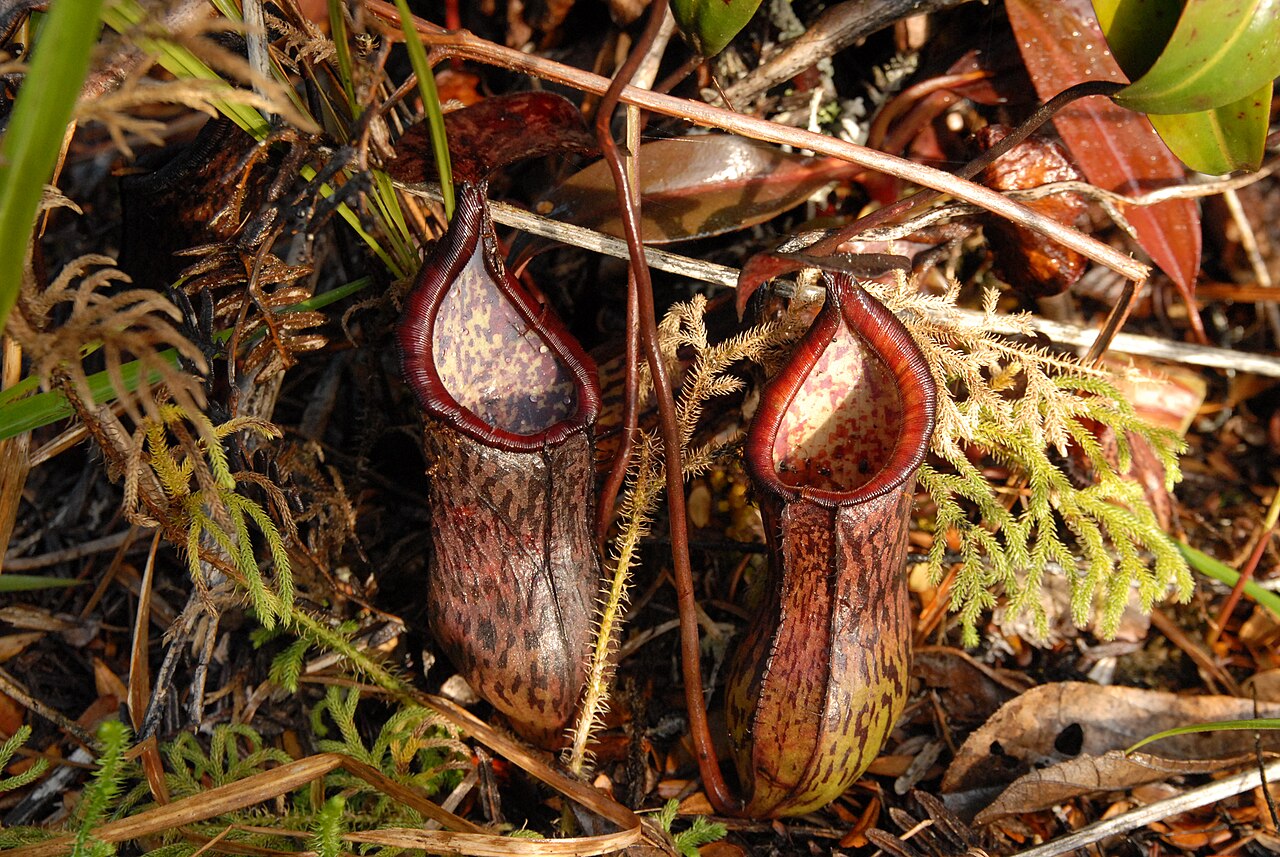
A branched climber to 3 m, with round stems up to 4 mm thick, yellowish green or reddish, with short internodes to 2 cm. The whole plant is glabrous. The leaves are stalked, with a linear blade to 16 cm long and 2.5 cm wide and a winged petiole to 4 cm, with two longitudinal veins on each side; the tendrils are up to 20 cm long and mostly coiled. Lower pitchers are up to 10 cm tall and 3 cm wide, cylindrical with a variably inflated lower third, with wings to 4 mm and thread-like fringes to 3 mm, an oblique mouth to 3 cm, a flattened peristome to 4 mm with very fine ribs, a cordate lid to 3.5 by 4 cm and an undivided spur to 5 mm. They are pale yellowish green, densely mottled with large, dull, dark red, rust-brown or blackish blotches, pale yellow to whitish inside. Upper pitchers are funnel-shaped throughout, up to 10 cm tall and 4 cm wide, with wings reduced to ridges; in full sun they are plain yellow, in shade yellowish green.
Similar species
Nepenthes ceciliae belongs to the N. alata group of the Philippines, species with winged petioles, a lid with a basal ridge on its underside, and upper pitchers broadest near the base. It was at first thought it might belong to N. copelandii. N. pulchra, which occurs on the same mountain and hybridises with it, differs in pitcher shape and colour. The absence of hair and the linear, stalked leaves help to distinguish it within the group.
The trap and how it works
A pitfall with two pitcher types. The spotted lower pitchers stand on or just above the ground and catch walking animals; the yellow, funnel-shaped upper pitchers hang in the open vegetation and mainly catch flying insects, their plain yellow colour in full sun making them visible from afar. The peristome is narrow, with very fine ribs about a tenth of a millimetre high and apart, which nonetheless form a slippery surface when wet. Nectar glands on the rim and under the lid lure prey to the mouth.
Habitat and ecology
Open upper montane vegetation on ultramafic soil (R3, R5), between 1500 and 1880 m, grading into mountain forest (B1). Ultramafic ground, rich in heavy metals and poor in ordinary nutrients, keeps the vegetation low and open and gives pitcher plants plenty of light. On Mindanao several Nepenthes species grow on such soils.
Distribution and elevation
Endemic to the Philippines, and known only from Mount Kiamo on the island of Mindanao. The world checklist gives the Philippines as its area. Its nearest relatives in the N. alata group grow elsewhere in the Philippines.
- Recorded (one-degree cells)
Forms and variation
No varieties have been described. The colour of the upper pitchers depends on light: plain yellow in full sun, yellowish green in shade. A natural hybrid is known with N. pulchra, which grows on the same mountain.
Where and when to see it
Mount Kiamo lies in the interior of Mindanao; a visit requires permission from the local community and authorities and an experienced local guide. In the open, low upper montane terrain the yellow upper pitchers stand out from a distance; the spotted lower pitchers sit low in the vegetation. Ultramafic soils are often red or orange and easy to recognise; that is where to start looking.
Conservation status
The species has not been evaluated by the IUCN (NE). Its authors proposed that it be regarded as Vulnerable: it is known from one mountain, and its open upper montane habitat on ultramafic ground is limited in extent. As a member of the genus it is listed in CITES Appendix II. Threats are fire, collecting and possibly mining, which takes place in many ultramafic areas of the Philippines.
Scientific name
Nepenthes ceciliae | Gronemeyer, Coritico, Micheler, Marwinski, Acil & Amoroso, 2011
Nepenthes ceciliae was described in 2011 by Thomas Gronemeyer, Franco Coritico, Volker Micheler, Wolfram Marwinski, Danilo Acil and Victor B. Amoroso, published in the book New Nepenthes: Volume One (pp. 412-423); the discovery had already been announced online in August 2011. Mount Kiamo, Mindanao, Philippines, at 1,500-1,880 m elevation. Who exactly is honoured by the name "Cecilia" could not be established with certainty from the accessible sources.
World Checklist of Vascular Plants (WCVP), via Plants of the World Online (POWO), Royal Botanic Gardens, Kew.