All species › Caryophyllales › Tropical pitcher plant family › Nepenthes burkei
Nepenthes burkei
One of the longest-known pitcher plants of the Philippines, and a species that entered the world through a nursery. David Burke collected plants on Mindoro for the London nursery of Veitch, and in 1889 Maxwell Masters described them in The Gardeners' Chronicle as Nepenthes burkei. The lectotype is a plant raised in England from that material. Only much later was the species better documented in the wild, and it received its present circumscription in the Flora Malesiana of 2001.
Identification
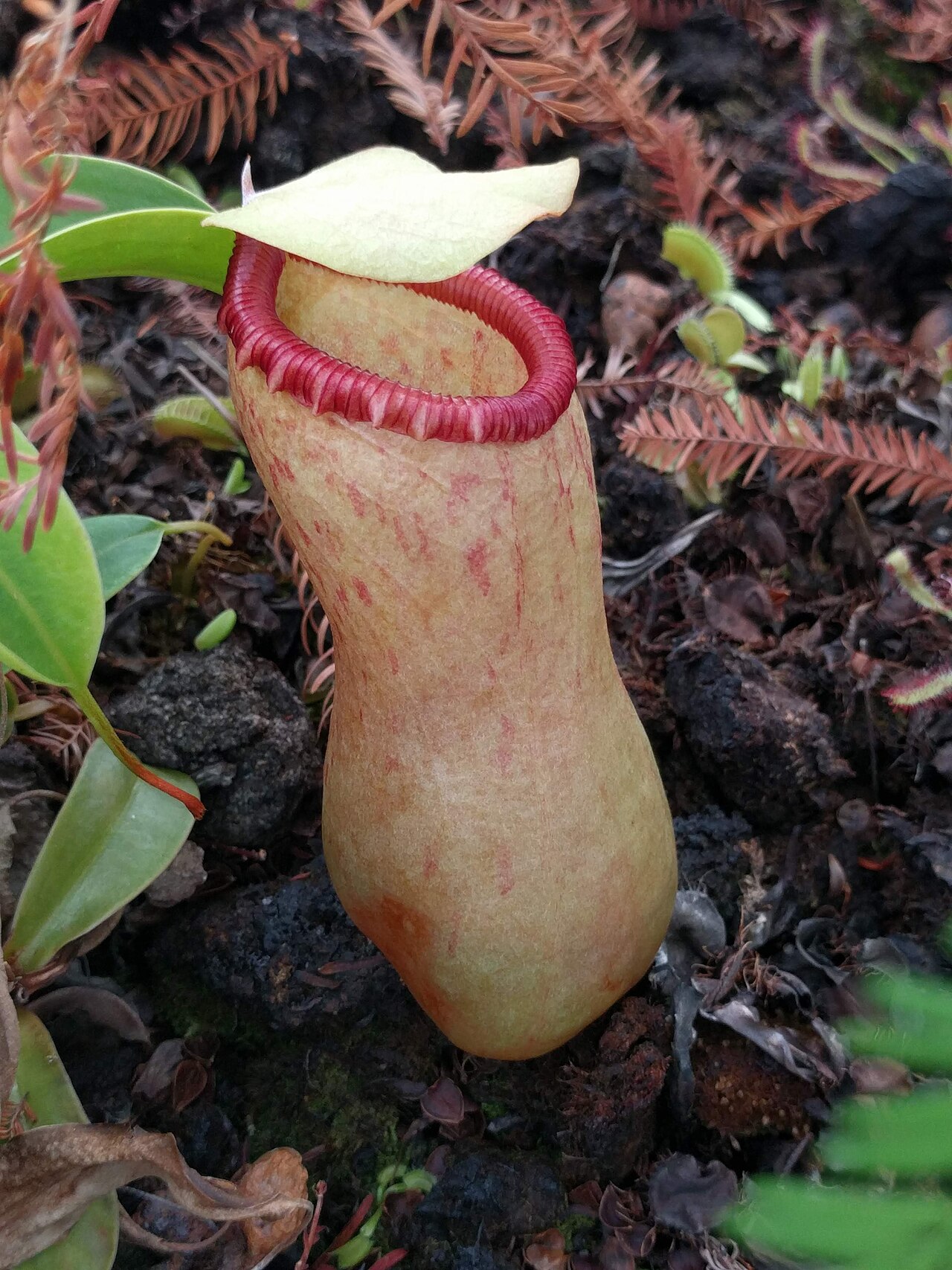
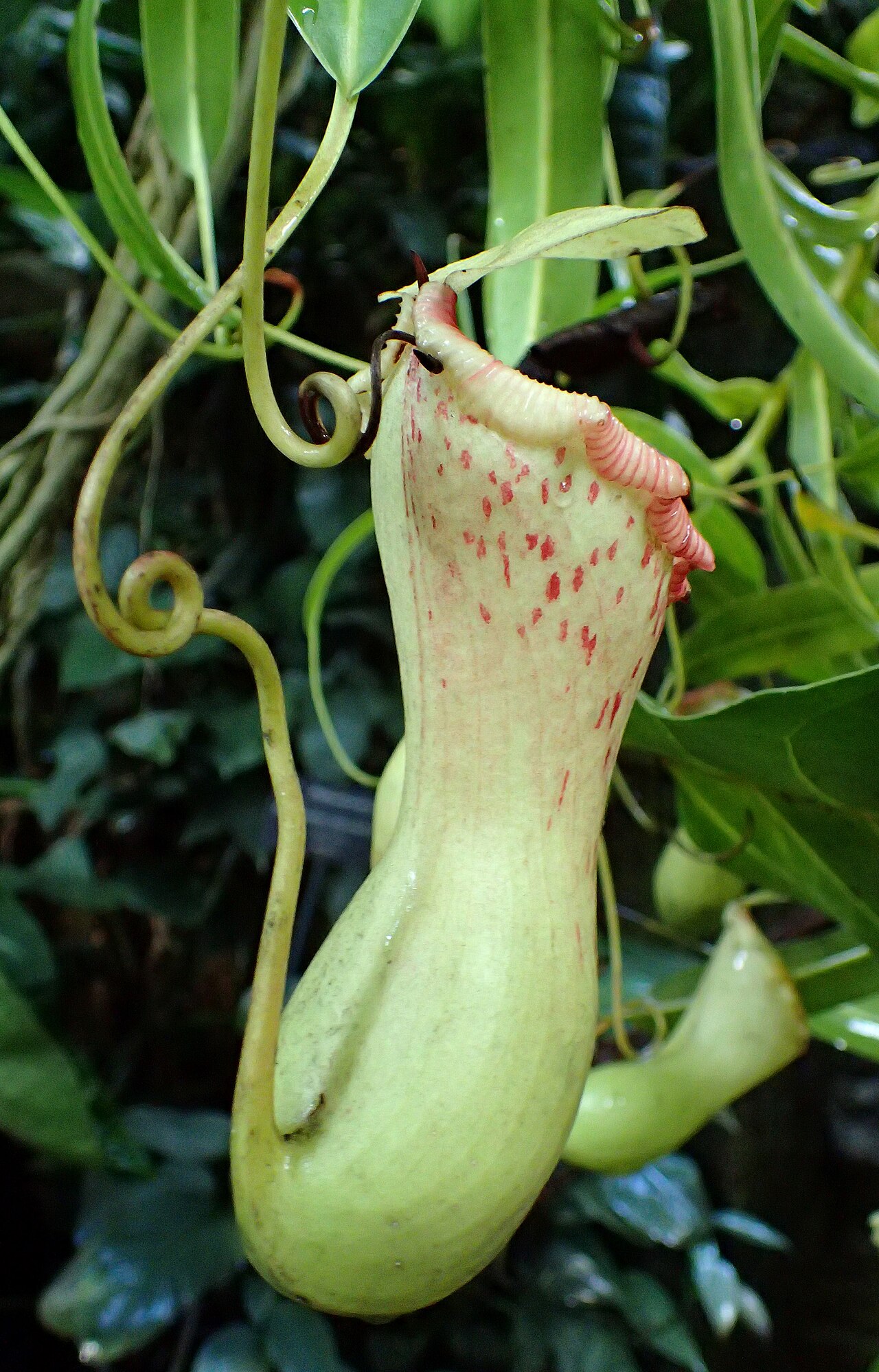
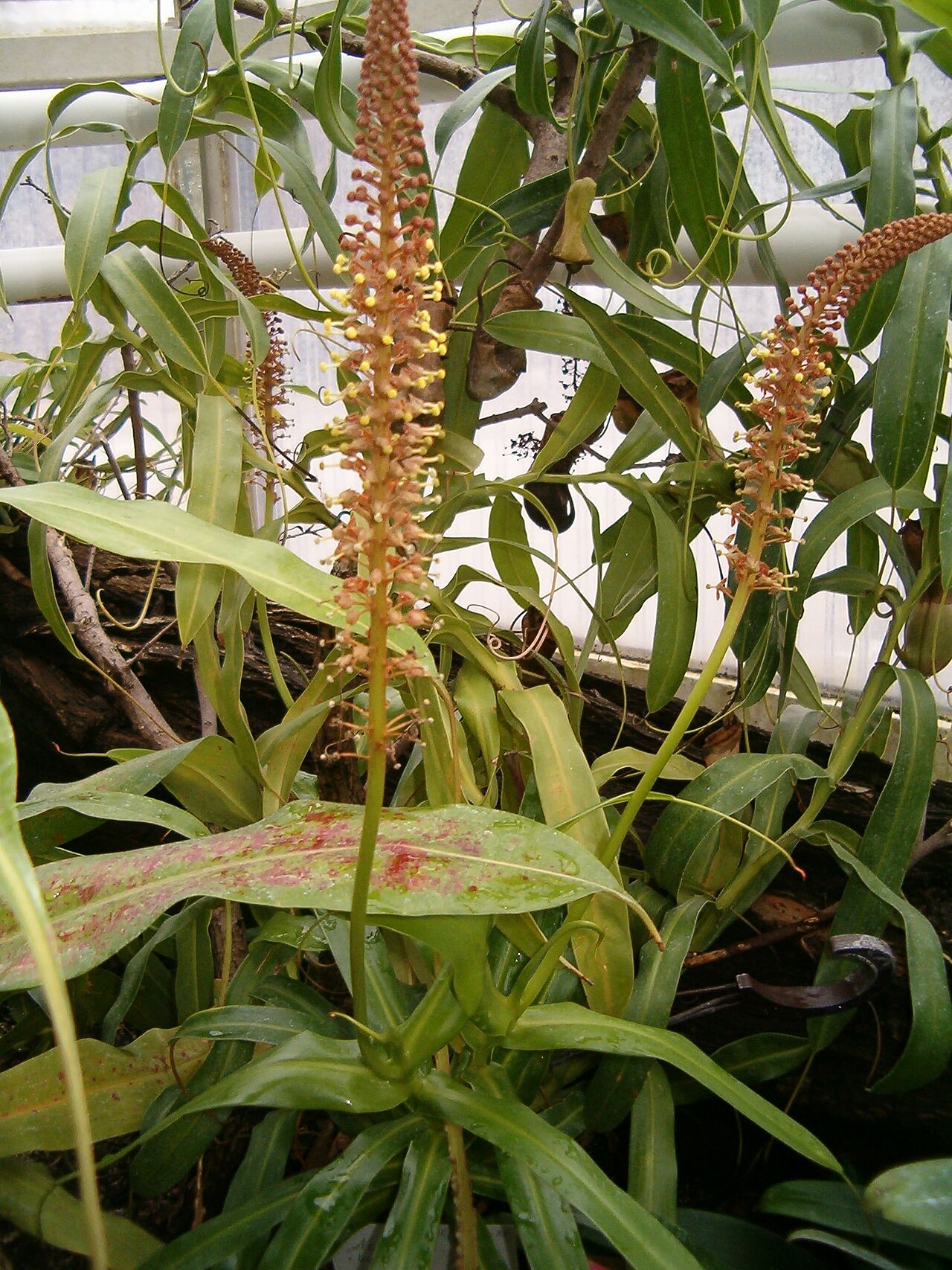
A climber one to two metres tall, terrestrial or epiphytic, with a round, glabrous stem about four millimetres thick. The leaves are sessile, papery to leathery, narrowly oblanceolate to oblong, 8.5 to 26 cm long and 1.2 to 3 cm wide, with four longitudinal nerves on each side and side veins at right angles to the midrib. Leaves on the climbing stem are shorter and more oblong. Lower pitchers are not known and, according to Flora Malesiana, are not produced. Upper pitchers are broadly cylindrical, 10 to 17.5 cm tall, up to 8 cm wide at the base, constricted at the middle to about 4 cm and wider again below the peristome; the wings are reduced to narrow ridges without fringe. They are dull green spotted red-purple; inside waxy yellow, sometimes tinged violet and with a bluish bloom. The peristome is deep red, flattened and eleven to twelve millimetres wide, with coarse ribs, an undulate outer margin and coarse teeth on the inner margin. The lid is elliptic, 4 to 6 cm, as large as the mouth, without appendages.
Similar species
The closest relatives are Nepenthes ventricosa of Luzon and above all Nepenthes sibuyanensis of Sibuyan. Nepenthes ventricosa has pitchers with a much stronger waist, glossy yellowish white, and a lid much smaller than the mouth; in Nepenthes burkei the waist is less pronounced, the pitcher spotted green and the lid as large as the mouth. Nepenthes sibuyanensis has heavy pitchers without a waist. On Mindoro itself this combination of a waisted, spotted pitcher with a broad red peristome is distinctive.
The trap and how it works
A pitfall that, lacking lower pitchers, consists entirely of aerial pitchers: even those touching the ground are of the upper type, without fringed wings. The broad, flattened red peristome with its coarse ribs, ten to fifteen fine striations between each pair of ribs and coarse inner teeth, forms a wide slick rim. The waxy yellow inner wall with a bluish bloom prevents captured insects from climbing back up. Under the lid lie transversely elliptic nectar glands half a millimetre or a little more across, slightly raised but unbordered. Data on prey are lacking.
Habitat and ecology
Montane forest between about 1300 and 1600 m (B1), according to Flora Malesiana; other sources give a wider range, from 1100 to 2000 m. The plant grows on the ground or epiphytically. The literature consulted says nothing specific about soil; Flora Malesiana notes that further habitat data are lacking.
Distribution and elevation
Endemic to the Philippines. Mindoro is the classic area, with herbarium collections from, among other places, Mount Halcon in Oriental Mindoro and the upper Subaan river near San Teodoro. Flora Malesiana also records the species from Panay. The label 'Mindoro' in our species list is therefore right but incomplete. A few herbarium labels naming the species from elsewhere, including Mindanao, probably rest on mix-ups or a broader concept of the species and are not counted here.
- Recorded (one-degree cells)
Forms and variation
Two varieties were described in the nineteenth century, prolifica in 1890 and excellens in 1897, both from cultivated plants; they are no longer distinguished and are treated as synonyms. Historical sources also regarded the species as a hybrid, but the original description says nothing of the kind. In the wild the pitcher varies mainly in the amount of spotting and the width of the base.
Where and when to see it
Mount Halcon in Oriental Mindoro is a well-known but hard climb through pristine forest; the species grows there in the mossy montane forest above about 1300 m. Look in the shrubs and on trees for broadly waisted pitchers, green spotted red, with a wide blood-red rim. A trek on Halcon requires permission from the local authorities and a guide; the area is also the land of the Mangyan.
Conservation status
The species has not yet been assessed by the IUCN (Not Evaluated). A formal assessment is therefore lacking, and the Flora Malesiana treatment gives none either. What is known: the species occurs on at least two islands and on several mountains, in montane forest that on Mindoro is still partly extensive. The forests of Mindoro are, however, under pressure from clearance in the lower zones. Like all Nepenthes it is listed in CITES Appendix II.
Scientific name
Nepenthes burkei | Veitch ex Masters, 1889
Nepenthes burkei was described in 1889 by Maxwell Tylden Masters, as "New or noteworthy plants. Nepenthes Burkeii" in The Gardeners' Chronicle, series 3, volume 6, no. 149, pp. 492-493. The island of Mindoro, Philippines, at 1,100-2,000 m elevation; a more specific type locality than this island could not be established with certainty from the accessible sources. The species is named after the British plant collector David Burke.
World Checklist of Vascular Plants (WCVP), via Plants of the World Online (POWO), Royal Botanic Gardens, Kew.