All species › Ericales › New World pitcher plant family › Heliamphora ionasi
Heliamphora ionasi
Between the foot of Ilú-tepui and that of Tramen-tepui lies a high valley linking the two mountains. There grows Heliamphora ionasi, the species with the largest pitchers in the genus: leaves up to about half a metre tall. It was found in the 1950s by Bassett Maguire's expedition, formally described only in 1978, and then went unseen for decades until material was collected again in 1998.
Identification
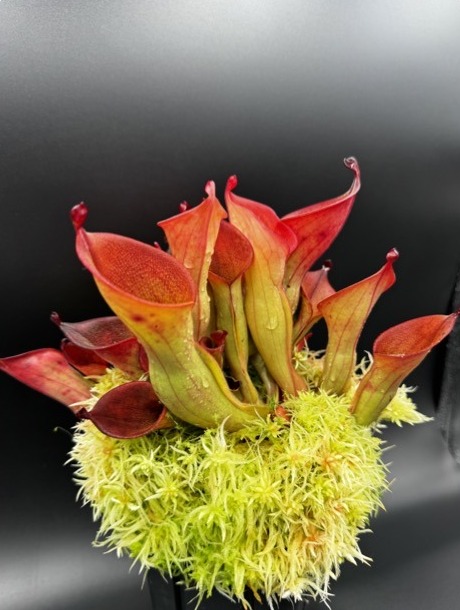
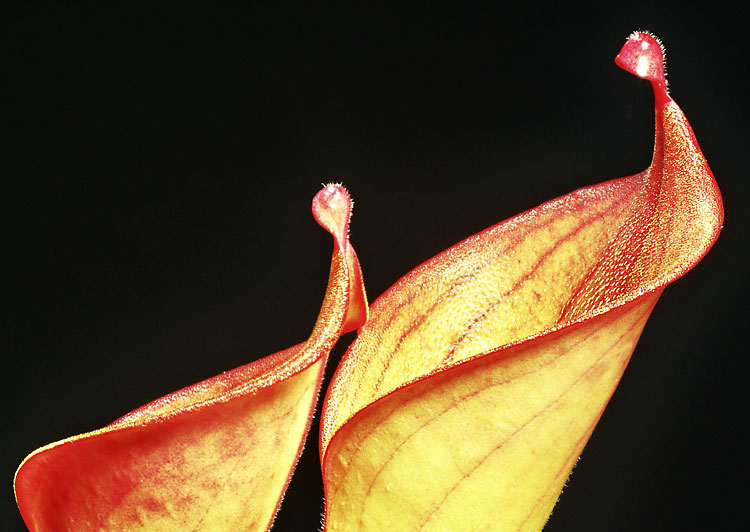
A rosette of very large, erect pitchers, each formed from a single leaf grown shut into a funnel with a seam down the front; they reach about 50 cm, the largest in the genus. The pitcher is narrow and infundibular below, bellied about halfway and widens again towards the top, giving a silhouette like an hourglass with its top cut off. A drainage opening in the wall keeps the rainwater at a working level. On the back rim stands the nectar spoon, small in proportion to the leaf. Colour runs from green with red veins to almost wholly red in plants in full light, with older pitchers usually colouring most strongly. The inflorescence is a one-sided raceme on a long scape held above the rosette, with nodding pale flowers.
Similar species
Size is the first character here: no other species of the genus reaches this pitcher size, and a half-metre rosette in this valley is identified by that alone. On the surrounding plateaus grows Heliamphora nutans of the Roraima group, clearly smaller and differently shaped, with a less pronounced belly. The small, mat-forming species of the Chimantá massif, Heliamphora minor and Heliamphora pulchella, are an order of magnitude smaller and grow a hundred kilometres away. Confusion with Sarracenia is ruled out geographically and structurally too: there is no broad hood, only the small spoon in its place.
The trap and how it works
A pitfall built to scale. This species too makes few digestive enzymes of its own; bacteria in the pitcher fluid do the breaking down and the plant takes up the nitrogen and phosphorus released. The nectar spoon on the back rim lures with sugary fluid and sits directly above the opening. The inner wall carries downward-pointing hairs in its upper zone and is smooth below, so an insect that slips does not climb back out. The large pitcher volume means a single trap can hold a considerable quantity of fluid and prey — which makes the drainage opening no small matter here, since without it the pitcher would overflow in the daily rain.
Habitat and ecology
The summit plateau and the connecting valley between the two mountains (R4). The plants stand in waterlogged hollows where acid peat and bog moss have accumulated (W1) and in wet, open vegetation along their margins (W6). The substrate is a thin, permanently wet organic layer over sandstone, extremely poor in nitrogen and phosphorus and constantly leached by rain. The climate is cool and all but permanently wet, with cloud covering the massif much of the day. Under those conditions it is striking that the largest pitchers in the genus should stand here: the valley is evidently sheltered and constant enough to keep half-metre leaves standing.
Distribution and elevation
Endemic to the Ilú–Tramen massif in Bolívar state, Venezuela, centred on the high valley between the two mountains; presence on Karaurín-tepui has also been suggested. Records run from about 1800 to 2600 m. The species has not been found beyond that. The genus as a whole is confined to the table mountains of the Guiana Shield — Venezuela, western Guyana and the far north of Brazil — and this species shows how narrow such a range can be: one massif, and mainly one valley.
- Recorded (one-degree cells)
Forms and variation
No varieties or subspecies have been described within the species. What varies is colour and pitcher size between sites in the valley, presumably with exposure and drainage; that variation carries no taxonomic name. No natural hybrids of this species have been formally described. In cultivation the species long remained rare and most plants descend from a small number of collections, but cultivars are left aside in a field guide — they say nothing about the wild populations.
Where and when to see it
The massif is reachable only by helicopter or a long trek, lies within Canaima National Park and is in practice visited with a permit and a guide. Standing in the valley you cannot miss the species: this is one of the few marsh pitcher plants recognisable as an individual plant from tens of metres away. Watch the proportion between leaf and spoon — precisely because the pitcher is so large, the nectar spoon looks strikingly small, which in photographs is a more reliable cue than absolute size. The flowering period is not established in the literature.
Conservation status
Not assessed for the IUCN Red List, and listed in no CITES appendix. What is known is that the species is confined to one massif and within it chiefly to one valley, which leaves it vulnerable to anything that befalls that ground; the long gap between the first collection and the rediscovery in 1998 also shows how few observations there are on which to base a trend. Against that, the area lies within a national park and World Heritage site, cannot be entered without a permit, and the species is locally numerous in the valley. Collection for trade is the risk usually named for the genus, but cultivated stock now comes almost entirely from seed and tissue culture. The absence of an assessment therefore marks a gap in the record rather than a known decline.
Scientific name
Heliamphora ionasi | Maguire, 1978
Described by Bassett Maguire in 1978, in "Sarraceniaceae (Heliamphora). The Botany of the Guyana Highland Part–X", published in Memoirs of the New York Botanical Garden. The type area lies on the plateau between Ilú-tepui and Tramen-tepui in Venezuela; the material was collected during the 1952 William H. Phelps Jr. Expedition to Ilú-tepui. The species name ionasi is the Latinised form of "Jonah" and honours Jonah Boyan, a member of Maguire's expedition team. The name is frequently misspelled "ionasii" in the literature, but "ionasi" is the correct form.
World Checklist of Vascular Plants (WCVP), via Plants of the World Online (POWO), Royal Botanic Gardens, Kew.