All species › Ericales › New World pitcher plant family › Heliamphora ceracea
Heliamphora ceracea
The epithet refers to wax, and wax is exactly what you see inside the pitcher: the inner wall here is not hairy but waxy and smooth. Heliamphora ceracea was described in 2011 and is known, so far, only from the Brazilian side of Pico da Neblina, the highest mountain in Brazil. That makes it one of the few species of the genus counted as a Brazilian endemic.
Identification
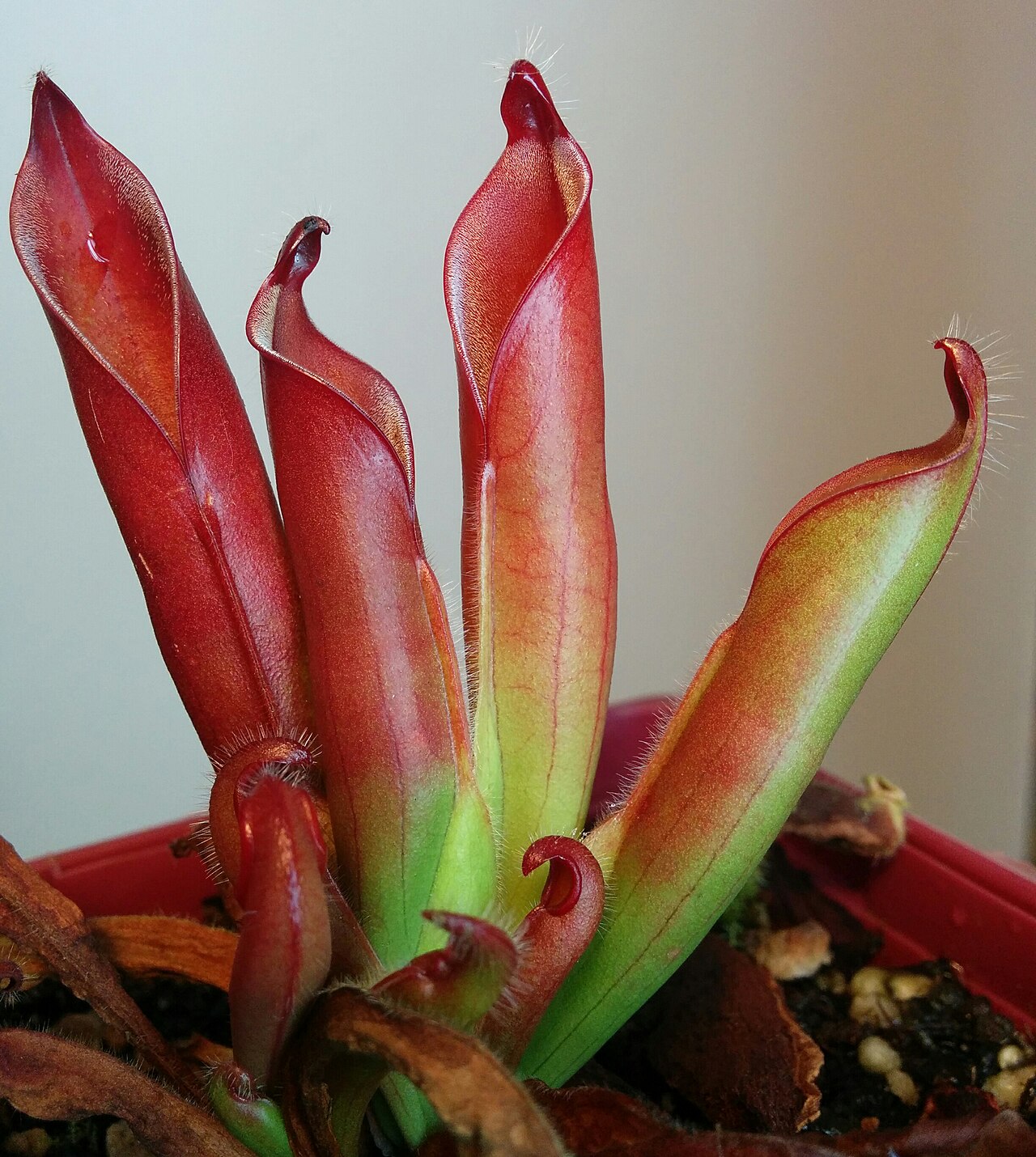
A rosette of erect pitchers, each formed from a single leaf grown shut into a funnel with a seam down the front. The pitchers reach 20 to 30 cm and are, for this genus, relatively narrow and tubular, with a pronounced dip in the front rim. Young pitchers are yellow-green to reddish and often clearly red-veined; with age they turn orange and red. The inner wall is waxy and hairless — no indumentum — and is set with large, irregularly shaped nectar glands showing as dark blotches. The nectar spoon on the back rim is red, flat to slightly concave, with a distinct midrib lined with hairs and a pointed tip. Plants spread by the rhizome into loose clumps that in the field can reach 1.5 m across, though the rosettes within them stand well apart.
Similar species
Several species of the genus grow on this massif, which makes identification harder here than elsewhere. Heliamphora neblinae is far larger, with pitchers of 35 to 45 and sometimes 50 to 60 cm. Heliamphora parva stays smaller and is densely set with short hairs on the outside, where H. ceracea is smooth. Heliamphora hispida, also of this massif, bears long stiff hairs inside the pitcher — the opposite of the waxy, hairless interior that gave this species its name. So look above all at the inside: waxy-smooth with large irregular gland patches, plus a red, pointed spoon with a hairy midrib, points to H. ceracea. Confusion with Sarracenia is ruled out geographically.
The trap and how it works
A pitfall trap in which the slippery surface does the work instead of the hairs. Where many species of the genus line the upper zone of the inner wall with downward-pointing hairs, that wall here is waxy and bare: an insect coming over the rim finds no purchase. The large, irregular nectar glands inside draw prey towards precisely that slippery surface, and the red spoon on the back rim, with its conspicuous midrib, does the luring above the mouth. There is no lid covering the pitcher, as throughout the genus. Digestion is left largely to bacteria in the pitcher fluid, after which the plant takes up the released nutrients. On this ground, where nitrogen and phosphorus are all but absent, that is the plant's main supply.
Habitat and ecology
The high, open upland meadows on the slopes of Pico da Neblina, around 1900 m (R4). The plant stands in wet, peaty substrate, in the open or among sparse vegetation (W1, W6), never under a closed canopy. This is the classic table-mountain setting: leached sandstone on which acid peat and bog moss collect, a soil extremely poor in nitrogen and phosphorus, and a climate that is cool and all but permanently wet, with cloud covering the slopes much of the day. The plants spread by rhizome into loose mats in which dead pitchers remain standing and build an untidy mound among the living ones. Anyone who knows the area recognises the species by that way of standing sooner than by any single plant.
Distribution and elevation
Known from several small populations on the Brazilian slopes of Pico da Neblina, in Amazonas state in northern Brazil, on the Neblina massif. Expeditions to the northern, Venezuelan side of the massif have not found it there, so for now it counts as a Brazilian endemic — a rarity in a genus whose centre of gravity lies in Venezuela. The genus as a whole is confined to the table mountains of the Guiana Shield — Venezuela, western Guyana and the far north of Brazil — and more than half its species occur on a single mountain. At nearly 3000 m Pico da Neblina is the highest summit in Brazil and lies in one of the least-opened corners of Amazonia.
- Recorded (one-degree cells)
Forms and variation
No varieties or forms have been described for this species. There is clear variation in colour with age and exposure: young pitchers are yellow-green to reddish with red veins, older ones turn orange and red, and plants in the most open places colour most strongly. That variation carries no taxonomic name. Across the Neblina massif as a whole several species of the genus grow intermingled and natural hybrids and even hybrid swarms have been described; no hybrids are on record specifically for H. ceracea, but given the situation on the mountain and the small amount of fieldwork, that is more likely a shortage of observations than evidence of isolation. The species was described only in 2011 and the number of known populations is small.
Where and when to see it
Pico da Neblina lies within a national park and on indigenous land; the ascent requires a permit and local guides, and the trek takes a week or more. The species stands not in woodland but in the open wet meadows on the slopes; search where the vegetation is sparse and the peat comes to the surface. Look into the pitcher rather than at it: what separates it from the other species of the massif is on the inside, in the waxy, bare wall with its large irregular gland patches. The loose, wide clumps with their persistent dead pitchers give the spot away from a distance. The flowering period of the species is not established in the literature.
Conservation status
The species has not been assessed for the IUCN Red List, and there is no CITES listing: Heliamphora appears in no appendix. What can be said is that it is a handful of small populations on the slopes of one mountain, a very restricted range by any measure. Against that, the area is a national park, it lies on indigenous land where visits require a permit, and Pico da Neblina is among the hardest places to reach in South America. Collection for trade is the risk usually named for the genus, but material in cultivation now comes almost entirely from seed and tissue culture. The absence of a formal assessment follows from the youth of the name and from how little of the area has been worked: there is too little fieldwork to establish population trends. It is a gap in knowledge, then, not a known decline.
Scientific name
Heliamphora ceracea | Nerz, Wistuba, Grantsau, Rivadavia, Fleischmann & McPherson, 2011
Described by Joachim Nerz, Andreas Wistuba, Ricardo Grantsau, Fernando Rivadavia, Andreas Fleischmann and Stewart McPherson in 2011, in “Sarraceniaceae of South America” (Redfern Natural History Productions, Poole), with a supplementary publication in AIPC Special Issue 4. The type area lies on the Brazilian side of Pico da Neblina, in the Neblina massif, at around 1900 metres elevation. The species name ceracea is Latin for "waxy" and refers to the plant's waxy appearance.
World Checklist of Vascular Plants (WCVP), via Plants of the World Online (POWO), Royal Botanic Gardens, Kew.