All species › Caryophyllales › Sundew family › Drosera silvicola
Drosera silvicola
A pygmy sundew of the northern jarrah forest that was considered lost at its best-known site for more than thirty years and was rediscovered there in 2025. Drosera silvicola — 'living in the forest' — has glossy pink flowers with a dark red centre and is one of the rarest pygmy species around Perth.
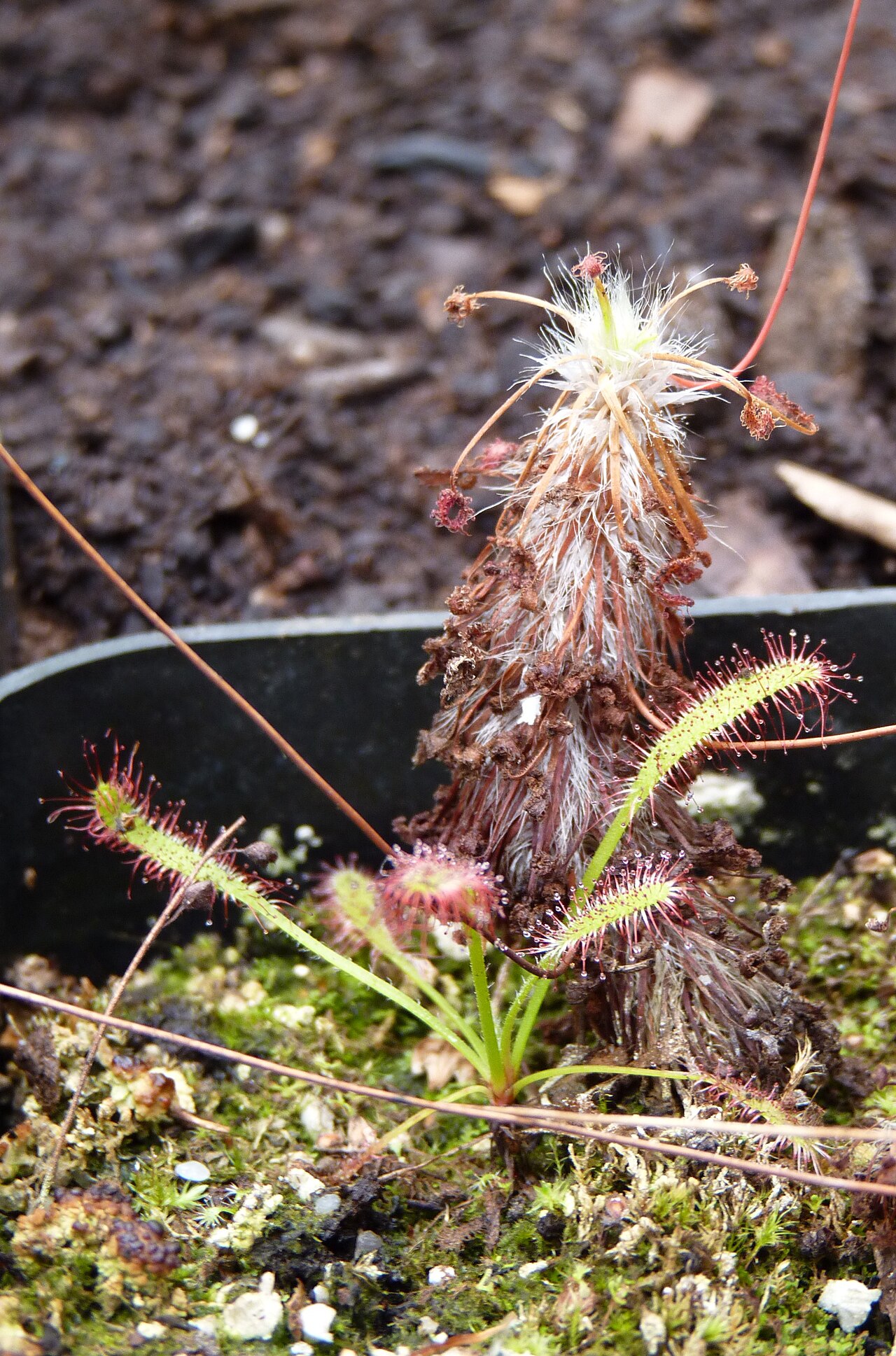
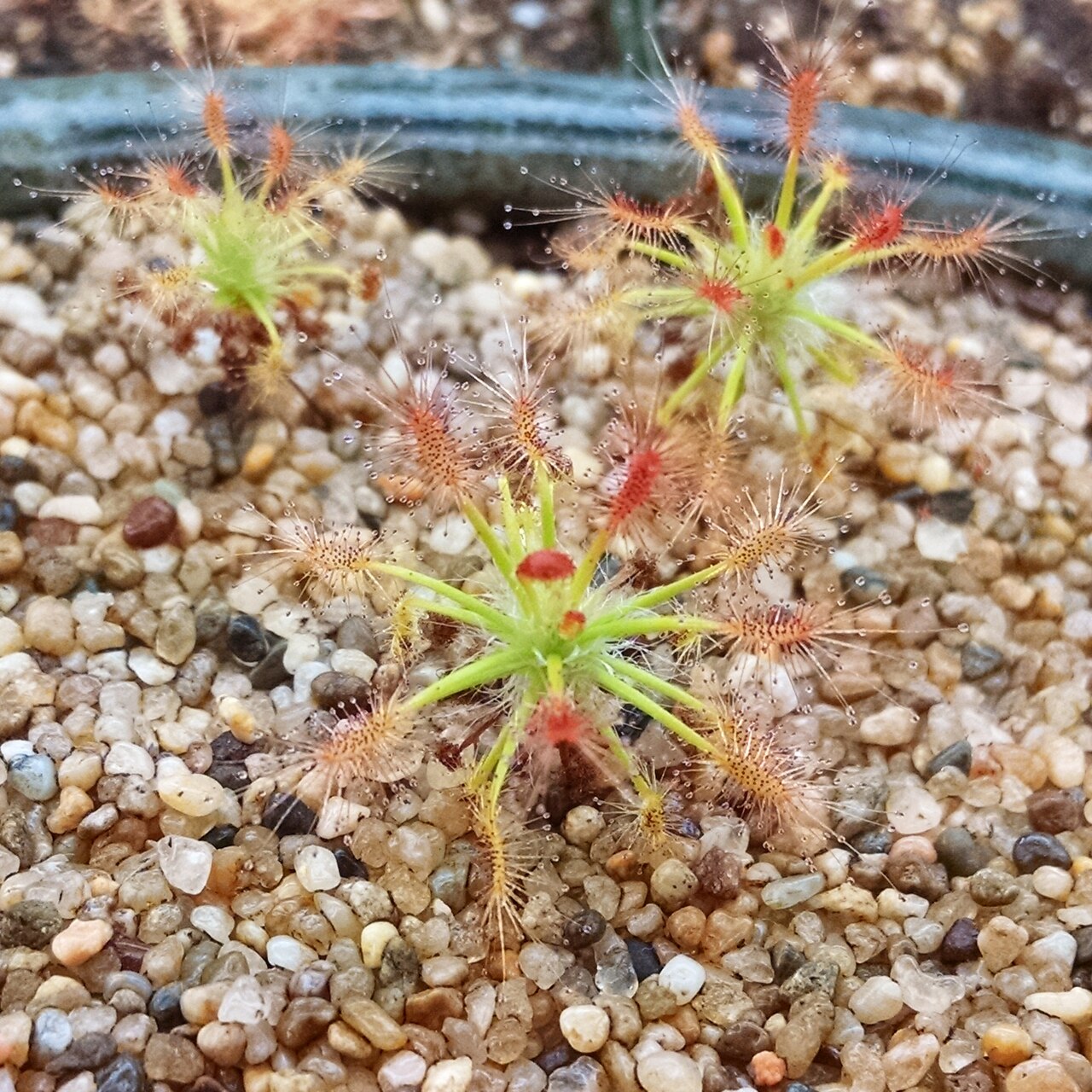
Identification
A perennial pygmy sundew with an open rosette up to 3 cm across and an overall height of up to 8 cm. The leaves are covered with sticky tentacles. The flowers are pink, with glossy petals and a dark red centre, and appear in November. Exact leaf and flower measurements are not published in the sources consulted.
Similar species
The GBIF backbone treats the plant as a subspecies of Drosera barbigera, and that species is therefore the obvious confusion; Plants of the World Online keeps it as a species in its own right, and this guide follows that. The difference between the two is not worked out in the sources consulted. The combination of pink flowers with a dark red centre, November flowering and laterite in the northern jarrah forest is the best guide to D. silvicola.
The trap and how it works
An active flypaper trap in miniature. Each leaf blade, often no larger than a pinhead to a few millimetres, carries stalked glands on its margin and upper surface, each holding a glistening sticky droplet; the marginal tentacles are usually the longest. A small animal that touches the droplets sticks fast, after which the tentacles bend towards the centre of the blade and press the prey against the digestive glands. The glands secrete enzymes and absorb nitrogen, phosphorus and minerals from whatever dissolves. Given the scale, the catch consists of the very smallest: springtails, mites, aphids, thrips and minute midges moving over or just above the sandy ground.
Habitat and ecology
Gravelly laterite soils (D3) in jarrah forest (B6), in open spots with little leaf litter. That lack of litter seems to matter: under a thick layer of fallen leaves, pygmy sundews get no light.
Distribution and elevation
Endemic to the northern jarrah forest of south-west Australia, east and south-east of Perth. FloraBase records the species from the Boddington, Murray, Swan and Wandering local government areas. Because the species is very rare, this guide gives no further localities.
- Recorded (one-degree cells)
Forms and variation
Allen Lowrie and Sherwin Carlquist described the species in 1992. Jan Schlauer later placed it under D. barbigera as subsp. silvicola; GBIF follows that, Plants of the World Online does not. In 2025 the plant was rediscovered in a private wildlife sanctuary near Perth, after more than thirty years without a record there; two other populations lie some 70 km away, on land within mining leases.
Where and when to see it
Do not go looking for it yourself. Its few populations lie on private sanctuary land and within mining areas, and are too small to tolerate trampling. The best way to see the plant is through an organised excursion or through the managers' photographs.
Conservation status
Assessed as Least Concern (LC) on the IUCN Red List; not listed in CITES. That global assessment contrasts sharply with the Western Australian one: there the plant is registered as Priority One — extremely rare, potentially threatened and urgently in need of full assessment. The difference may reflect the taxonomic disagreement: anyone placing the plant under D. barbigera assesses a much larger whole. Bauxite mining in the jarrah forest, root rot and fire are the main threats.
Scientific name
Drosera silvicola | Lowrie & Carlquist, 1996
Drosera silvicola was described in August 1992 by Allen Lowrie and Sherwin Carlquist, published in Phytologia, volume 73(2): 105–107. The type locality is near Boddington, Western Australia. The holotype (PERTH 2753480) was collected by Allen Lowrie on 11 November 1991, in lateritic gravel soils in open jarrah forest. The name is descriptive Latin: "silvicola" means "forest-dweller" (silva = forest, -cola = dweller), referring to the species' habitat in forested areas.
World Checklist of Vascular Plants (WCVP), via Plants of the World Online (POWO), Royal Botanic Gardens, Kew.