All species › Caryophyllales › Sundew family › Dionaea muscipula
Dionaea muscipula | Venus flytrap
Venusvliegenval | Venus atrapamoscas
The best-known carnivorous plant in the world grows wild on an area you could cross in a day: a strip of coastal plain around Wilmington in the Carolinas, and nowhere else. What everyone knows from a windowsill is, in the field, a rarity barely a hand's breadth across.
Identification
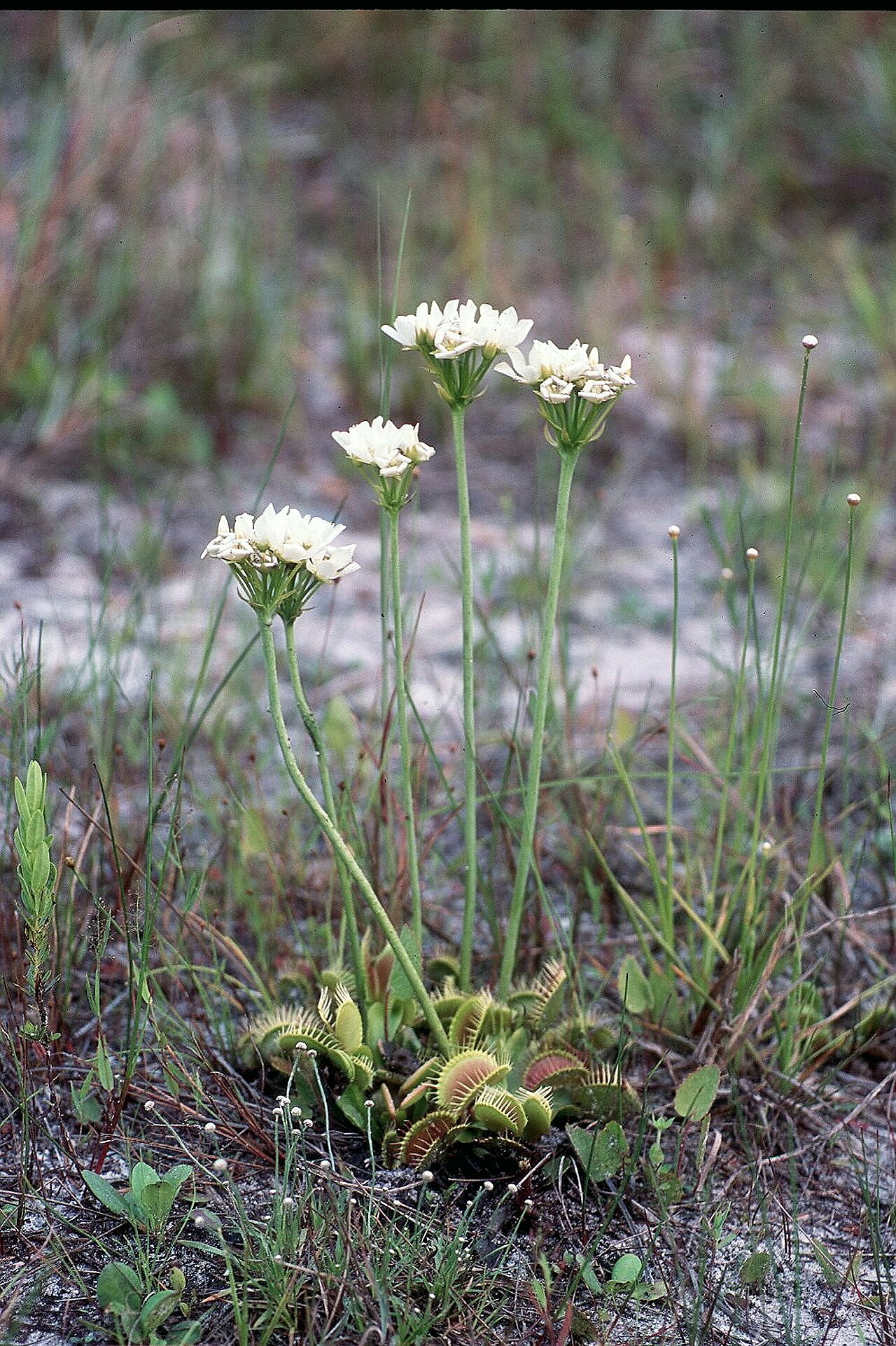
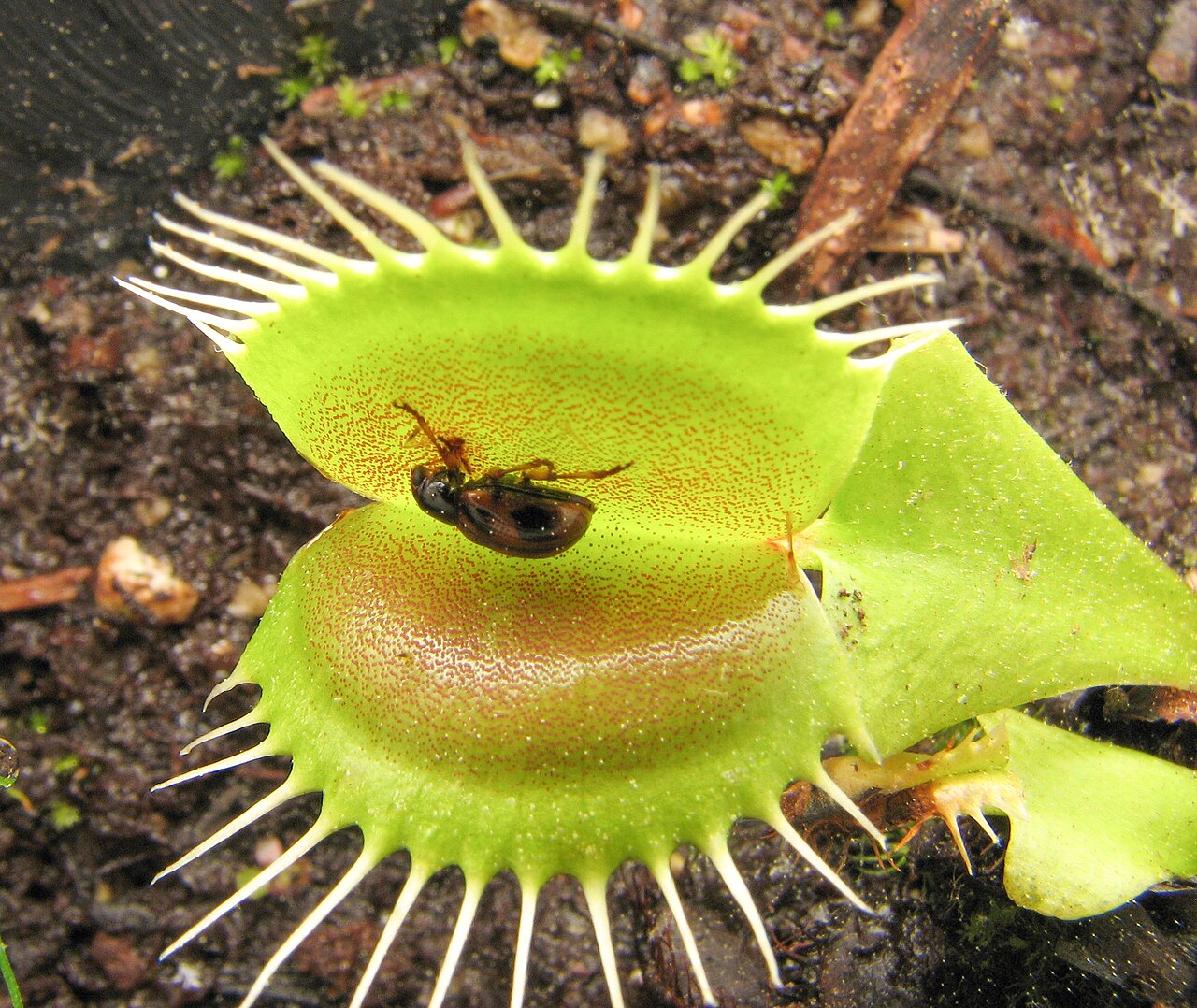
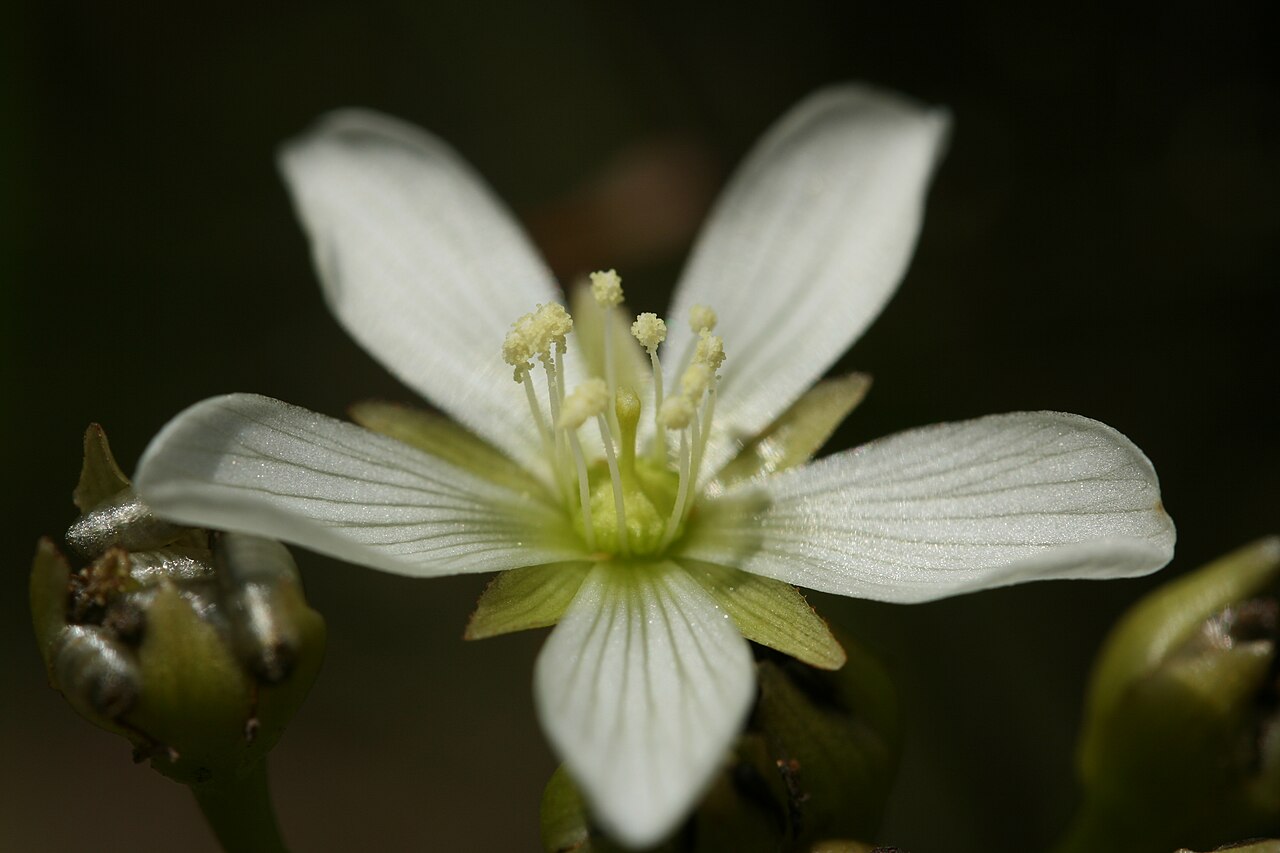
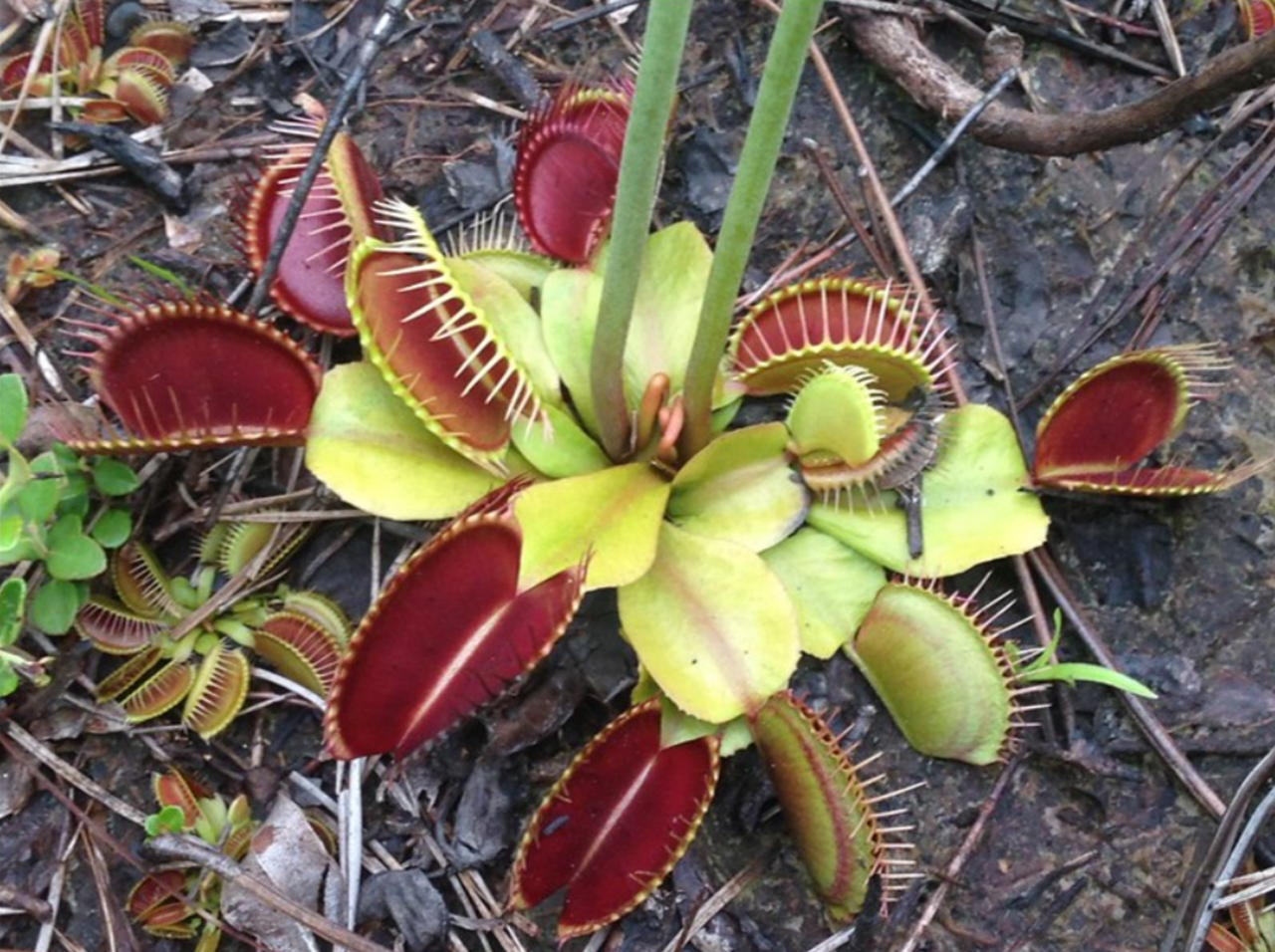
A flat rosette of four to seven leaves, each with a winged petiole 2 to 7 cm long carrying the trap: two kidney-shaped lobes at most 25 mm long, fringed with stiff teeth up to 8 mm. Three fine trigger hairs stand in a triangle on the inner face of each lobe, and in full sun that face turns deep red in many plants. In May and June a bare scape 10 to 30 cm tall rises above the rosette, bearing an umbel-like cyme of white flowers; the five petals are 11 to 13 mm long and carry conspicuous dark veins. After flowering the plant produces longer, more upright leaves than it did in spring.
Similar species
In the field confusion is all but impossible: no other plant on earth has this trap. What does confuse is the plant without one — out of season, or in shade, a young rosette looks like any other savanna rosette. The sundews it shares the ground with (Drosera capillaris, D. intermedia) carry glandular hairs with a droplet and no hinge. Watch the flower too: a white five-petalled flower on a long bare stalk is, in this landscape, more likely a sundew than a flytrap.
The trap and how it works
The trap shuts when two trigger hairs are touched within about twenty seconds, or one hair twice — a shower of rain or a grain of sand does not clear that threshold. The lobes then snap over in roughly a tenth of a second, the curved halves flipping from convex to concave; the marginal teeth interlock like the bars of a cage. A small animal walks out between them, and that is the point: the trap is not built for crumbs. Only after five further stimuli from struggling prey does the plant secrete digestive fluid and seal the trap completely. The menu is ground-based: field studies found roughly 40 per cent spiders, 26 per cent ants and their relatives and 11 per cent beetles — flies barely feature, the name notwithstanding. A trap is good for about three meals.
Habitat and ecology
Wet longleaf pine savanna, and in the Sandhills the narrow seepage zones between streamhead pocosins and dry sand ridges. The soil is acid, sandy-peaty and permanently moist but seldom flooded. The plant depends absolutely on fire: without a burn every few years the shrub layer closes and it is gone within a decade. It grows among sundews, pitcher plants and bladderworts — in this landscape four of the five trapping mechanisms stand side by side within a hand's breadth of ground.
Distribution and elevation
Endemic to the coastal plain of eastern North Carolina and north-eastern South Carolina, the major populations lying in Brunswick, Pender and Onslow counties. The whole natural range sits between sea level and a few tens of metres. Beyond it the species has been planted in several places and holds on locally: in the Florida Panhandle, in New Jersey and at a handful of other sites. Those colonies are not natural spread but the work of growers and enthusiasts.
- Recorded (quarter-degree cells)
Forms and variation
In the wild variation is limited to the degree of red colouring and the shape of the teeth, and that already differs from plant to plant within one population; no varieties are recognised. The hundreds of names in the trade — all-red plants, plants with fused teeth, dwarfs — are cultivars, selected in cultivation or thrown up by tissue culture. They belong to a different world from this guide and are not in it.
Where and when to see it
May and June: it flowers then, and a white flower above the grass carries at a distance while the rosette itself disappears among the sedges. The plant is small and sits low — you will find it on your knees sooner than on your feet. Go to ground managed with fire, where the savanna stands open; several preserves and state parks around Wilmington have a marked trail for it. Do not touch traps to make them close: every closure costs the plant energy it cannot spare on poor ground.
Conservation status
Vulnerable on the Red List and listed in CITES Appendix II. The American assessment of 2023 arrived at roughly 880,000 plants across all populations — far more than earlier estimates, but on ground that has shrunk severely in a century. The greatest threat is not the poacher but the absence of fire: without it the savanna closes over. Beyond that, land conversion, right-of-way maintenance and drainage. Digging wild plants has been a felony in North Carolina since 2014; the federal government decided in 2023 not to list the species under the Endangered Species Act.
Scientific name
Dionaea muscipula | Ellis, 1773
John Ellis described the species in 1773 in the Nova Acta Regiae Societatis Scientiarum Upsaliensis, having already written to Linnaeus about the plant by letter in 1768 and proposed the English name 'Venus's Flytrap'. The governor of North Carolina, Arthur Dobbs, had already described the plant as the first European in 1759. The type locality lies in the coastal plain of North and South Carolina, United States, within a radius of about a hundred kilometres of Wilmington. The genus name Dionaea refers to Dione, in Greek mythology the mother of Aphrodite and itself also a name for the goddess — an allusion to the plant's allure. The species epithet muscipula is Latin for 'mousetrap', here applied to a plant that traps insects rather than mice.
World Checklist of Vascular Plants (WCVP), via Plants of the World Online (POWO), Royal Botanic Gardens, Kew.