All species › Caryophyllales › Sundew family › Drosera ramentacea
Drosera ramentacea
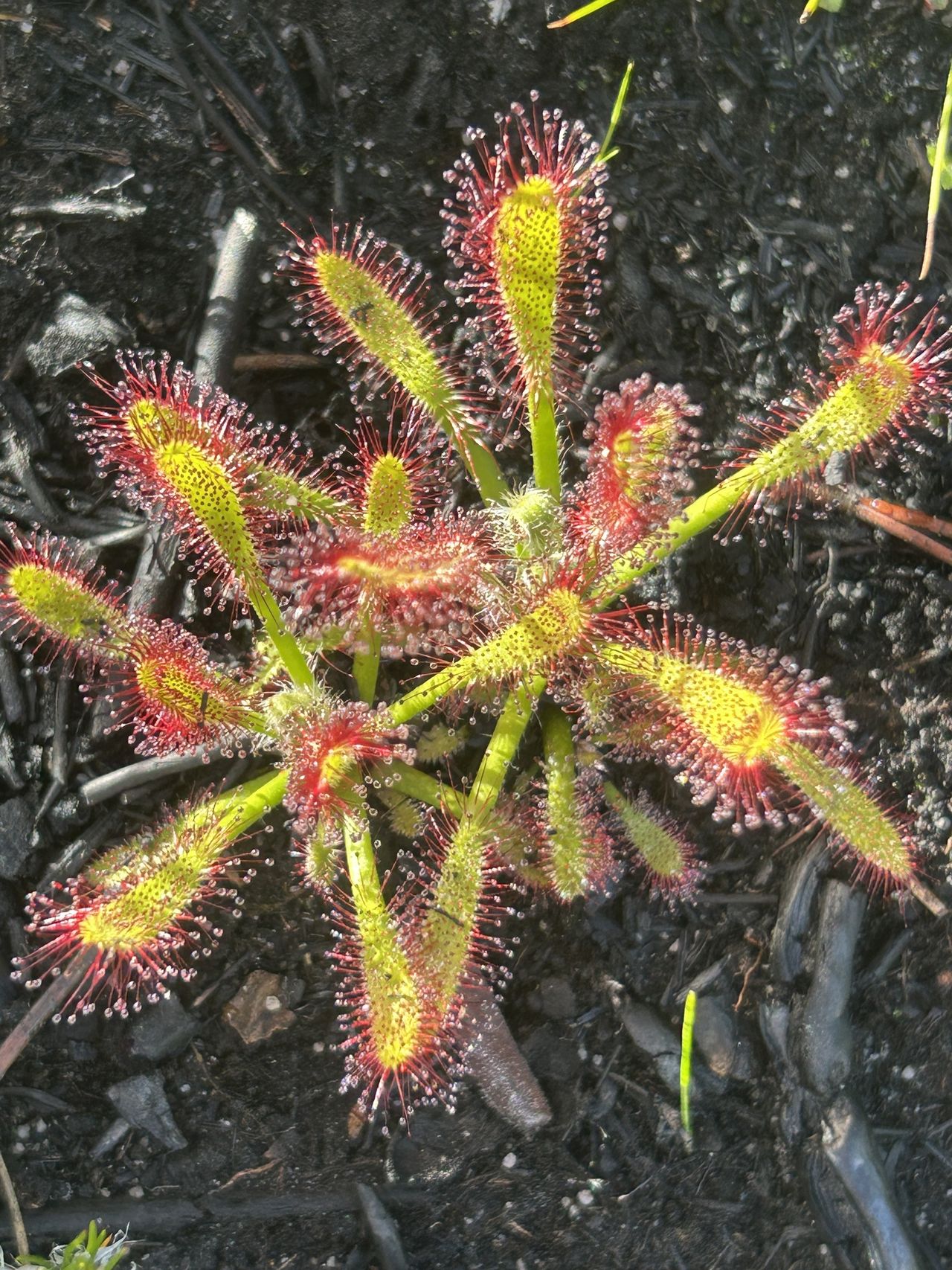
A Cape sundew with a stem and a coat of scales. Drosera ramentacea was published by De Candolle in 1824 from a name by the explorer William Burchell. The epithet refers to the ramenta: thin brown scale-like hairs covering stem and leaf bases and giving the plant a shaggy look.
Identification
Older plants form a short to moderately long ascending stem covered in dead leaf remains and scale-like ramenta, topped by a loose rosette of spatulate leaves with red tentacles. The scape carries pink flowers. Published measurements from a flora were not available for this text; the measurement fields are left empty.
Similar species
Drosera glabripes also forms a stem but lacks the ramenta; its flower stalks are bare. Drosera madagascariensis from tropical Africa has a comparable habit but does not occur in the Cape. Drosera hilaris and D. aliciae remain rosettes without a distinct stem.
The trap and how it works
An active flypaper trap: sticky droplets hold small insects, the tentacles bend towards the prey and the glands digest the soft parts. The stem lifts the traps above the mosses and low herbs of the seep.
Habitat and ecology
Wet seeps, stream banks and waterlogged slopes in mountain fynbos, on nutrient-poor peaty soil over sandstone (R1, W4, B5).
Distribution and elevation
Endemic to the south-western Cape of South Africa. This clearly departs from the label 'tropical Africa' in this guide's working list: the species does not occur in tropical Africa, though its habit is compared with that of the tropical D. madagascariensis. Altitudinal limits were not found.
- Recorded (one-degree cells)
Forms and variation
No varieties are recognised. Drosera glabripes was described in the nineteenth century as a variety of a related stem-forming species before being recognised as distinct; both are now kept apart.
Where and when to see it
Search in the wet months along seep zones on mountain slopes. The shaggy brown stem topped by a red rosette is characteristic.
Conservation status
Not assessed for the global IUCN Red List and not listed in CITES. Local threats are alien trees, drying of seeps and changes in the fire regime.
Scientific name
Drosera ramentacea | Burchell ex de Candolle, 1824
Drosera ramentacea was described on the basis of material collected by the English explorer and botanist William John Burchell, formally published by Augustin Pyramus de Candolle (author citation "Burch. ex DC.") in "Prodromus Systematis Naturalis Regni Vegetabilis", volume 1, page 318, in 1824. The species occurs in the south-western Cape region, particularly on and around the Cape Peninsula, South Africa, in fynbos vegetation. The author citation "Burch. ex DC." indicates that the type material was collected by Burchell during his travels through South Africa (1811–1815); however, the exact collection site, date and herbarium of the type specimen could not be confirmed with certainty. The epithet ramentacea is derived from the Latin ramentum ("scraping, chaff, scale") and means "chaffy" or "covered in scale-like scraps". It refers to the reddish-brown, scale-like hairs or scales on the plant. It is a descriptive name, not a toponym or a person's name (Burchell's appearance in the author citation reflects him being the collector of the type material, not the source of the epithet itself).
World Checklist of Vascular Plants (WCVP), via Plants of the World Online (POWO), Royal Botanic Gardens, Kew.