All species › Caryophyllales › Sundew family › Drosera glabripes
Drosera glabripes
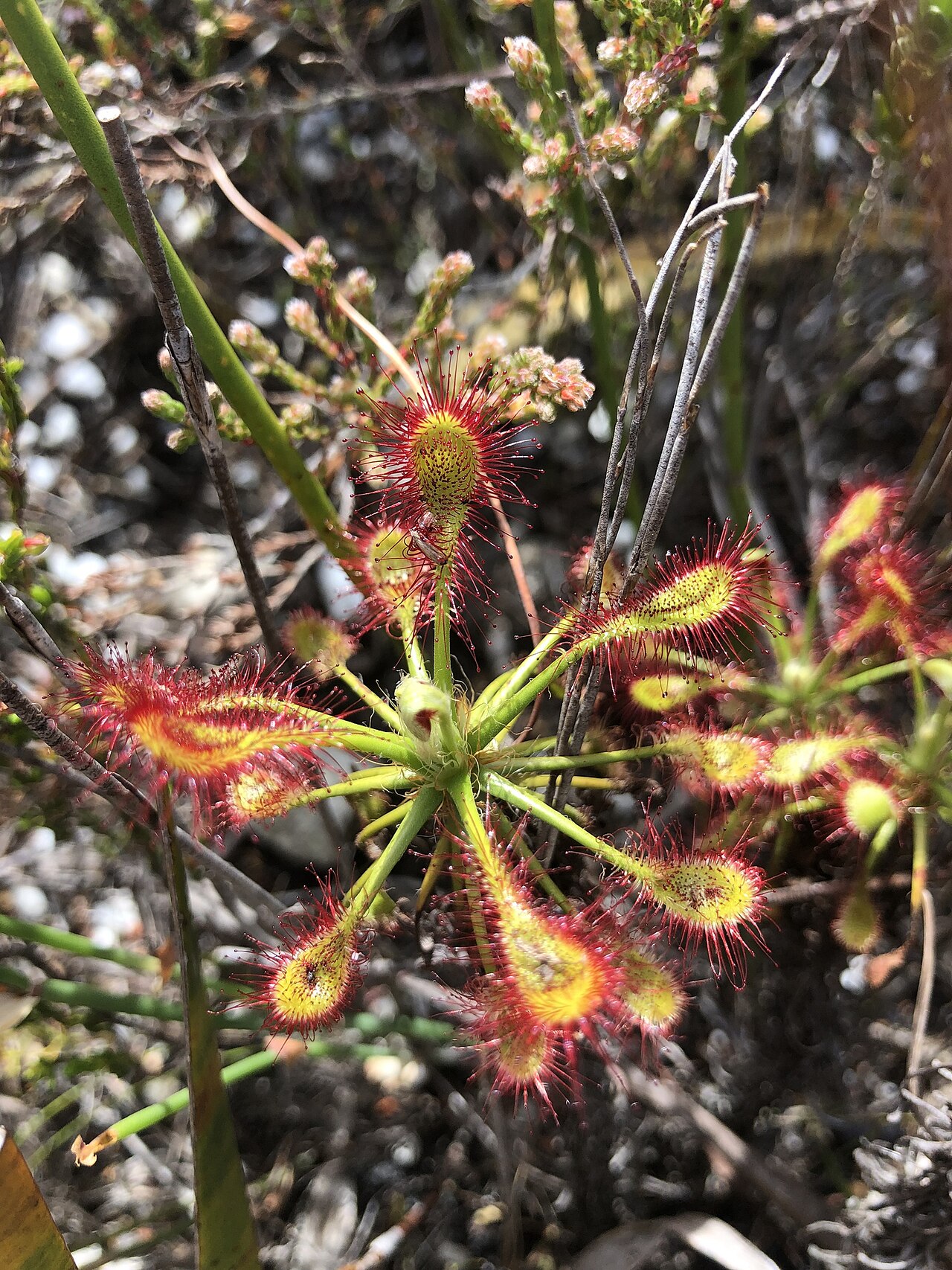
A sundew that does not keep to the rosette form. Over the years Drosera glabripes forms long, thin stems that climb up among or lean through restios and shrublets, with the trapping leaves scattered along the stem. The species was originally described by Harvey and Planchon as an infraspecific taxon and raised to species rank by Stein in 1886.
Identification
Young plants form a small rosette; older plants develop an ascending or leaning, thin stem along which spatulate leaves with red tentacles are set. The name glabripes ('bald foot') refers to the hairless flower stalks. The flowers are pink. Published measurements from a flora were not available for this text; the measurement fields are left empty.
Similar species
Drosera ramentacea also forms a stem but bears scale-like hairs (ramenta) on the stem and leaf bases. Drosera hilaris remains a rosette. Drosera xerophila often grows at the same sites but is a small, flat rosette.
The trap and how it works
An active flypaper trap. Because the leaves are spread along a stem, the plant catches insects at different heights in the fynbos. After capture the tentacles bend towards the prey and the glands secrete digestive enzymes.
Habitat and ecology
Moist to periodically wet places in mountain fynbos, often among restios and low shrubs in which the stems find support, also on the margins of seeps (W4, B5, R1). In the Overberg it has been found with D. xerophila, including on drier sandstone slopes.
Distribution and elevation
Endemic to the south-western Cape of South Africa, in the coastal mountains from the Cape Peninsula to the Overberg. Altitudinal limits were not found.
- Recorded (quarter-degree cells)
Forms and variation
The species has a long history as a variety of a related species before Stein recognised it as distinct in 1886. In Kew's current lists it is accepted. No varieties are recognised.
Where and when to see it
In mountain fynbos do not look only at the ground: the stems of this species can reach well into the vegetation, the red trapping leaves then hanging among the restios. Best in the wet months.
Conservation status
Not assessed for the global IUCN Red List and not listed in CITES. Threats are the usual ones for mountain fynbos: alien trees, changes in the fire regime and drying out.
Scientific name
Drosera glabripes | (Harvey ex Planchon) Stein, 1886
Originally described as Drosera ramentacea var. glabripes by William Henry Harvey, validly published by Planchon in 1848, in Annales des Sciences Naturelles, Botanique, series 3, volume 9 — the same publication as D. fulva, earlier in this golf. Raised to species rank by Stein in 1886, in Gartenflora, volume 35, p. 657. The precise type locality could not be established. The species occurs in South Africa (Cape region). From the Latin glaber ("hairless, smooth") and pes ("foot, stalk") — "with smooth petioles", probably distinguishing it from related species with hairy petioles.
World Checklist of Vascular Plants (WCVP), via Plants of the World Online (POWO), Royal Botanic Gardens, Kew.