All species › Caryophyllales › Sundew family › Drosera peltata
Drosera peltata
The shield sundew is the starting point of one of the knottiest naming problems in the genus. For two centuries Drosera peltata stood for an extremely variable tuberous sundew said to range from India and Japan to Tasmania. Since the revisions by Gibson, Conn and colleagues (2010–2014) and De Salas (2018) that broad species has been split into seven, and the name D. peltata in the strict sense remains for a slender, reddish plant of the wet ground of south-eastern Australia.
Identification
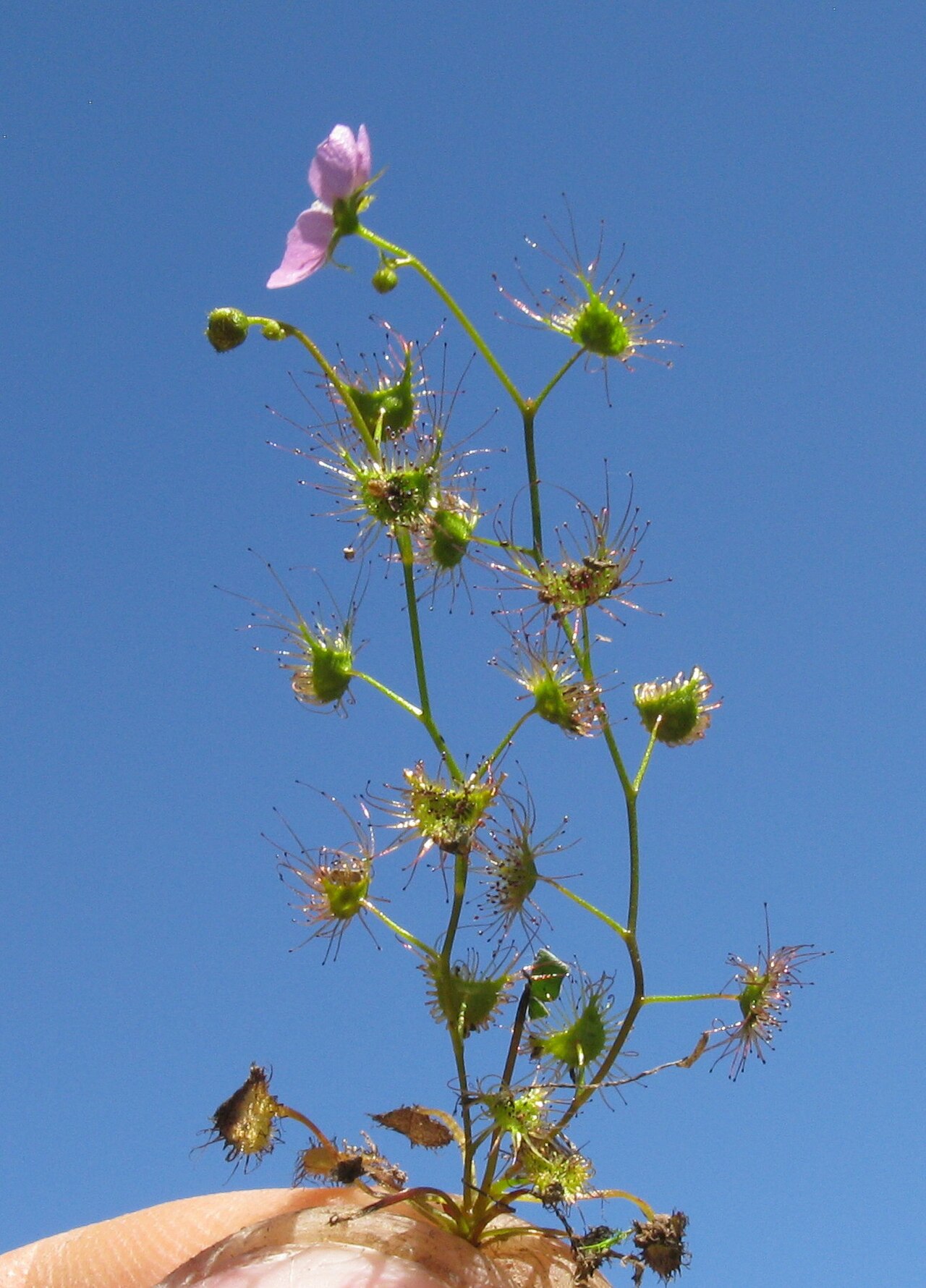
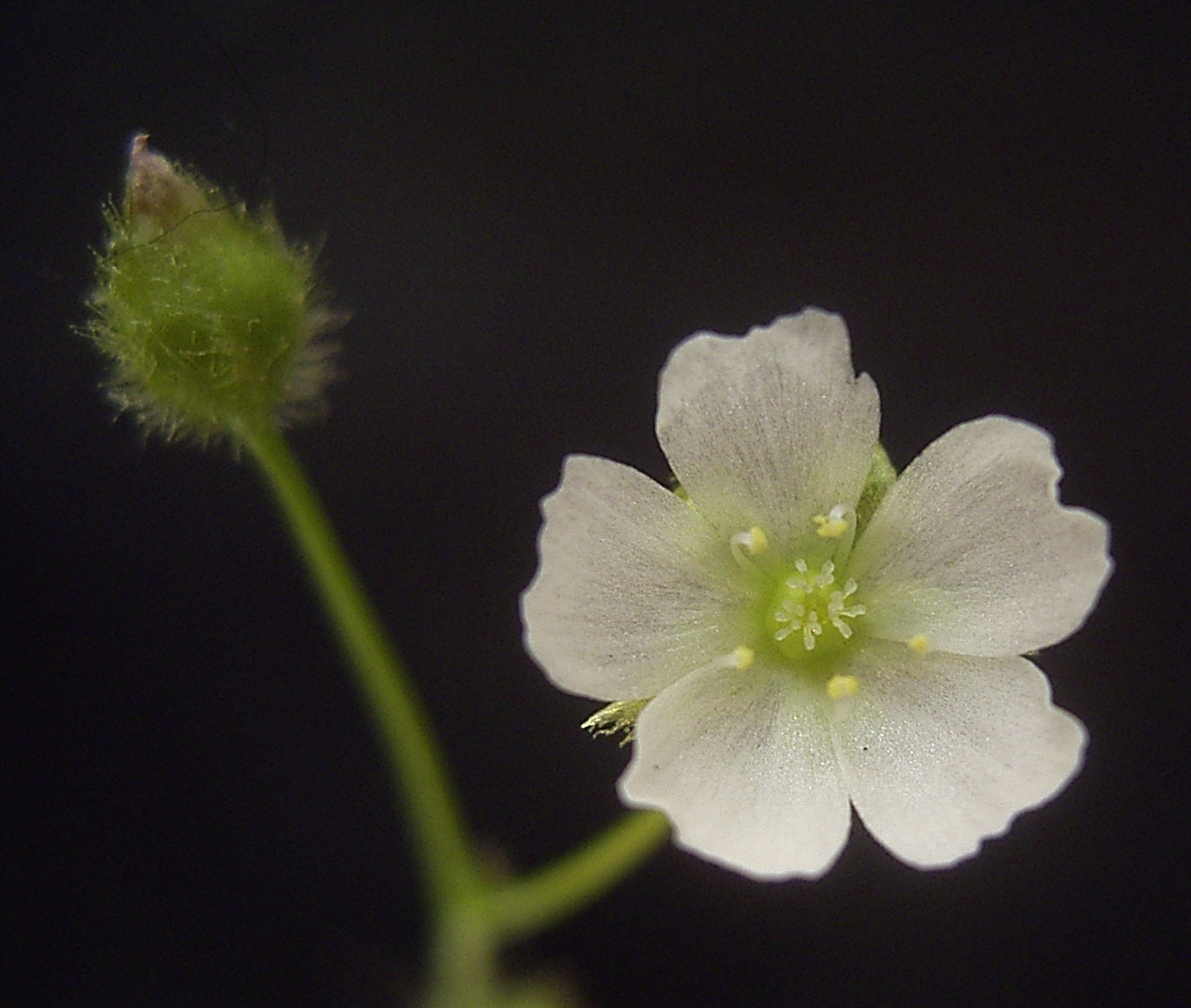
From a small pink to red tuber at most 6 mm across, the growing season first brings a rosette of 4 to 11 small, non-peltate leaves, then an erect, usually unbranched and often red-flushed stem 7 to 47 cm tall. Along the stem, on long stalks, stand the actual trapping leaves: small crescent-shaped blades 1 to 4.5 mm long, peltately attached, with longer marginal tentacles on both 'horns'. In D. peltata in the strict sense the stem is thin and often sparsely leafy. The white, sometimes pink flowers form a terminal raceme; the petals are 2.5 to 5 mm long, the sepals densely hairy with a fringed margin. Each of the three styles is divided into some 15 to 25 segments.
Similar species
The confusion lies entirely within the complex. Drosera auriculata has completely glabrous sepals and long cylindrical seeds; D. hookeri is smaller, bright yellow-green, often branched from the base, with white tubers and only sparsely hairy sepals; D. gunniana is stouter and leafier, with longer sepal hairs (over 0.8 mm) and larger petals 5 to 8 mm long that dry pink; D. gracilis has glandular sepal hairs and seeds with a beak-like tip. Reliable identification therefore needs a hand lens on the calyx and preferably ripe seed.
The trap and how it works
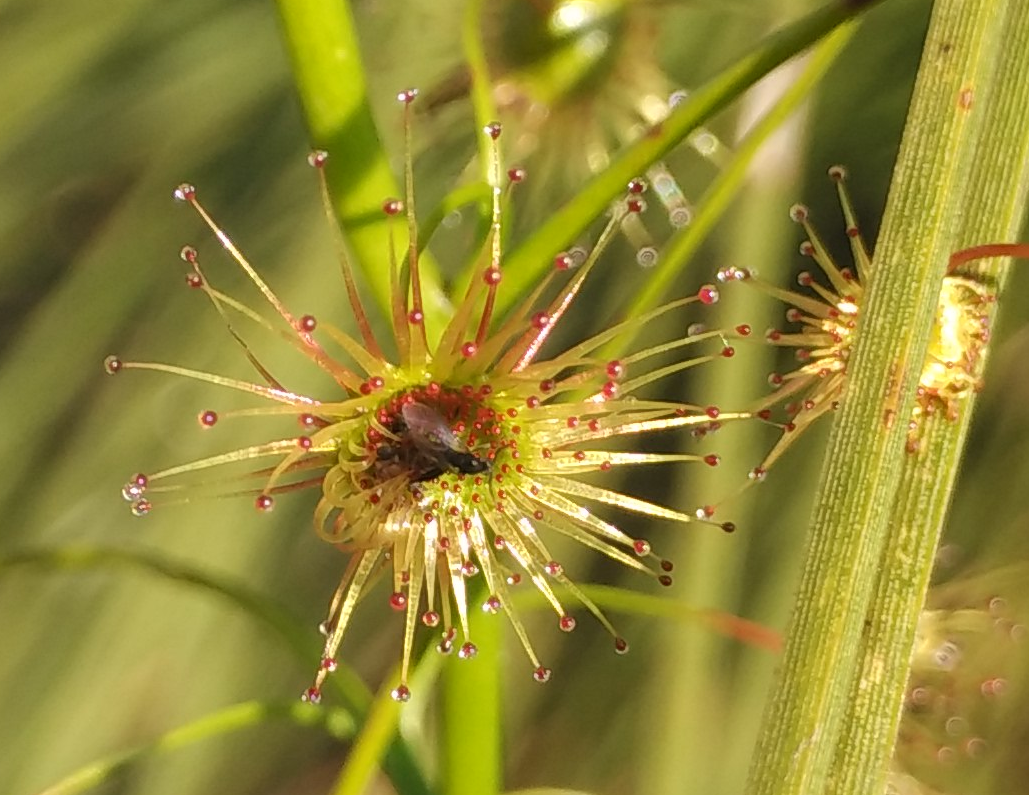
An active flypaper trap on a striking support. Each peltate leaf is a miniature trap: the marginal tentacles, especially those on the two points of the crescent, are long and bend quickly towards a stuck insect, after which the shorter central tentacles take over digestion. Because the leaves stand at different heights up the stem, the plant catches flying insects up to half a metre above the ground. In some forms the stem leans its sticky leaves against surrounding vegetation.
Habitat and ecology
Coastal and tableland wetlands, always on wet, often peaty ground (W4): swamp margins, wet grassland and seasonal swamps that flood in winter and dry out in summer (W7). Wet road verges and ditches are also colonised (H2). The species survives the dry summer as a tuber in the soil and sprouts again when the autumn and winter rains arrive; at higher, colder sites the dormant period may fall in winter. It ranges from sea level to at least 1600 m.
Distribution and elevation
In the strict sense: south-eastern Australia — New South Wales, the Australian Capital Territory, Victoria, South Australia and Tasmania — with records also from alpine New Guinea. In the old, broad sense (as still in many databases and in the range description 'from India to Australia') the name also covers the plants of southern and eastern Asia, New Zealand and south-western Australia; under the revision the Asian plants belong to D. lunata and the New Zealand ones to D. auriculata and D. gunniana.
- Recorded (quarter-degree cells)
Forms and variation
The complex has been split into D. peltata, D. auriculata, D. hookeri, D. gunniana, D. gracilis, D. yilgarnensis (south-western Australia) and D. lunata (Asia). The main characters are the density and type of hairs on the sepals, seed shape and size, tuber colour and the number of style segments. Not every database has adopted this arrangement yet, and older literature and herbarium labels almost always use D. peltata in the broad sense. Anyone comparing records must therefore check which species concept is meant.
Where and when to see it
Search in the Australian spring in wet, sunny hollows: swamp margins, wet meadows and ditches on heath. The upright stems with their glistening shields stand out well among low grass, especially with low sun from the side. Take a hand lens and look at the calyx of a flower or bud: dense, short hairs point to D. peltata in the strict sense, a glabrous calyx to D. auriculata. Never dig up tubers; the plant survives only thanks to them.
Conservation status
On the IUCN Red List the species is Least Concern (LC); that assessment refers to the broad concept with a very large range. It is not listed in CITES. No separate global assessment is known for D. peltata in the strict sense; it is widespread in south-eastern Australia, although coastal wetlands have shrunk greatly through drainage and building. The taxonomic split means the status of the individual species deserves fresh attention.
Scientific name
Drosera peltata | Thunberg, 1797
Drosera peltata was described in 1797 by the Swedish botanist Carl Peter Thunberg, published in his dissertation (Dissert. volume 2, page 295); in the same year James Edward Smith also published a name under the same combination, so two independent 1797 publications exist side by side. The precise type locality, collector and collection date of the type material could not be established with certainty (partly due to the double 1797 publication); the species occurs naturally in Australia, New Zealand and parts of Southeast Asia. The epithet peltata is descriptive Latin for "shield-shaped", referring to the shape of this species' stem (cauline) leaves.
World Checklist of Vascular Plants (WCVP), via Plants of the World Online (POWO), Royal Botanic Gardens, Kew.