All species › Caryophyllales › Sundew family › Drosera linearis
Drosera linearis
The only North American sundew at home in lime-rich water. Drosera linearis is a plant of the base-rich spring fens around the Great Lakes and scattered through Canada, where groundwater full of dissolved lime comes to the surface and sometimes even deposits a white layer of marl. It is an inconspicuous, narrow-leaved sundew — but an evolutionary key species: together with D. rotundifolia it is the ancestor of D. anglica, which arose from their hybrid by doubling of the chromosome number.
Identification
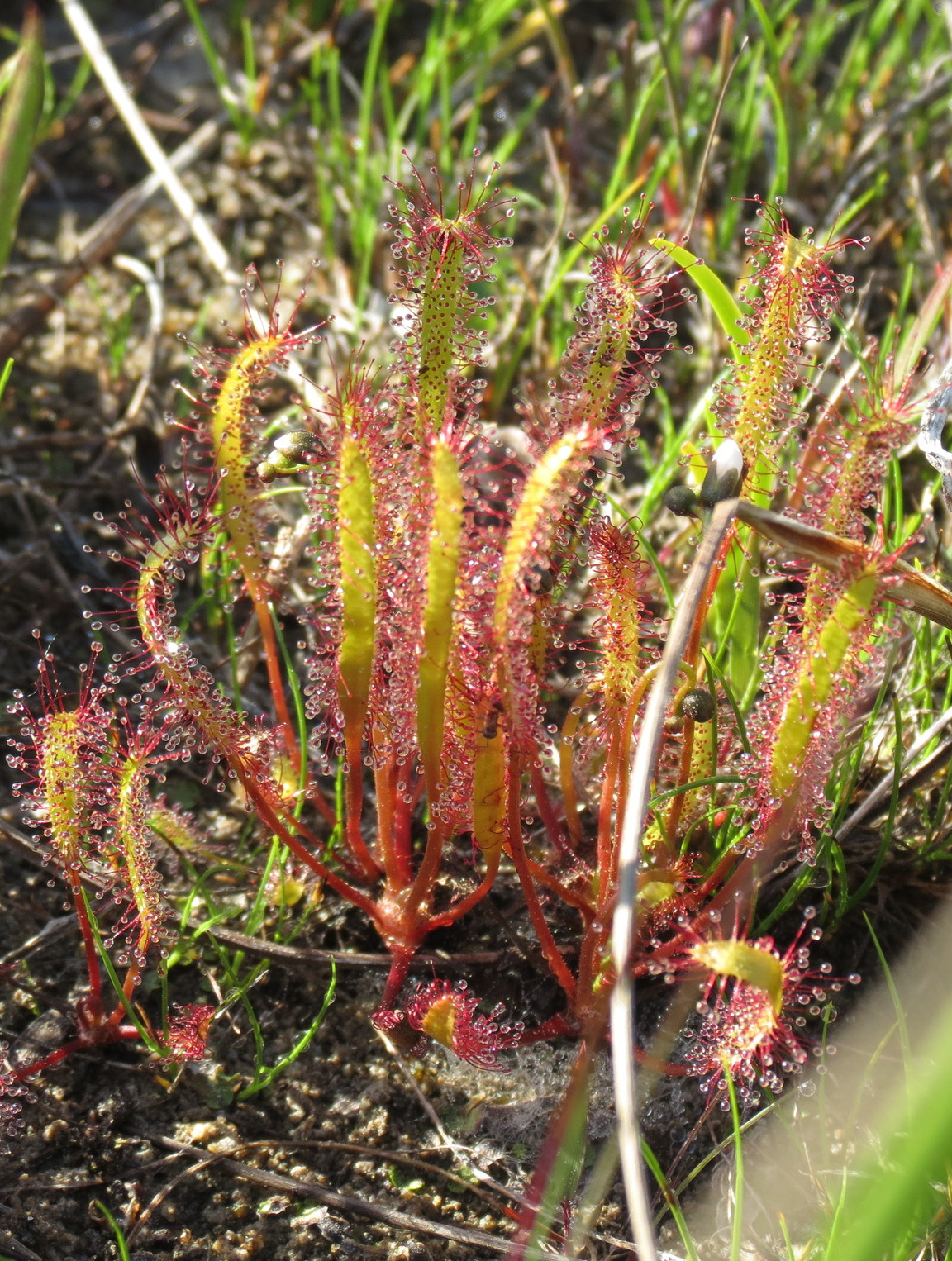
A perennial rosette of obliquely to fully upright leaves. Each leaf has a glabrous petiole and a linear blade 1 to 6 cm long and only 1.5 to 3 mm wide, with parallel margins and a blunt tip; the tentacles sit on the upper surface and along the margin. The scape is glabrous, 6 to 13 cm tall, and carries one to four white flowers 6 to 8 mm across with obovate petals. The seeds are black and 0.5 to 0.8 mm long. The chromosome number is 2n = 20. The plant overwinters as a hibernaculum.
Similar species
Drosera anglica, which often grows at the same sites, is the closest look-alike: its blade is elongate-spatulate, widening towards the tip, whereas in D. linearis it stays equally wide along its whole length. The two sometimes produce a sterile hybrid with intermediate forms. D. rotundifolia has a round blade and cannot be confused; D. intermedia has a short spatulate blade on a long petiole and a scape that leaves from the side.
The trap and how it works
An active flypaper trap. The tentacles along the narrow blade each carry a sticky droplet; a small insect that lands in it is held, and the tentacles bend towards the prey. A long, narrow leaf can curve round its prey but not close as completely as a round blade. The catch is mainly small midges and flies of the fen. As in all sundews, enzymes from the glands do the digesting and the released nitrogen and phosphorus are absorbed by the leaf.
Habitat and ecology
Lime-rich, permanently wet spring fens and marl flats where base-rich groundwater reaches the surface (W5), and open, wet parts of other mires fed by mineral-rich water from the surroundings (W4). The ground is poor in nitrogen and phosphorus but rich in lime — a rare combination. The plant grows in open, low vegetation of sedges and brown mosses, often on marl or in shallow, clear pools. It tolerates neither shade nor enrichment.
Distribution and elevation
North America: the Great Lakes region (Michigan, Wisconsin, Minnesota, Ontario), Maine, Quebec, New Brunswick and Newfoundland, and scattered west through Manitoba, Saskatchewan and Alberta to British Columbia, the Northwest Territories and Montana. Over most of that range it is rare and only locally common. It does not occur outside North America. No published altitudinal range was found; the elevation field is left empty.
- Recorded (quarter-degree cells)
Forms and variation
No varieties or forms are recognised. What matters is the species' role as a parent: the hybrid D. linearis × D. rotundifolia is sterile, but its chromosome-doubled form has grown into an independent, circumboreal species as D. anglica. D. linearis also forms sterile hybrids with D. anglica. In this guide these belong with the parents.
Where and when to see it
July and early August are the best time. Search open lime fens, preferably where groundwater visibly wells up or where a white marl layer covers the ground; the plant grows low among the sedges. Close-focusing binoculars help to tell the narrow leaves from those of D. anglica without having to step into the fen. Many of these fens are protected and extremely fragile; keep to paths and boardwalks.
Conservation status
On the global IUCN Red List the species is listed as Least Concern (LC); it is not in CITES. Locally it is rare and protected, for example in Minnesota, where it is listed as threatened. Lime fens are vulnerable to drainage, changes in groundwater flow through excavation and development, and enrichment with fertilisers; because the species is so tied to this particular habitat, it disappears quickly where the seepage stops.
Scientific name
Drosera linearis | Goldie, 1822
Described by Goldie, published in Edinburgh Philosophical Journal (1822), p. 325. The precise type locality could not be established. The species occurs in bogs of the Great Lakes region and eastern Canada, North America. From the Latin linearis ("linear") — refers to the narrow, linear leaves (1-6 cm long, 1.5-3 mm wide).
World Checklist of Vascular Plants (WCVP), via Plants of the World Online (POWO), Royal Botanic Gardens, Kew.