All species › Caryophyllales › Sundew family › Drosera huegelii
Drosera huegelii
One of the more robust erect tuberous sundews of south-west Australia, known locally as Bold Sundew. Stephan Endlicher described Drosera huegelii in 1837 in his Enumeratio plantarum, a treatment of the plants the Austrian traveller Carl von Hügel had collected shortly before around the Swan River; the epithet honours Hügel. It is thus one of the first sundews known from Western Australia.
Identification
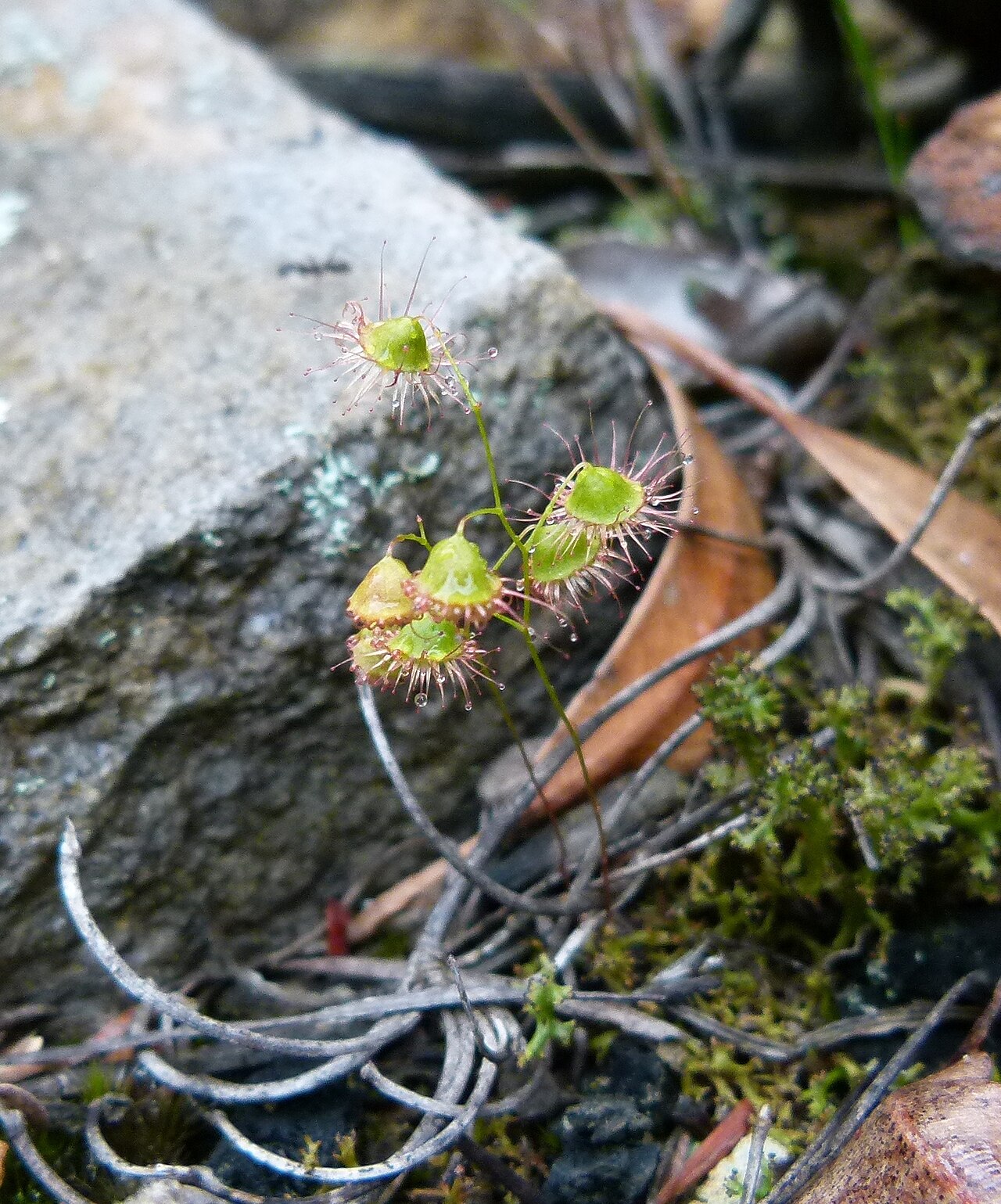
A perennial that shoots each year from an underground tuber with a sturdy, straight stem 10 to 50 cm tall. Along the stem sit small, bell-shaped trapping leaves on short stalks pointing obliquely outwards, each with a ring of glistening tentacles. From June to September white to cream flowers open at the top. The combination of a robust unbranched stem, bell-shaped leaves and pale flowers, in a wet hollow in the middle of winter, makes the species easy to recognise in the field. We did not find precise leaf and flower measurements in any source consulted.
Similar species
Other erect tuberous sundews can look similar. Drosera heterophylla grows in comparable wet hollows but has a many-petalled white flower. D. microphylla has large golden sepals. D. marchantii is smaller and usually has pink flowers. Within the broad group around D. peltata and D. macrantha many species are difficult without flowers; watch the leaf shape and the colour and size of the flower.
The trap and how it works
An active flypaper trap. The cup-shaped leaf blades carry long tentacles with a sticky droplet along the margin. An insect that lands sticks; the tentacles bend inwards and press the prey into the cupped leaf, where digestion takes place. Because the leaves are held along a tall stem, the plant catches mainly flying insects swarming through the low vegetation.
Habitat and ecology
Sandy soils along the margins of swamps and in hollows that are wet in winter (W7, W4, D1). In the wet months the ground there is saturated or under water; in summer everything dries out and the plant retreats into its tuber, which lies deep enough to survive the heat and the frequent bushfires.
Distribution and elevation
Endemic to south-west Australia, along the south-west coast and scattered inland. FloraBase lists the Avon Wheatbelt, Esperance Plains, Jarrah Forest, Mallee, Swan Coastal Plain and Warren bioregions, from around Perth to beyond Esperance.
- Recorded (quarter-degree cells)
Forms and variation
Yves-Alain Utz and Robert Gibson recently described a variety, Drosera huegelii var. phillmanniana, which is listed by Plants of the World Online. We were unable to consult details of how it differs from the typical form. The species belongs to section Ergaleium, the erect and climbing tuberous sundews.
Where and when to see it
July and August are the best months. Search the edges of wet hollows and small swamps on the coastal plain south of Perth or along the south coast, ideally after a few dry days so you can get close without wading. Against the sun the droplets on the bell-shaped leaves light up like little lanterns along the stem.
Conservation status
On the global IUCN Red List the species is listed as Least Concern (LC); in Western Australia it is regarded as not threatened. It is not listed in CITES. The range is large, but on the coastal plain around Perth many wet hollows have disappeared through drainage and housing, and in the Wheatbelt the species is confined to remnants of native vegetation.
Scientific name
Drosera huegelii | Endlicher, 1837
Described by Stephan Endlicher in 1837, in "Enumeratio Plantarum", p. 6. King George Sound, Western Australia, collected by Baron Carl Alexander Anselm von Hügel. The species is endemic to south-western Australia (near Albany and Augusta), on sandy soils along swamp margins and winter-wet depressions. Named in honour of Baron Carl von Hügel, the Austrian botanist and explorer who himself collected the type material at King George Sound during his Australian travels (1833-1834).
World Checklist of Vascular Plants (WCVP), via Plants of the World Online (POWO), Royal Botanic Gardens, Kew.