All species › Caryophyllales › Sundew family › Drosera glanduligera
Drosera glanduligera | Pimpernel sundew
A sundew two to six centimetres across that makes the fastest movement in the whole genus: around the rim of its little leaf stand tentacles that catapult a passing insect onto the blade in seventy-five thousandths of a second. It is also an annual — it germinates after the first rains, lives some four months and is gone again — which among sundews makes it doubly an outsider. Its orange flower is unique in Australia.

Identification
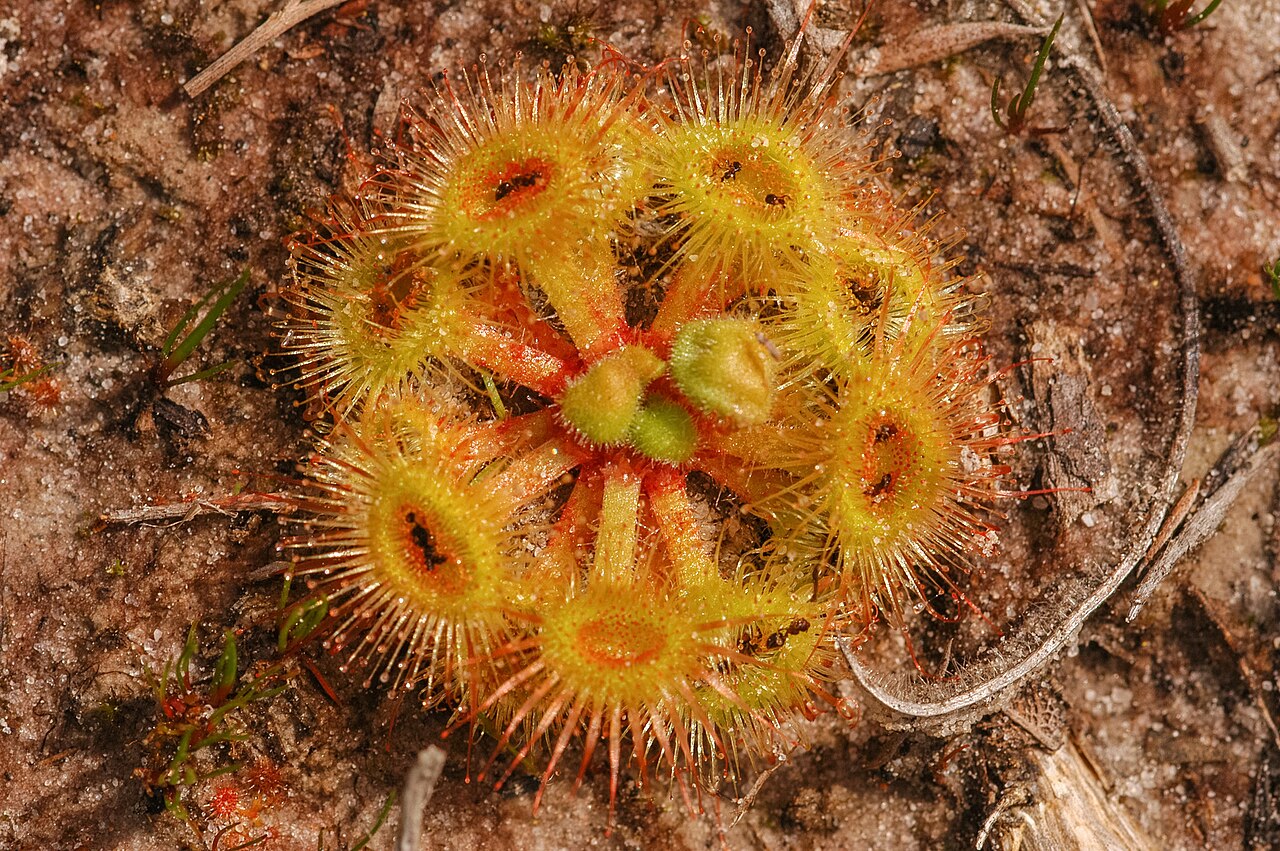
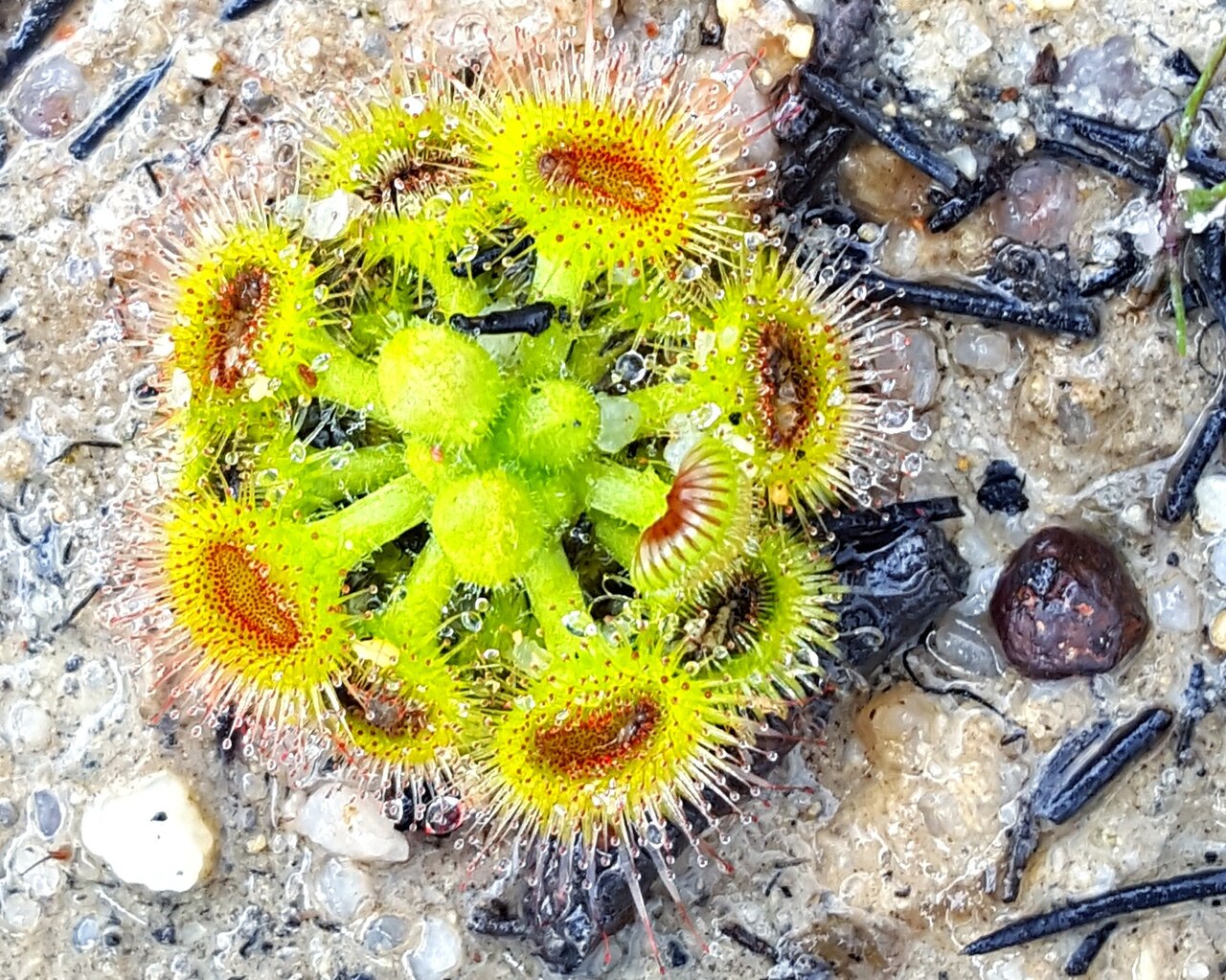
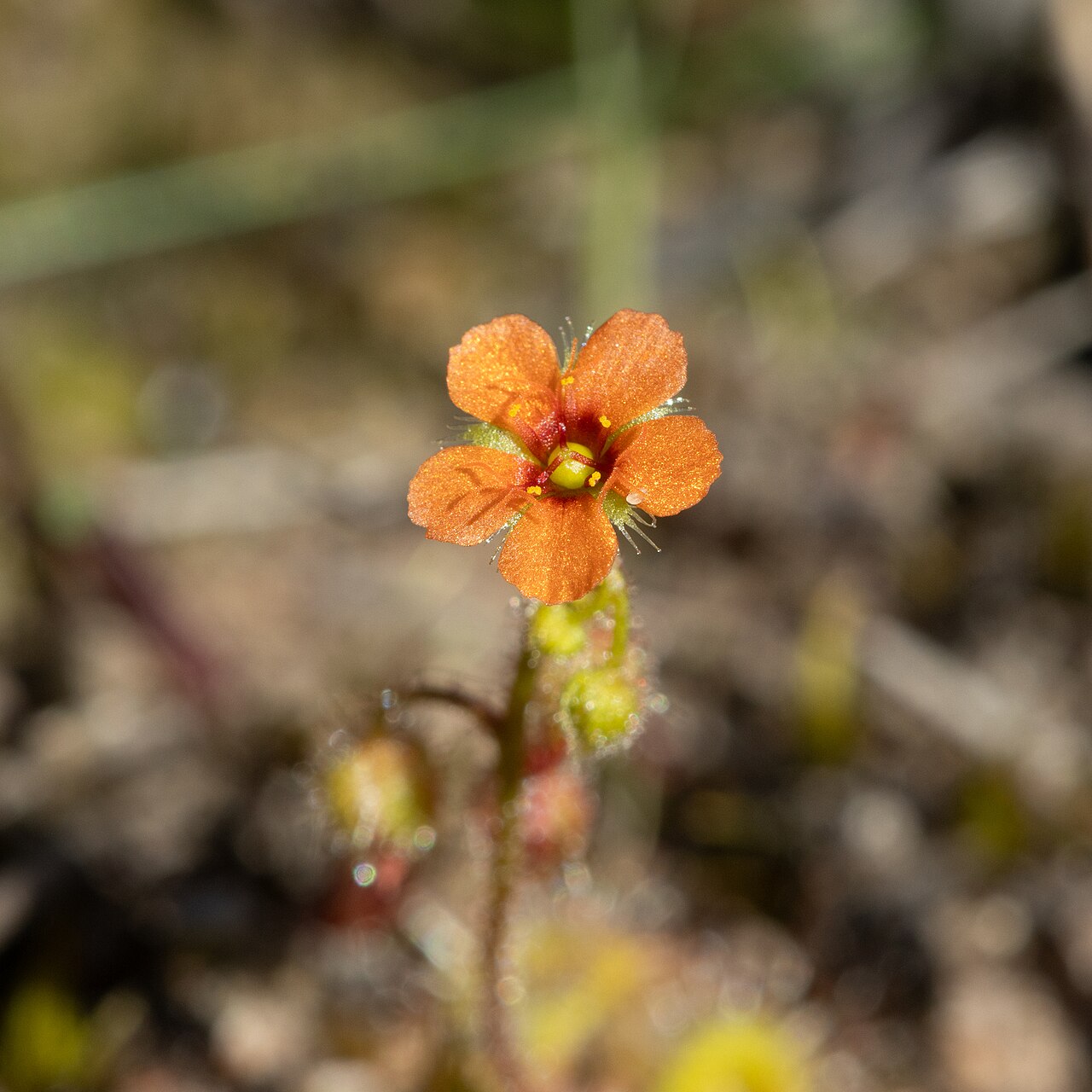
A fibrous-rooted annual 2.5 to 6 cm high forming a flat rosette of small spoon-shaped leaves. Each blade is slightly concave above, like a shallow bowl. That bowl carries two kinds of tentacle, and there lies the character: in the centre the ordinary stalked glandular hairs with a drop of glue, and around the margin twelve to eighteen straight, stiff tentacles about six millimetres long that carry no droplet at all. The flowers stand on a thin stalk above the rosette and are orange — no other Australian sundew has that colour. Flowering runs from August to November; the plant then sets seed and dies.
Similar species
The orange flower settles it: every other sundew in its range flowers white or pink. Look as well at the leaf margin, where the straight, dropless catapult tentacles stick out like a ring of short spines; no other species has that. The small rosette species it shares ground with survive the summer as a tuber or a winter bud, where this plant survives only as seed — outside the growing season there is literally nothing to see. And although it looks like a flypaper trap, in speed it recalls the Venus flytrap (Dionaea muscipula): that one shuts in about a tenth of a second, this one throws a tentacle over in seventy-five thousandths — with the difference that the flytrap's trap opens again, while this tentacle works only once.
The trap and how it works
A flypaper trap with a catapult in front of it. Prey walking along the leaf margin touches the head of one of the marginal tentacles. After a run-up of about four tenths of a second that tentacle snaps inward — the fastest movement measured in any sundew, at best seventy-five thousandths of a second — and flings the animal onto the glue tentacles in the middle of the leaf. There it sticks. Over the following two minutes the glue tentacles bend inward and draw the prey deeper into the concave leaf, where digestion begins. The catapult movement is a one-off: as the tentacle flips, cells in its hinge zone tear, and it does not return. The plant can afford that because it puts out a new leaf every three or four days. The rest of this series moves in minutes to hours; this species does it a thousand times faster and pays a tentacle for it.
Habitat and ecology
Open, sunny ground that is damp in winter and dries out completely in summer: bare patches between low shrubs, open woodland and forest edge, roadsides and disturbed ground. It is anything but choosy about soil and grows on more or less everything, from sand to loam, as long as light reaches the ground. Its whole life hangs on the rain: the seed germinates when the winter rains come, the plant grows on through the cool season, and it is gone before the summer is at its hottest.
Distribution and elevation
Australia only, and there across the southern part of the continent: south-western Western Australia, South Australia, Victoria, New South Wales and Tasmania. It occurs naturally nowhere else and there are no naturalised populations elsewhere. Within that range it can stand locally in thousands in a good rainfall year and be all but absent from the same spot the year after.
- Recorded (quarter-degree cells)
Forms and variation
Little variation, and that suits its way of life: a plant that lives four months and maintains itself by seed alone gets little chance to fix local forms. No varieties or colour forms are recognised. What differs is the size of the rosette and the intensity of the red colouring, and both depend mainly on how much rain fell that season and how much sun the site gets; large and small plants stand side by side in one patch.
Where and when to see it
Only findable in the cool, wet season: August to November, and not a day outside it. Look on open, bare ground in the sun — verges, paths, places where the shrubs do not close over — and get down on your knees, because you will not see a three-centimetre plant standing up. The orange flower is the finder: you will spot it before the rosette. Anyone hoping to see the catapult work needs patience and should watch without touching; every tentacle you fire off with a grass stem is one tentacle less for that plant.
Conservation status
Least Concern on the world list, and with this species that is easy to follow: it occurs across the whole south of Australia, is not fussy about soil and stands locally in large numbers. Those numbers do swing sharply from year to year, as they do in annuals — a dry season can reduce a population at a stroke to a seed bank in the soil, which makes counts hard to read. The real threat is the loss of open, seasonally damp ground to agriculture and to urban growth. Collecting plays no part: from an annual there is nothing to take but seed.
Scientific name
Drosera glanduligera | Lehmann, 1844
Described by Johann Georg Christian Lehmann in April 1844, in "Novarum et Minus Cognitarum Stirpium Pugillus", volume 8, p. 37, Hamburg. The precise type locality could not be established. From the Latin glandula ("small gland") and -ger/-gera ("bearing") — "gland-bearing", consistent with the glandular trapping tentacles of this species, also known as the "snap sundew" for its rapid trapping motion.
World Checklist of Vascular Plants (WCVP), via Plants of the World Online (POWO), Royal Botanic Gardens, Kew.