All species › Caryophyllales › Sundew family › Drosera fulva
Drosera fulva
Drosera fulva is a sundew with a long naming history. Planchon described it as early as 1848, from specimens John Armstrong collected for Kew at Port Essington in the Northern Territory between 1838 and 1840. Almost all later authors, however, treated the name as a synonym of D. petiolaris, until Allen Lowrie recognised it again as a separate species in the 1990s. The name, Latin for 'tawny' or 'reddish-brown', refers to the colour of its hairs.
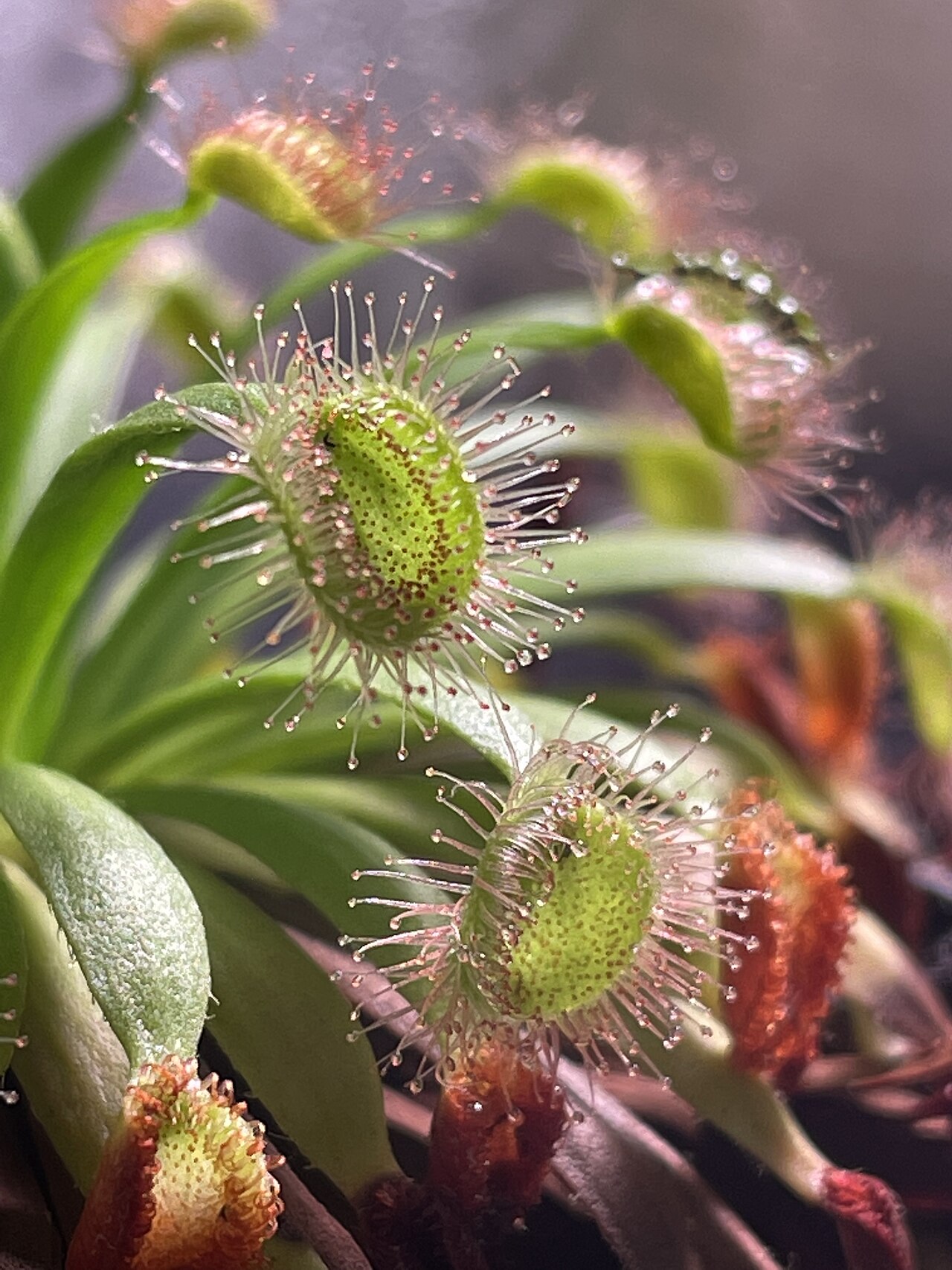
Identification
A compact perennial basal rosette of the D. petiolaris complex, with long petioles and small red trapping blades about 2 to 3 mm across. Parts of the plant carry reddish-brown to tawny hairs. The inflorescences are tall, 25 to 45 cm, with racemes of fifty or more white, sometimes pink, flowers. The species produces different types of rosette leaves over the season, one of the characters by which Lowrie separated it from its relatives.
Similar species
Its closest relatives are Drosera brevicornis and D. dilatatopetiolaris. D. fulva differs from both in inflorescence height, rosette leaf types and fruit characters. D. dilatatopetiolaris is the easiest to tell apart by its broad green petioles; D. darwinensis, which occurs in the same area around Darwin, has much shorter inflorescences of 5 to 15 cm. D. petiolaris lacks the reddish-brown hairs.
The trap and how it works
An active flypaper trap. The small red blades at the ends of the stalks carry glandular tentacles with sticky mucilage in which small insects are caught; the tentacles then bend towards the prey and the glands digest it. Trapping falls mainly in the wet season, when the rosettes are actively growing.
Habitat and ecology
Damp sandy soil in ephemeral wet depressions above seasonal flood levels, and in seepage areas (W7), in open savanna woodland (B6). In the dry season the plant survives as a small bud of smaller leaves.
Distribution and elevation
Endemic to the Northern Territory. Current known sites lie around Darwin, between Koolpinyah and Noonamah; in addition there is the historical collection from Port Essington on the Cobourg Peninsula. The range description 'northern Australia (Northern Territory)' fits, although the actual range is small. Altitudinal limits are not published in the sources consulted; the elevation field is left empty.
- Recorded (quarter-degree cells)
Forms and variation
No varieties are recognised. The century and a half of confusion with D. petiolaris means that older records under that name from around Darwin may partly refer to D. fulva. With D. brevicornis and D. dilatatopetiolaris it forms a small group of closely related species within the complex.
Where and when to see it
Search from February to May, when the tall flowering stems appear, in temporarily wet sandy hollows and seepages in the savanna between Darwin and Noonamah. The rosettes are small, but the long white racemes can be seen from afar. Many sites lie on or next to private land; ask permission and keep to paths.
Conservation status
On the IUCN Red List the species is Least Concern (LC); it is not listed in CITES. Lowrie assessed it in 1996 as common and not threatened. Its known range, however, is small and lies in the fastest-growing region of the Northern Territory, where urban growth, agriculture, changes in fire regime and invasive grasses are real local threats.
Scientific name
Drosera fulva | Planchon, 1848
Described by Jules Émile Planchon in 1848, in Annales des Sciences Naturelles, Botanique, series 3, volume 9, p. 289 — the same publication in which Planchon also described D. ramentacea var. glabripes (basionym of D. glabripes, later in this golf). Port Essington, Northern Territory, Australia — material collected between 1838 and 1840 by botanist John W. Armstrong. From the Latin fulvus ("tawny, reddish-gold") — probably refers to the colour of the plant or leaves.
World Checklist of Vascular Plants (WCVP), via Plants of the World Online (POWO), Royal Botanic Gardens, Kew.