All species › Caryophyllales › Sundew family › Drosera fimbriata
Drosera fimbriata
The Manypeaks sundew is the only tuberous sundew with fringed, non-carnivorous leaves at the base of the stem. Larry DeBuhr described Drosera fimbriata in 1975, and two years later made it one of the founding species of section Stolonifera, the tuberous sundews with fan-shaped leaves. The name means 'fringed' and refers to those unusual lower leaf whorls.
Identification
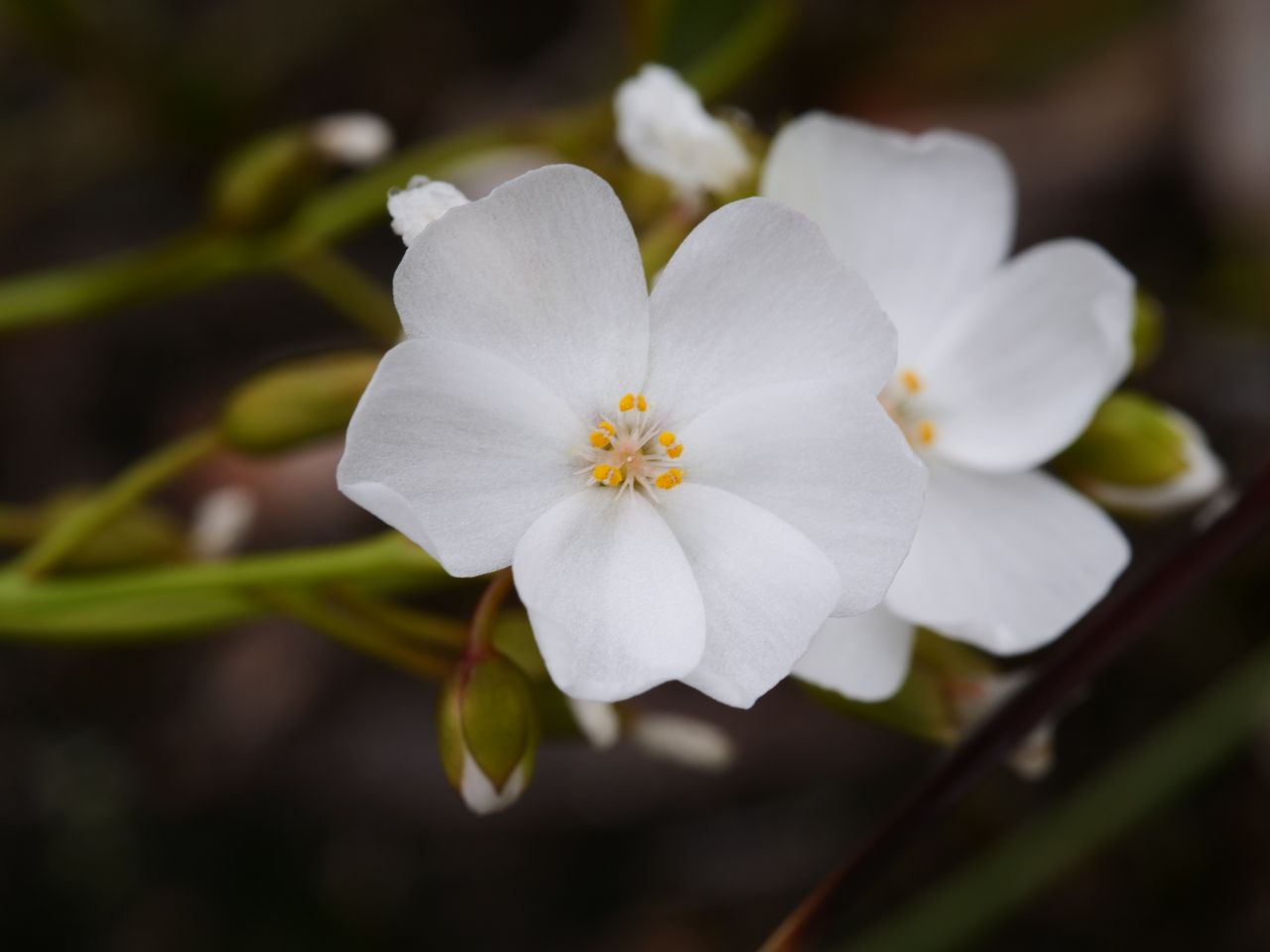
A perennial tuberous plant with an orange, ellipsoid tuber about 10 by 7 mm, enclosed in brown papery scales, and a vertical underground stolon about 10 cm long. From it grows a single, erect, glabrous stem 10 to 15 cm tall. At the base are two or three whorls of narrow, non-carnivorous leaves 4 to 6 mm long with fringes up to 3 mm long along the margin. Above them follow two to five whorls of trapping leaves, becoming solitary towards the top. The trapping leaves are fully peltate: a terete petiole 5 to 18 mm long carries a broadly reniform blade 2.5 to 4 mm across. The terminal raceme, 3.5 to 6.5 cm long, bears 4 to 18 white flowers with petals 8 to 10 by 5 to 8 mm.
Similar species
Within section Stolonifera the species resembles Drosera platypoda, Drosera porrecta and Drosera stolonifera in tuber and inflorescence. The fringed, non-carnivorous basal leaves and fully peltate trapping leaves occur in none of those relatives and make D. fimbriata easy to recognise with a hand lens.
The trap and how it works
An active flypaper trap. The small, peltate blades in whorls along the stem carry tentacles with droplets of glue and together form a layered net 5 to 15 cm above the ground. Flies and gnats moving through the heath become entangled; the tentacles bend over the prey and secrete enzymes. The lower, fringed leaves do not catch.
Habitat and ecology
Winter-wet but well-drained white or grey sand among low shrubs in the heath east of Manypeaks and in the Scott River district (B5, D1). Near Denmark it grows in moss mats with Borya, the cushions typical of granite rocks (R3). It survives the dry summer as a tuber.
Distribution and elevation
Endemic to the south-west of Western Australia along the south coast: known from a few sites from the Scott River east to near Denmark, but mainly from around Manypeaks, east of Albany. FloraBase lists the Esperance Plains, Jarrah Forest, Swan Coastal Plain and Warren bioregions.
Forms and variation
No subspecies or varieties have been described. Within section Stolonifera the species is taxonomically isolated by its fringed basal leaves. Lowrie counts ten species in the section, all endemic to the south-west.
Where and when to see it
Visit the heath around Manypeaks or William Bay National Park near Denmark in September or October. Search among low shrubs on white sand, or on moss mats by granite rocks. Kneel by any plant you find and look at the base of the stem: the fringed leaves are the ultimate feature. Do not step on moss mats on granite; they barely recover.
Conservation status
Not assessed for the IUCN Red List (NE) and not in CITES. In Western Australia the species is listed as Priority Four, the category for rare species requiring monitoring. According to Lowrie it is abundant around Manypeaks and secure in William Bay National Park, but populations near the Scott River are at risk of disappearing through sand mining.
Scientific name
Drosera fimbriata | De Buhr, 1975
Described by Larry Eugene DeBuhr in 1975, in Aliso, volume 8, no. 3, p. 267. The precise type locality could not be established. The species occurs mainly around Manypeaks, with populations near Scott River and Denmark, south-western Western Australia. From the Latin fimbria ("fringe, border") — "fringed", consistent with the English common name "Manypeaks sundew" and probably referring to fringed stipules or leaf structures.
World Checklist of Vascular Plants (WCVP), via Plants of the World Online (POWO), Royal Botanic Gardens, Kew.