All species › Caryophyllales › Sundew family › Drosera falconeri
Drosera falconeri
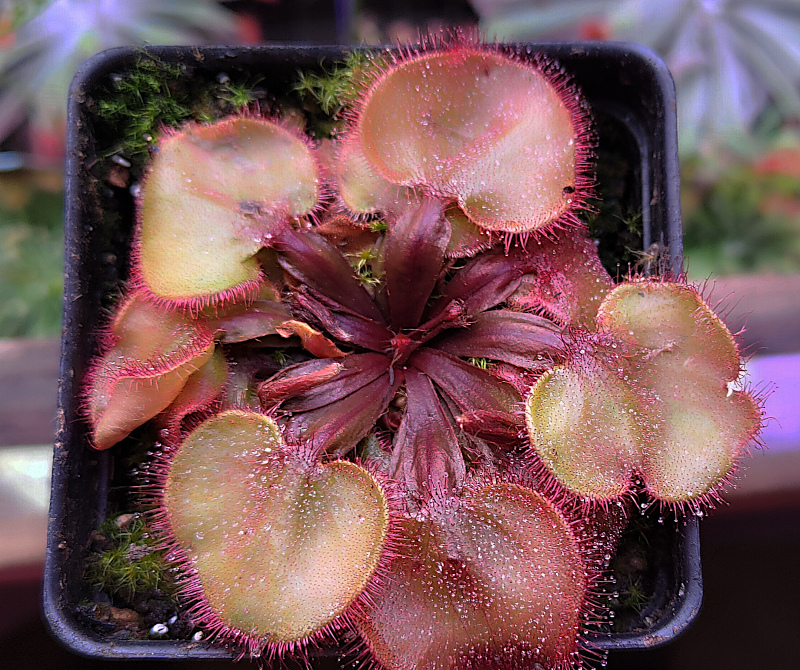
The sundew that looks like a Venus flytrap. Drosera falconeri has unusually large, flat, kidney-shaped blades on broad petioles for a sundew, and botanists have cited it as an example of what a flypaper trap can look like before evolution turns it into a snap trap. The species was found in 1980 by a Mr Falconer along the Finniss River in the Northern Territory, and formally described in 1984 by the Japanese botanist Katsuhiko Kondo. Note that it is a Northern Territory species, not one of the Kimberley and certainly not of the south-west.

Identification
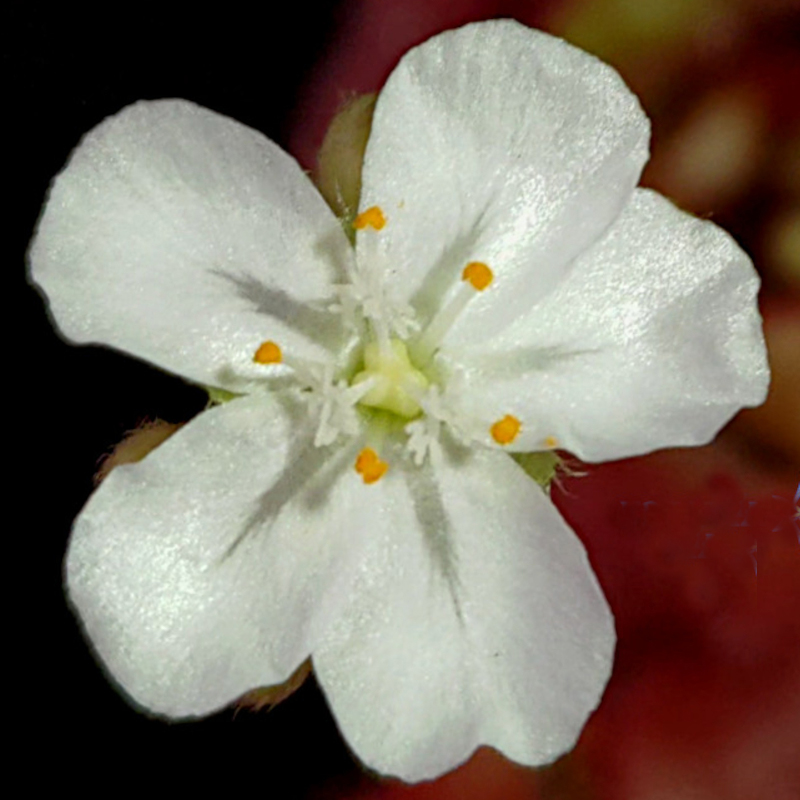
A perennial tropical sundew with a flat rosette whose leaves lie against the ground. Mature blades are reniform, about 1.5 cm long and 2 cm wide, up to 3 cm wide in old plants; within the subgenus they are exceptionally large. The petiole is oblanceolate, about 10 mm long, glabrous above and with white hairs along the margins and beneath. The underside of the blade is clearly veined and sparsely hairy. One or two racemes, usually 8 cm long, each carry about twelve flowers on pedicels 3 to 5 mm long. The petals are white or pink, about 7 by 4 mm; the stamens are white with orange anthers, and the three white styles are much branched. In the wild the leaves turn deep red.
Similar species
Within subgenus Lasiocephala, the 'woolly sundews' of northern Australia, most species have small blades on long, narrow, often densely hairy petioles, such as Drosera petiolaris and Drosera dilatatopetiolaris. The large, flat, reniform blades and broad, short petioles make D. falconeri unmistakable. Natural hybrids with D. dilatatopetiolaris and D. petiolaris are known and intermediate; they are recognised by smaller blades and longer petioles.
The trap and how it works
An active flypaper trap. Stalked tentacles secreting mucilage line the margin of the blade, with shorter glands in the centre. An insect landing on the leaf sticks and is enclosed by the tentacles. Because the broad blade offers a large surface, the plant can handle larger prey than its relatives, and precisely that problem, that large prey can tear free, is regarded as the evolutionary pressure that elsewhere led to the snap trap of the Venus flytrap.
Habitat and ecology
Seasonally wet ground in the monsoon belt (W7, B6). At the original site along the Finniss River the species grew on calcareous, alkaline sand (measured pH 8) under tall, dense grass; elsewhere on grey silty clay. That is unusual: most carnivorous plants avoid lime. In the dry season the leaves die back and the plant survives as a bulb-like structure of tightly packed leaf bases just below the soil surface, insulated by the hard clay. White, fleshy roots serve as water stores. The first rains of the wet season break dormancy.
Distribution and elevation
Endemic to the Northern Territory, in the northern coastal region: around the Finniss River, Palmerston and Berry Springs south of Darwin, and Melville Island. Within this area it is described as not uncommon. The label 'Kimberley, Western Australia' in the base list is incorrect: as far as known the species does not occur in Western Australia.
- Recorded (one-degree cells)
Forms and variation
No subspecies have been described, but natural hybrids have. The first documented was with D. dilatatopetiolaris, informally named by E. Westphal in 1991; its seed proved viable, which is unusual in sundew hybrids, and about four recognisable forms 4 to 10 cm across occur in the wild. A second natural hybrid is with D. petiolaris. In the wild such hybrids are rare because the species prefer different soils.
Where and when to see it
The wet season, November to March, is the time to see the plant in leaf and flower; flowering falls in November and December, usually with one flower a day that stays open for a single day. Search grey clay and sandy, calcareous spots around Darwin, among the grass. In the dry season there is nothing to see above ground. Allow for heat, flooding and crocodiles near open water.
Conservation status
Assessed as Least Concern (LC) on the IUCN Red List. Not in CITES. The Darwin and Palmerston area is developing rapidly, threatening local sites, but the species occurs over a wider area. In cultivation it is regarded as difficult; the red leaf colour of wild plants is usually lost when grown under weaker light.
Scientific name
Drosera falconeri | Tsang ex Kondo, 1984
Described by Katsuhiko Kondô & Peter Tsang in 1984, in Boletim da Sociedade Broteriana, series 2, volume 57, p. 52 — the same publication in which D. dilatatopetiolaris (golf 41) was also described, part of a revision of the Petiolaris complex. Along the Finniss River, Northern Territory, Australia; originally discovered in 1980. A more precise site along the river is not known. Named after Mr Falconer, the discoverer of the species along the Finniss River; the epithet was suggested by Peter Tsang.
World Checklist of Vascular Plants (WCVP), via Plants of the World Online (POWO), Royal Botanic Gardens, Kew.