All species › Caryophyllales › Sundew family › Drosera banksii
Drosera banksii
Drosera banksii is a small annual sundew of tropical northern Australia and New Guinea, named after Joseph Banks, naturalist on James Cook's first voyage. It is an inconspicuous plant that appears only in the wet season and then vanishes again, and as a result receives little attention in many field guides.
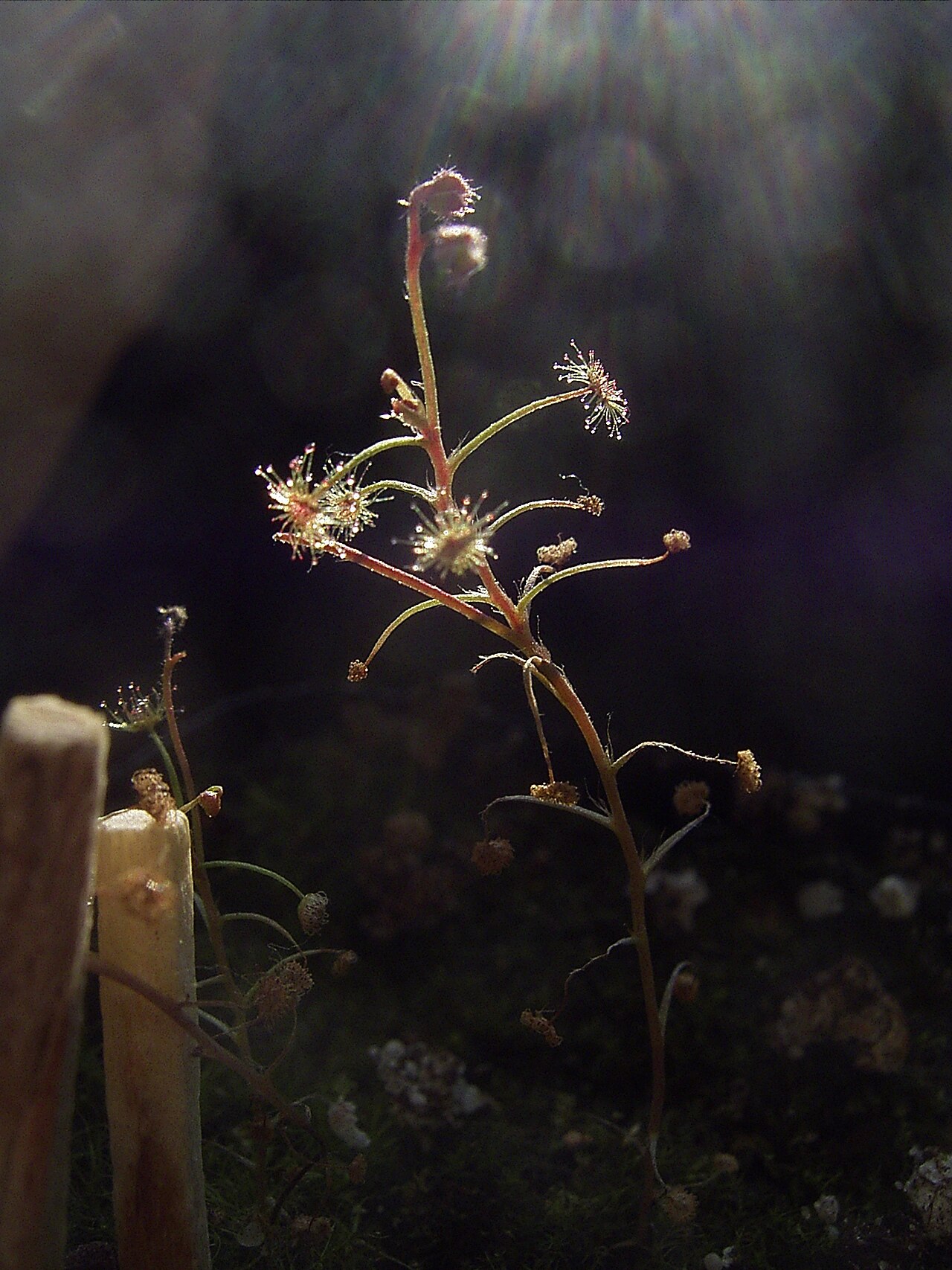
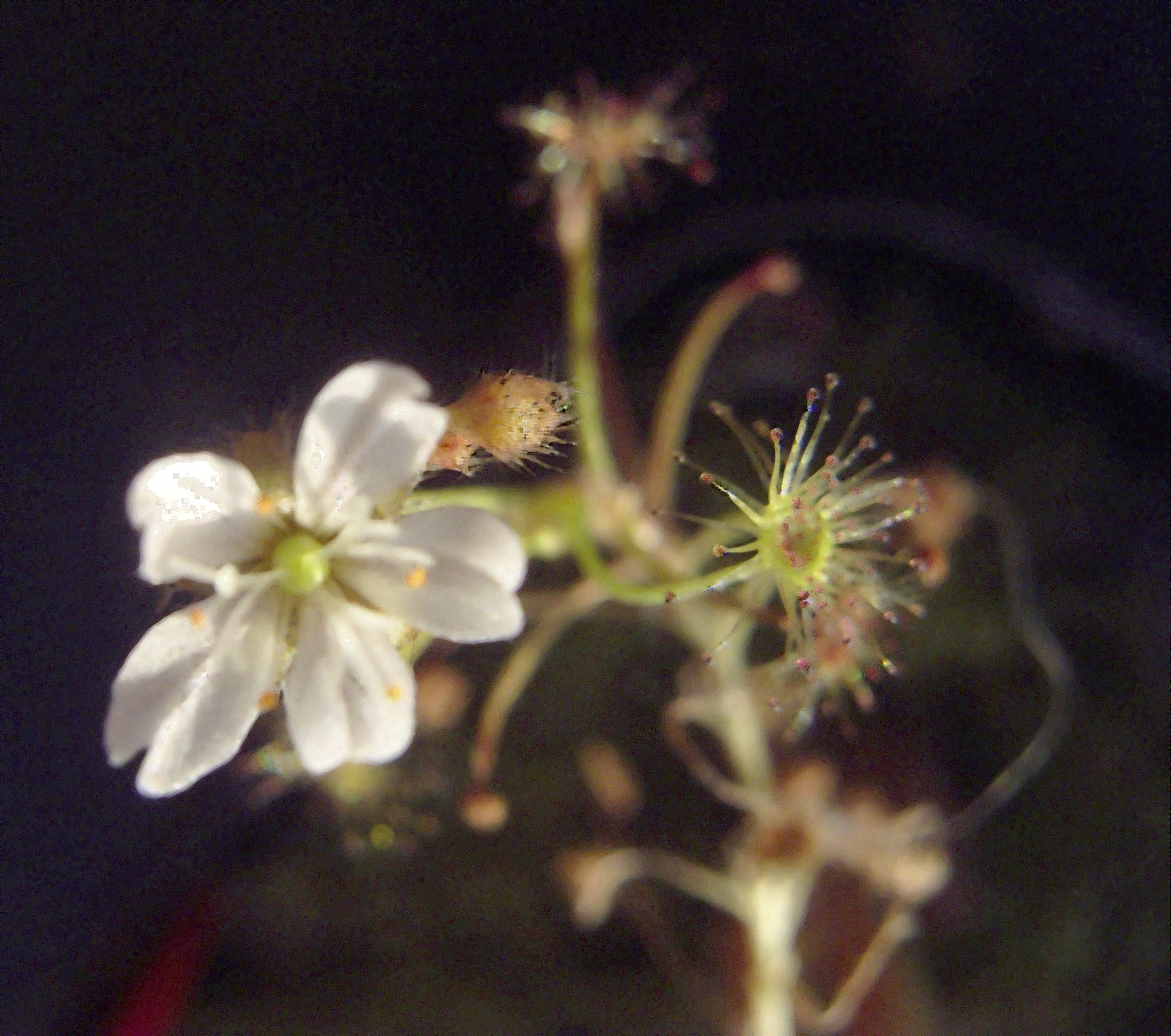
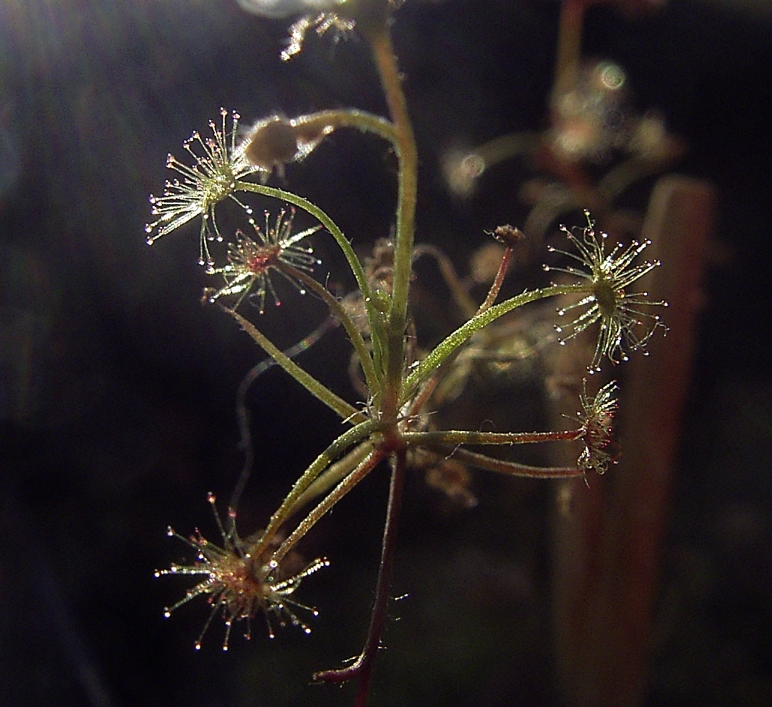

Identification
A small annual herb whose leaves stand in a ring around a short stem. Each leaf has a petiole and a kidney-shaped blade set with glandular tentacles. The plant is green to flushed red depending on light. The flowers are white and small, about 5 mm across. Reliable measurements of plant and leaf were not available for this guide; those fields are left empty.
Similar species
Other small annual sundews of the tropical savannas may grow alongside it. Drosera burmannii forms a rosette pressed flat to the ground, with wedge-shaped leaves bearing long marginal tentacles, and has no distinct stem. Young plants of the D. indica group have long, linear leaves. Species of the D. petiolaris complex are perennial and have long, narrow petioles with a small round blade. The kidney-shaped blade and small white flowers help to recognise D. banksii.
The trap and how it works
An active flypaper trap. The glandular tentacles on the kidney-shaped blades catch small insects such as gnats, springtails and ants in sticky mucilage, after which the tentacles bend towards the prey and the glands digest it. For an annual that must grow, flower and set seed within a few months, the catch provides a quick supplement to the nitrogen in the poor sandy soil.
Habitat and ecology
Seasonally wet, sandy, nutrient-poor ground in tropical savanna: wet hollows and depressions that are wet in the rainy season (W7), open patches in savanna woodland (B6) and wet sand flats (D1). As an annual the species survives the dry season solely as seed.
Distribution and elevation
Northern Australia — Queensland, the Northern Territory and northern Western Australia — and New Guinea, both Papua New Guinea and the Indonesian western part. Robert Brown described the species, and Augustin Pyramus de Candolle validly published the name in 1824. Flowering times and altitudinal limits are not published in the sources consulted; those fields are left empty.
- Recorded (quarter-degree cells)
Forms and variation
No varieties are recognised. Little has been published on its exact relationships within the genus or its variation over the large range. Because the species is small, annual and inconspicuous, it is probably under-represented in herbaria, and its real distribution may be denser than known localities suggest.
Where and when to see it
Search in the wet season, when the sand is wet, in open, sunny places in savanna country, along tracks and in shallow hollows. The plants are small and are best spotted by the glistening droplets on the tentacles in low, slanting light. Because the species is above ground only in the wet months, timing matters more than place.
Conservation status
The species has not been assessed for the global IUCN Red List and is not listed in CITES. Given its large range in little-developed savanna country of northern Australia and New Guinea, there seems to be no acute threat. Locally, changes in fire regime, grazing and invasive grasses can eliminate the open, wet sandy patches on which the species depends.
Scientific name
Drosera banksii | R. Brown ex de Candolle, 1824
Originally described by Robert Brown, validly published by Augustin Pyramus de Candolle in January 1824, in "Prodromus Systematis Naturalis Regni Vegetabilis", volume 1, p. 319. The precise type locality could not be established. The species occurs across northern Australia. Very likely named after Sir Joseph Banks, the British botanist who sponsored and organised collecting expeditions in Australia — Robert Brown, the original author of the name, worked closely with Banks. This remains a plausible assumption, however, not a fact explicitly confirmed by a source.
World Checklist of Vascular Plants (WCVP), via Plants of the World Online (POWO), Royal Botanic Gardens, Kew.