All species › Caryophyllales › Sundew family › Drosera albonotata
Drosera albonotata
One of the youngest names in this guide: Drosera albonotata was described only in 2018, split off from the group of orange-flowered pygmy sundews around Drosera miniata. The name means 'marked with white' and refers to the most striking feature of the flower: a bright white collar at the heart of an otherwise fiery orange bloom. It is a plant barely one and a half centimetres across bearing a flower nearly twice as wide as the rosette itself.

Identification
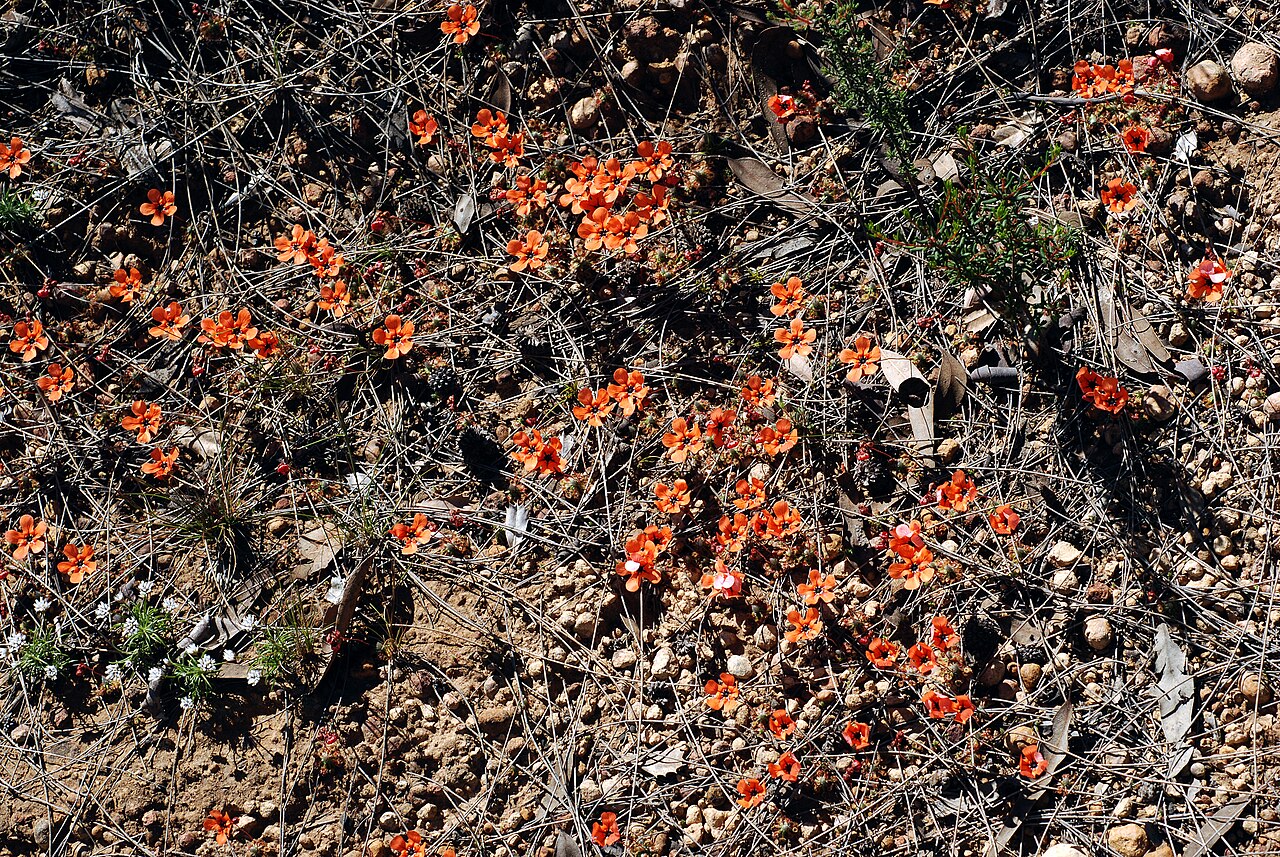
A pygmy sundew with a small, dense rosette usually about 15 mm across; the largest measured reached 22 mm. Older plants may develop a short stem from the remains of previous seasons, lifting the rosette slightly above the ground. The inflorescence grows up to 14 cm tall and carries one to fifteen flowers. At about 25 mm across these are remarkably large for a pygmy sundew, orange, with a white 'collar' around the centre and white patches at the base of each petal. As in all pygmy sundews the centre of the rosette holds a small cone of silvery stipules. Precise leaf measurements could not be found in the sources available for this guide, so the trap-size field is left empty.
Similar species
The closest relative is Drosera miniata, also orange-flowered and from the same part of Western Australia; until 2018 plants of D. albonotata were included in it. The authors separate the two on petal venation, the shape of petals and sepals, anther colour, leaf shape and the number and density of certain glands and hairs on the leaf. In the field the white markings at the heart of the flower are the most practical guide. Drosera barbigera and Drosera callistos also have orange flowers; in doubtful cases a hand lens on leaf and flower is essential.
The trap and how it works
An active flypaper trap in miniature. The leaves carry stalked glands each with a sticky droplet; a small insect landing on them sticks, after which the tentacles slowly bend towards the prey and secrete digestive enzymes. With a rosette one and a half centimetres across the prey is the smallest there is: springtails, mites, tiny gnats and ants. Pygmy sundews also often have longer marginal tentacles that react faster and can pull prey towards the centre of the leaf.
Habitat and ecology
Little about the habitat is recorded in the accessible sources, beyond the fact that the species occurs in the western Wheatbelt of Western Australia. Related orange-flowered pygmy sundews grow there in open, nutrient-poor heath and shrubland (kwongan) on sand or gravel, where the ground is moist in winter and dries out in summer; code B5 is therefore a cautious assignment still awaiting confirmation. Like other pygmy sundews the plant survives the dry summer as a resting bud of stipules.
Distribution and elevation
Endemic to the south-west of Western Australia and, as far as known, confined to the western Wheatbelt. Much of this region has been converted to farmland, so the natural vegetation often survives only in reserves and roadside strips. A more precise distribution could not be established for this guide.
- Recorded (one-degree cells)
Forms and variation
No varieties or subspecies have been described. The species itself belongs to a complex of orange-flowered pygmy sundews whose classification has been revised repeatedly in recent years; further splits or mergers cannot be ruled out. Like all pygmy sundews, D. albonotata reproduces not only by seed but also by gemmae, small brood bodies formed at the centre of the rosette at the end of autumn.
Where and when to see it
Search in September and October, when the orange flowers are open; outside flowering the rosette is almost impossible to find in the litter. The flowers open only in sunshine, so choose a bright day around midday. Look closely at the centre of the flower: the white collar is the feature that separates this species from D. miniata. Keep to paths in reserves and road verges; these are often the last scraps of natural vegetation in a farming landscape.
Conservation status
Not assessed for the IUCN Red List (NE) and not listed in CITES. Because the species was described only in 2018, it also appears to lack its own assessment on the Western Australian priority list. The source base for this guide is thin: the original description (Robinson, Cross, Meisterl & Fleischmann 2018) is the only good source, and the FloraBase profile was not reachable at the time of writing. Habitat and distribution data should therefore be read as provisional.
Scientific name
Drosera albonotata | Robinson, Cross, Meisterl & Fleischmann, 2018
Described by A.S. Robinson, A.T. Cross, M. Meisterl & A. Fleischmann, in Phytotaxa, volume 346, no. 3, p. 221-236 (specifically p. 223), published 6 April 2018. The precise type locality could not be established with certainty. The species occurs in the western Wheatbelt region of Western Australia. From the Latin albus ("white") and notatus ("marked") — "white-marked", referring to the white patches at the base of the petals, which distinguish this species from the related orange-flowered pygmy sundew D. miniata.
World Checklist of Vascular Plants (WCVP), via Plants of the World Online (POWO), Royal Botanic Gardens, Kew.