All species › Lamiales › Rainbow plant family › Byblis lamellata
Byblis lamellata
The northern Byblis species are annuals that come and go with the monsoon; Byblis lamellata belongs to the other camp. This is a perennial, woody subshrub of Mediterranean south-western Australia, which survives the summer drought in an underground rhizome and shoots again each year. An old plant can form a bush of sixty centimetres with fifteen or more shoots at once, glittering in the kwongan as though glass had been poured over it. It was only separated from Byblis gigantea in 2002, and has since become the species on which the story of the south-western sand plains hangs.
Identification
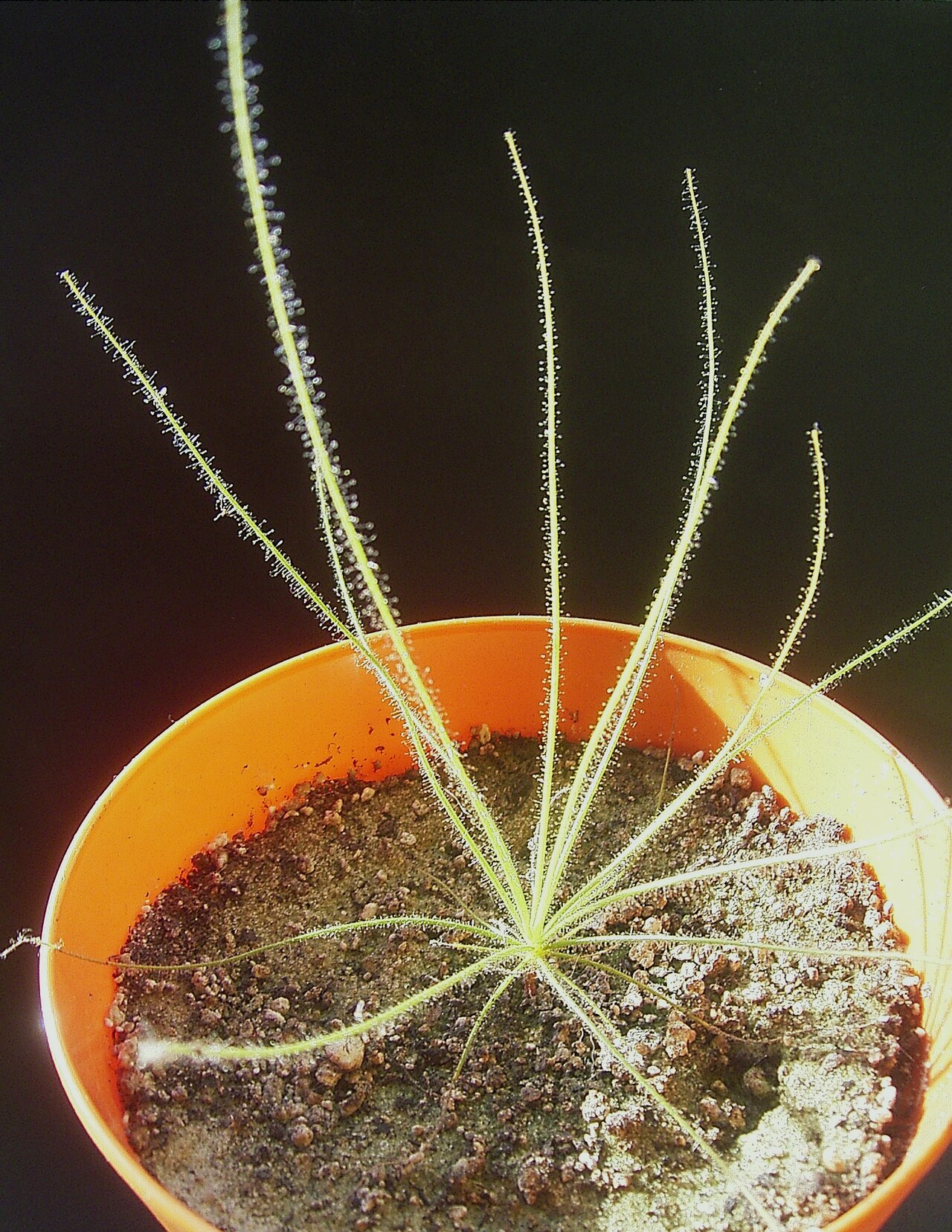
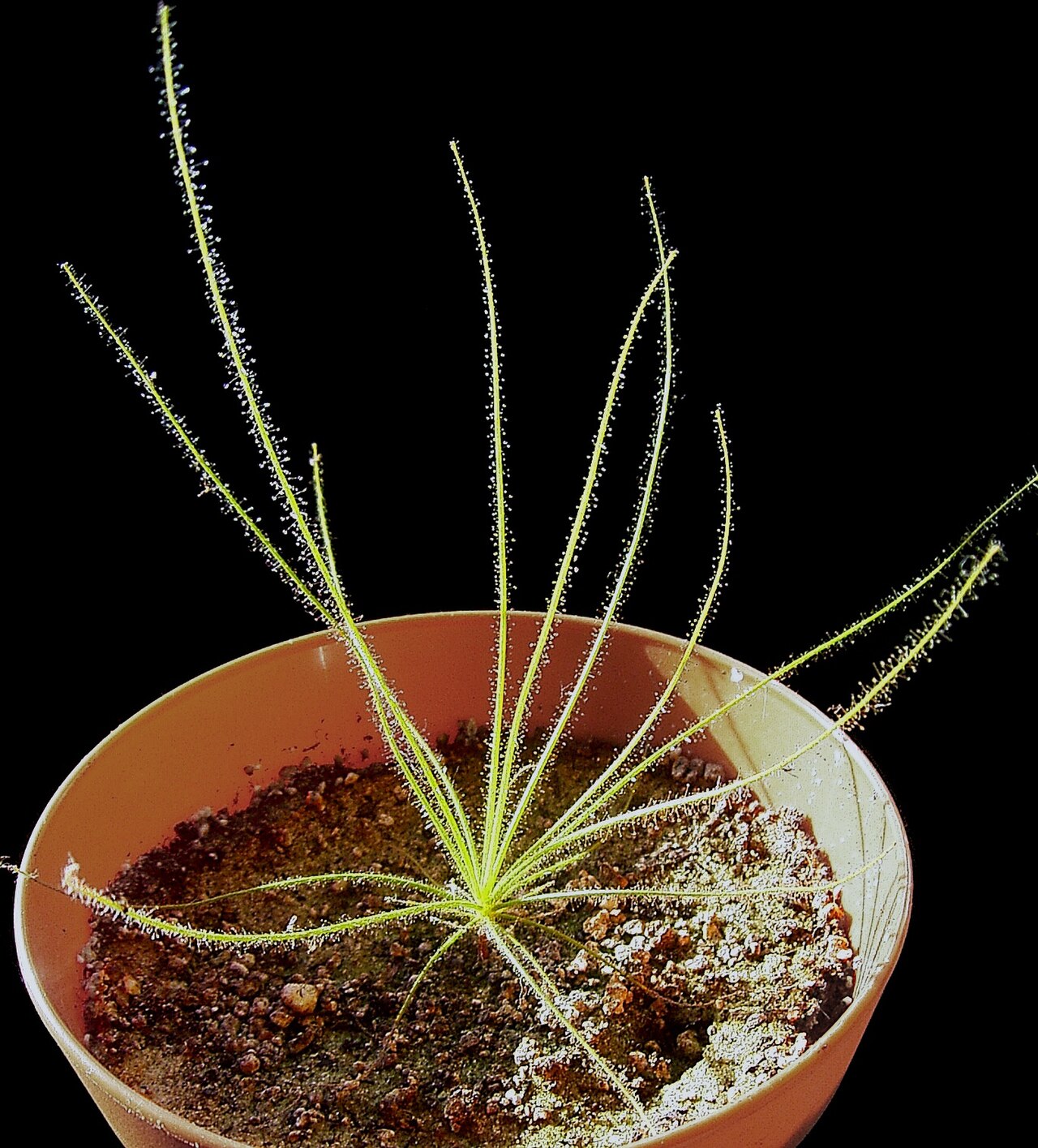
A branched, woody subshrub to about 60 cm tall, arising from a subterranean rhizome and also renewing itself from the remnants of the aerial stems. The leaves are linear and may reach 20 cm long; in cross-section they are kidney-shaped rather than round, and they are densely glandular-hairy along the margins and on the underside. The flowers are borne on long stalks and are large for the genus: petals 15 to 20 mm, pink to cerise-mauve, rarely white. The five stamens curve to one side; the anthers are strikingly long at 5 to 6 mm, yellow with brown tips, while the filaments stay distinctly shorter at 2.5 to 3.5 mm. Flowering falls in the southern spring and early summer, September to December or January. The seed carries weakly longitudinal, plate-like ridges; those lamellae gave the species its name.
Similar species
The only serious confusion is with Byblis gigantea, the other perennial of the south-west. That species grows in seasonally wet swamps that stay damp through summer, whereas B. lamellata grows on free-draining, dry white sand; the two are moreover separated by some hundred kilometres, with lamellata the northern of the pair. B. gigantea resprouts after fire or drought only from the underground rhizome, B. lamellata also from the remains of the aerial stems. The hard evidence lies in the seed: in B. lamellata weakly longitudinally ribbed with plate-like lamellae, in B. gigantea with distinct transverse ridges and a more complex honeycomb sculpture. Confusion with the northern annuals is impossible: those are smaller, slenderer and occur thousands of kilometres away.
The trap and how it works
A passive flypaper trap like the rest of the genus, but on a larger scale. The long leaves carry stalked glands along their margins and underside, each with a clear, sticky droplet; the leaf does not move and the glands do not move. Whatever sticks is digested by the far smaller sessile glands set between the stalks on the leaf surface, which only go to work once prey is lying on them. Because the plants grow large and carry dozens of leaves at once, the catch is correspondingly large: besides midges and flies, bigger insects regularly end up held fast. That trapping surface is no luxury, for the white quartz sand the species grows in is among the most phosphorus-poor soils on earth — the plant takes from its prey what the ground does not supply.
Habitat and ecology
Open heathland on free-draining white silica sand of the northern sand plains: the kwongan, the low, species-rich shrubland that defines the landscape on these poor soils. Unlike most carnivorous plants, then, this species stands not in the wet but in the dry part of the landscape; the sand holds no water and the plant bridges the summer underground. Fire belongs to that habitat: after a burn the rhizome resprouts and the plants flower profusely, while in long-unburnt, closed-up heath they dwindle. In the fixed codes: white quartz sand (D2) on a sand plain (D1), carrying shrubland on poor ground (B6).
Distribution and elevation
South-western Western Australia, on the northern sand plains from the Arrowsmith River south to Cataby, with Eneabba and its surroundings as the centre of gravity. The herbarium records the species from the Geraldton Sandplains, Jarrah Forest and Swan Coastal Plain regions. The range is small and elongated: a few hundred kilometres north to south, but narrow and heavily fragmented by agriculture and mining. The plant stays in the lowlands; no reliably documented altitudinal limit exists, so the elevation field is left empty.
- Recorded (one-degree cells)
Forms and variation
Little wild variation has been described. Flower colour shifts from pink to cerise-mauve and rarely goes to pure white; that is the only variation the literature names as such. Plant size depends strongly on time since the last fire: shortly after a burn they are low, freely flowering shoots, while after years without fire they grow into the heavy, many-shooted bushes that give the species its reputation. No varieties or colour forms are recognised, and no natural hybrids are known; the only possible partner, B. gigantea, stands more than a hundred kilometres away and flowers at a different time.
Where and when to see it
September and October are the best time: the plants are in full flower and the 15 to 20 mm blooms are visible from a distance. Search in low, open shrubland on white sand, and pay particular attention to patches burnt one to three years ago — there the plants stand densest and flower best. Do not push straight through the vegetation: the kwongan is fragile and the soil pathogen Phytophthora travels on boot soles and tyres. A record is only complete once you note how the plant has resprouted, since resprouting from aerial stem remnants is exactly what separates this species from its southern counterpart.
Conservation status
The Red List treats the species as Vulnerable. The range is small, the number of sites limited, and the sand plains it grows on are precisely the ground being stripped in this district for heavy minerals; on top of that the plant depends on a fire regime that fragmentation makes ever harder to maintain. Too little fire lets the shrubland close over, too much exhausts the rhizomes. The Western Australian Herbarium meanwhile lists the species as not threatened, which shows that national and international assessments diverge here.
Scientific name
Byblis lamellata | Conran & Lowrie, 2002
Described by John G. Conran and Allen Lowrie in 2002, in the paper "A revision of Byblis (Byblidaceae) in south-western Australia", published in Nuytsia 15(1): 11–19. The species occurs on the sandplains of the northern sandplain region of Western Australia, where it grows in well-drained white silica sand. The species name lamellata is Latin for "furnished with thin plates" and refers to a lamella-like structure in the plant's build.
World Checklist of Vascular Plants (WCVP), via Plants of the World Online (POWO), Royal Botanic Gardens, Kew.