All species › Even-toed ungulates › Oceanic dolphins › Risso's dolphin
Risso's dolphin | Grampus griseus
Grijze dolfijn | Delfín de Risso
Risso's Dolphin is a large, beakless dolphin with a blunt head and a body that with age becomes covered in white scratches. It lives over the continental slope in temperate and tropical seas worldwide and feeds mainly on squid. In Europe it occurs from Shetland to Iberia and in the Mediterranean; around the Hebrides and in the northern Irish Sea it is regularly seen from the coast.
Tracks
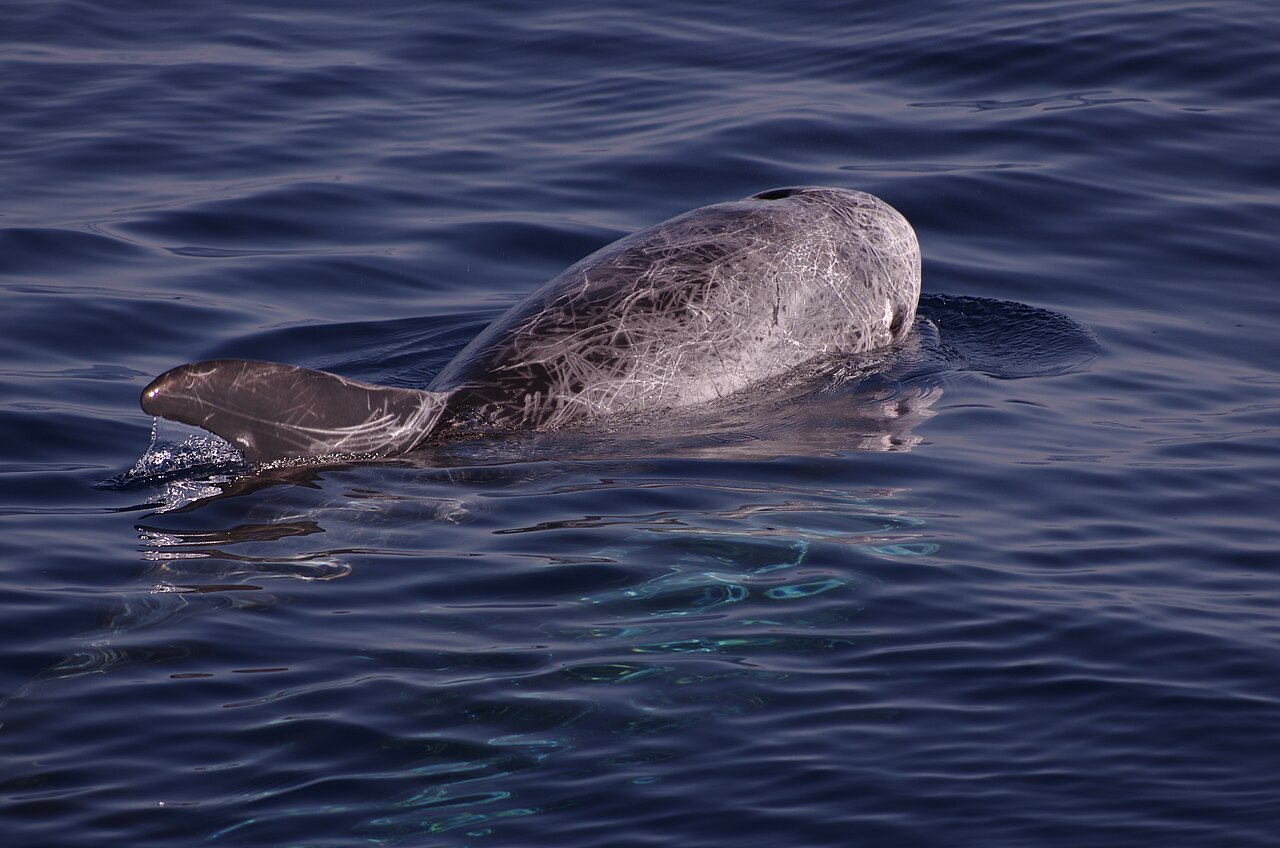
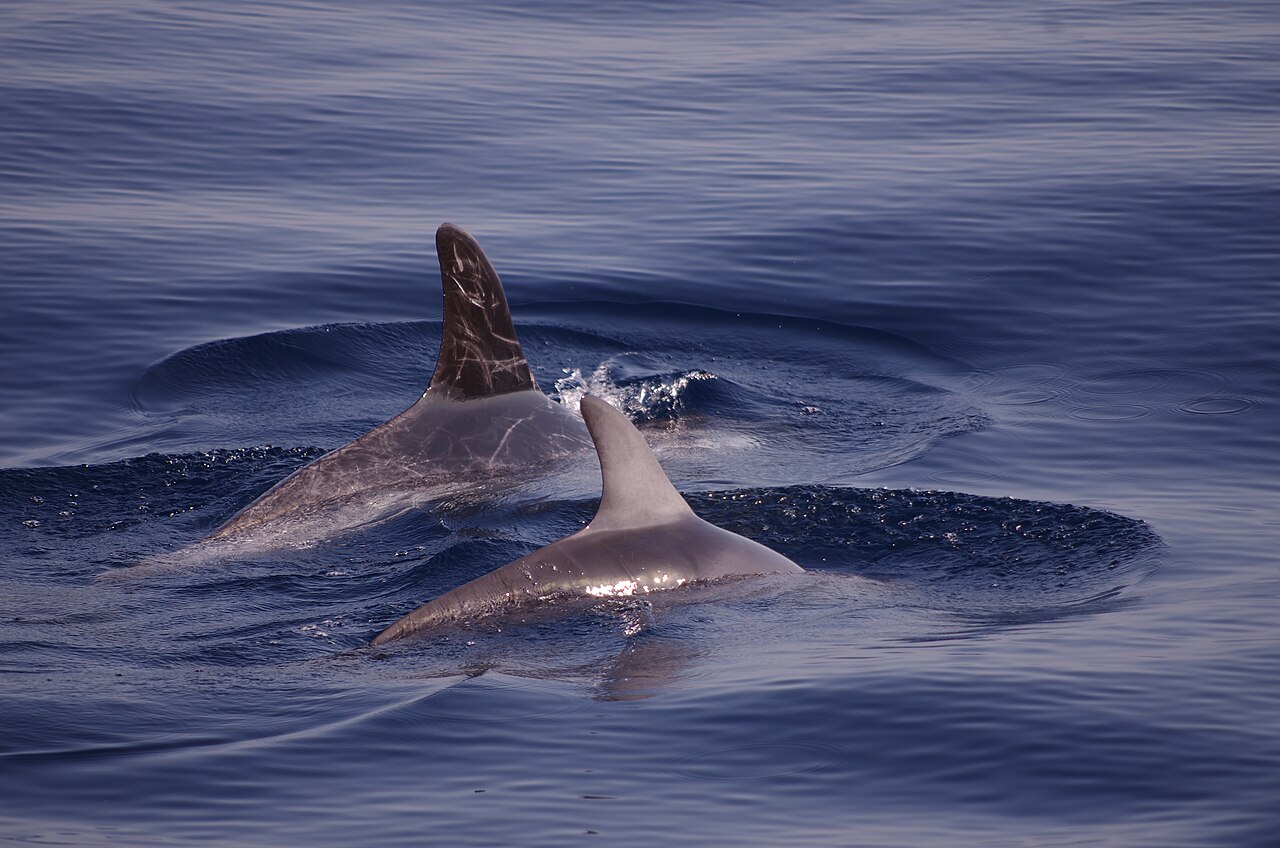
At sea Risso's Dolphin stands out by its tall, dark, sickle-shaped fin and the pale, scarred back that rolls over slowly on surfacing; old animals show at sea as white patches. The blow is low and usually not visible. On surfacing the blunt head often rises high out of the water. The species usually swims slowly, at five to eight kilometres per hour, in groups that in British waters usually number six to twelve animals, sometimes abreast in a loose line. Foraging dives last eight to twelve minutes, followed by five to ten minutes at the surface. Risso's Dolphins leap, slap head, tail and flippers on the water and raise the head vertically above the surface to look around; they rarely ride the bow wave of ships.
The young
Identification
Large and heavy in the front half, narrowing towards the tail. The head is blunt and rounded, without a beak, with a vertical crease down the front of the melon, visible only at close range. The dorsal fin is tall and sickle-shaped, set in the middle of the back, and stays darker than the body. Young animals are plain grey to brownish grey; with age the body becomes paler and covered in white scratches and scars, caused by the teeth of other Risso's Dolphins and by the suckers and beaks of squid. Old animals are almost white on head and back. Adults are 3.5 to 4 m long.
Similar species
The Bottlenose Dolphin is the same size and has a similar tall fin, but a short beak, plain grey skin without white scratches and a darker head; without a view of the head the two can sometimes not be separated at a distance. The Long-finned Pilot Whale is larger and black, with a round, bulbous head and a low, broad fin set far forward. A female or young Killer Whale also has a tall curved fin, but is black with a white eye patch and a grey saddle behind the fin. The white, scratched skin of an adult Risso's Dolphin is found in no other European cetacean.
Habitat
The water over the continental slope, in open sea between about two hundred and twelve hundred metres deep, where the bottom falls away steeply; around the British Isles also over slopes of fifty to a hundred metres close inshore. The species prefers water warmer than ten to twelve degrees. It forages largely near the bottom, mainly on cephalopods: octopus, cuttlefish and small squid, sometimes also small fish. Dives reach almost six hundred metres.
Where the animal is most at home, classified with EUNIS — the European standard for habitats.
Distribution
From the tropics north to Shetland, along the west coast of France, in the Bay of Biscay, along Iberia and throughout the Mediterranean, including the Ligurian Sea and the Gulf of Genoa. In the shelf seas of north-west Europe the population was estimated at about 16,200 animals in summer 2016. Around the British Isles the centre is the Hebrides; the species is regular off Shetland and Orkney, in north-east Scotland, in the Irish Sea (especially off County Wexford and west Pembrokeshire) and along the west coast of Ireland. In recent years it has also been seen more often along the east coast of Scotland. In the southern North Sea and the Baltic the species is seen only rarely.
- Native
- dark = core range, pale = thinly spread
Way of life
Active by day and night; feeding takes place mainly in the late afternoon and at night, when squid rise higher in the water column. Groups have a stable core and often consist of animals of similar age and sex. Gestation is thirteen to fourteen months; around the British Isles calves are born from March to July, and a female calves once every two to four years. The newborn is about 1.35 m long, plain grey and still without scratches. Females mature at eight to ten years, males at ten to twelve. The usual life span is about twenty-five years, the highest known thirty-four.
Where and when to look
On the Isle of Lewis in the Outer Hebrides, Tiumpan Head, on the Eye Peninsula east of Stornoway, is a known place to see Risso's Dolphins from the headland; the ferries across the Minch also pass through their range. The animals are seen from the coast mainly from April to September, in calm weather. In the Irish Sea the coasts of Wexford and west Pembrokeshire are good. In the Mediterranean they are seen mainly on boat trips over the deep waters of the Ligurian Sea, from harbours between Genoa and the Côte d'Azur. Look for a tall, dark fin above a strikingly pale back; a group swimming slowly in a line can often be followed for a long time.
Conservation status
Least Concern (LC, 2018). Little is known about trends in European waters. Threats are fisheries bycatch, prey depletion, underwater noise and, outside Europe, hunting, among others in Japan; in the Faroe Islands Risso's Dolphins are occasionally killed in the pilot whale hunt. The species is protected under the Habitats Directive and is covered by the ASCOBANS and ACCOBAMS agreements; the Mediterranean population is listed on Appendix II of the Bonn Convention on migratory species.
Scientific name
Grampus griseus | (G. Cuvier, 1812)
G. Cuvier described the species in 1812 as delphinus griseus; because it was later moved to another genus, the author and year stand in brackets. Grampus is an old English name for small whales, via Old French from medieval Latin crassus piscis, 'fat fish'. griseus is medieval Latin for 'grey'. The specimen the first description was based on came from France, Brest.