All species › Even-toed ungulates › Oceanic dolphins › Long-finned pilot whale
Long-finned pilot whale | Globicephala melas
Griend | Calderón común
The Long-finned Pilot Whale is a large, black toothed whale of the dolphin family, with a bulbous, rounded head and a low, broad dorsal fin set far forward on the back. The species lives in groups of dozens over the continental slope of the cool and temperate North Atlantic and in the western Mediterranean, and dives deep for squid at night. Pilot whales often strand in groups. In the Faroe Islands the species is still hunted.
Tracks
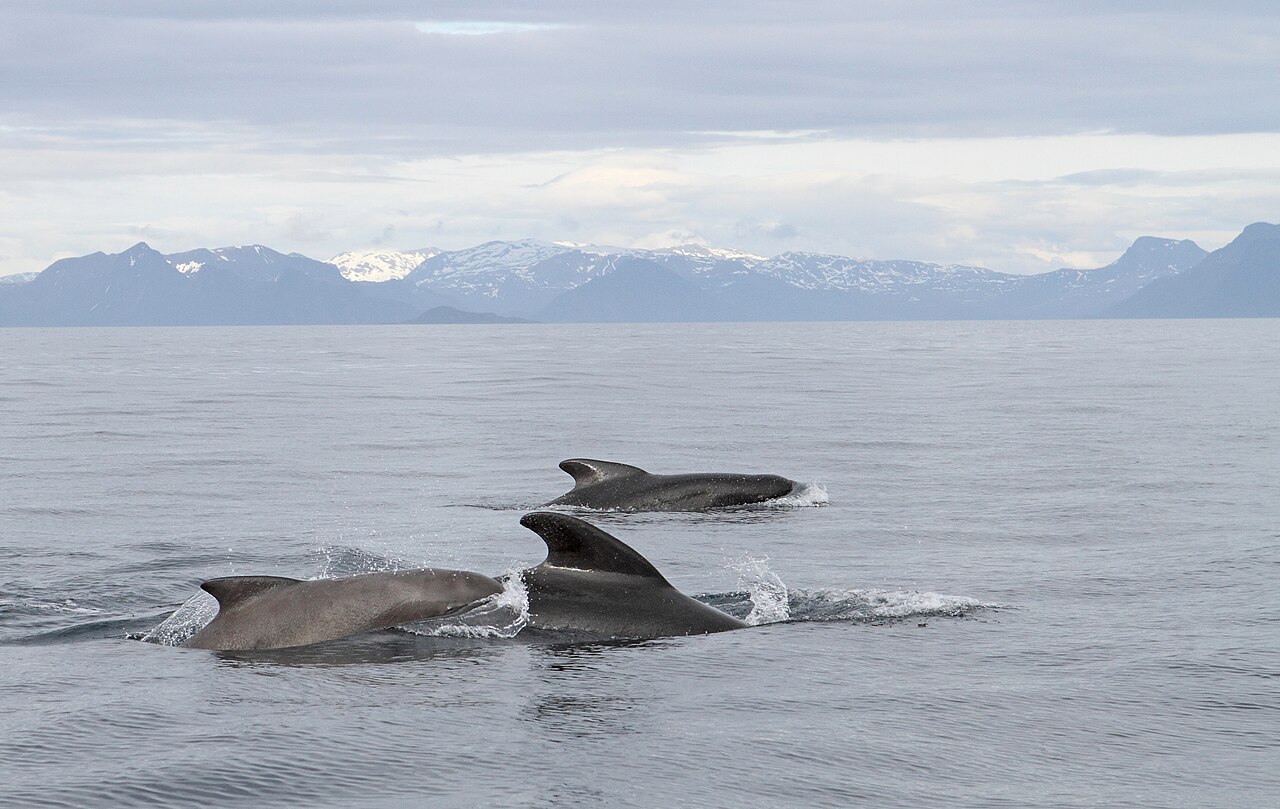
At sea you recognise pilot whales by the low, broad fin set far forward on a long black back, and by the round head that shows first on surfacing. The blow is low and strong, in still weather visible as a short bushy cloud and clearly audible. Pilot whales usually swim slowly, often in a long line abreast; by day groups regularly lie still at the surface ('logging'), with only the back and fin above water. They raise the head vertically out of the water, slap the tail, and young animals leap regularly; adults rarely do. A group usually numbers twenty to a hundred animals, divided into subgroups of ten to twenty; temporary gatherings of hundreds occur. A diving group stays under for ten to sixteen minutes.
Identification
Large, long and dark: the skin is black to dark brownish grey, with a pale grey, anchor-shaped patch on throat and chest and in many animals a faint grey blaze behind the fin and behind the eye. The head is round and bulbous, without a beak; in old males the melon is tall and steep. The dorsal fin is set far forward, about a third of the way along the body, and is low, long and broad-based: swept back in females and young animals, thick and rounded like a flag in adult males. The flippers are long and narrow, a fifth to a quarter of the body length, but rarely seen. Females grow to six metres, males to 7.6 m.
Similar species
In European seas the only similar species is the Short-finned Pilot Whale (Globicephala macrorhynchus), which lives in warmer water, among others around the Canary Islands and Madeira; in the field the two can be separated almost only by the length of the flipper, which is rarely visible. Risso's Dolphin also has a blunt head, but is paler, scarred, and has a tall fin mid-back. The Killer Whale is black and white with an eye patch and a tall fin. A group of pilot whales resting at the surface can resemble a group of Bottlenose Dolphins at a distance; the low, broad fin set far forward and the round head decide.
Habitat
Deep water over the continental slope and in the open ocean, especially where the shelf drops to the deep sea at about a thousand metres, as in the Faroe-Shetland Channel, the Rockall Trough and the Porcupine Bight; in summer also over the shelf and in fjords and deep bays. The Long-finned Pilot Whale dives deeper than a thousand metres; most food is caught at night at two to five hundred metres. The diet is mainly squid, supplemented by fish such as mackerel, hake, cod, whiting, pollack, horse mackerel and sea bass.
Where the animal is most at home, classified with EUNIS — the European standard for habitats.
Distribution
In Europe from northern Norway, the Faroes and Iceland south to the Bay of Biscay and the Iberian Peninsula, and in the western Mediterranean, where the species is common, with a resident group in the Strait of Gibraltar. Around the British Isles it lives mainly along the continental slope north and west of Scotland and Ireland and in the south-western approaches to the Channel. Surveys in 2016 estimated about 33,000 pilot whales from southern Norway to Portugal, and in 2015 about 600,000 around the Faroes and Iceland. In the North Sea and the Channel the species is rare; groups that swim into the North Sea sometimes strand.
- Native
- dark = core range, pale = thinly spread
Way of life
Active by day and night, with deep feeding dives mainly at night. The Long-finned Pilot Whale lives in stable groups around related females, with about three females to every male. There is no fixed breeding season; in the Faroes conception peaks from April to July. Gestation is twelve to sixteen months; the calf is about 1.8 m long at birth and is suckled for one and a half to almost four years, sometimes longer. A female calves once every three to six years. Females mature at about eight years, males at twelve to thirteen. Males live thirty-five to forty-five years, females sixty or more. The close group bonds are one of the explanations offered for mass strandings.
Where and when to look
In the Strait of Gibraltar boats leave Tarifa all year round, and pilot whales are one of the species seen most often there. In northern Norway they are seen in summer off Andenes, among other places. The ferries from Plymouth and Portsmouth to Spain cross the continental slope in the Bay of Biscay, where pilot whales are regularly seen in summer; on the ferries to the Faroes and Iceland the route runs through the Faroe-Shetland Channel. In calm weather look for a line of low black backs with a broad fin; a resting group often stays in the same place for a long time.
Conservation status
Least Concern (LC, 2018). In the Faroe Islands pilot whales are driven into bays and killed in the traditional drive hunt, the grindadráp, mainly in summer; between 1991 and 2017 an average of about seven hundred animals a year were taken. In 2008 the Faroese health authorities advised against eating the meat because of high mercury levels. Other threats are bycatch in trawls, driftnets and longlines, pollution, ship strikes and underwater noise. The species is protected under the Habitats Directive and is covered by ASCOBANS and ACCOBAMS; the North Sea and Baltic populations are listed on Appendix II of the Bonn Convention.
Scientific name
Globicephala melas | (Traill, 1809)
Traill described the species in 1809 as Delphinus melas; because it was later moved to another genus, the author and year stand in brackets. Globicephala is formed from Latin globus, 'ball', and Greek kephalē, 'head': the globe-head. melas is Greek for 'black'. The specimen the first description was based on came from Scotland, Orkney Islands (Pomona).