All species › Even-toed ungulates › Deer › Reindeer
Reindeer | Rangifer tarandus
Rendier | Reno
The reindeer (Rangifer tarandus) is the deer of the tundra and the northern taiga, and the only deer in which both sexes carry antlers. In the guide area wild reindeer live in the Norwegian mountains, as forest reindeer in Finland and Russian Karelia, and on Svalbard. In Iceland the species was introduced in the eighteenth century. In northern Scandinavia and on the Kola Peninsula large numbers of semi-domesticated reindeer are also kept.
Tracks
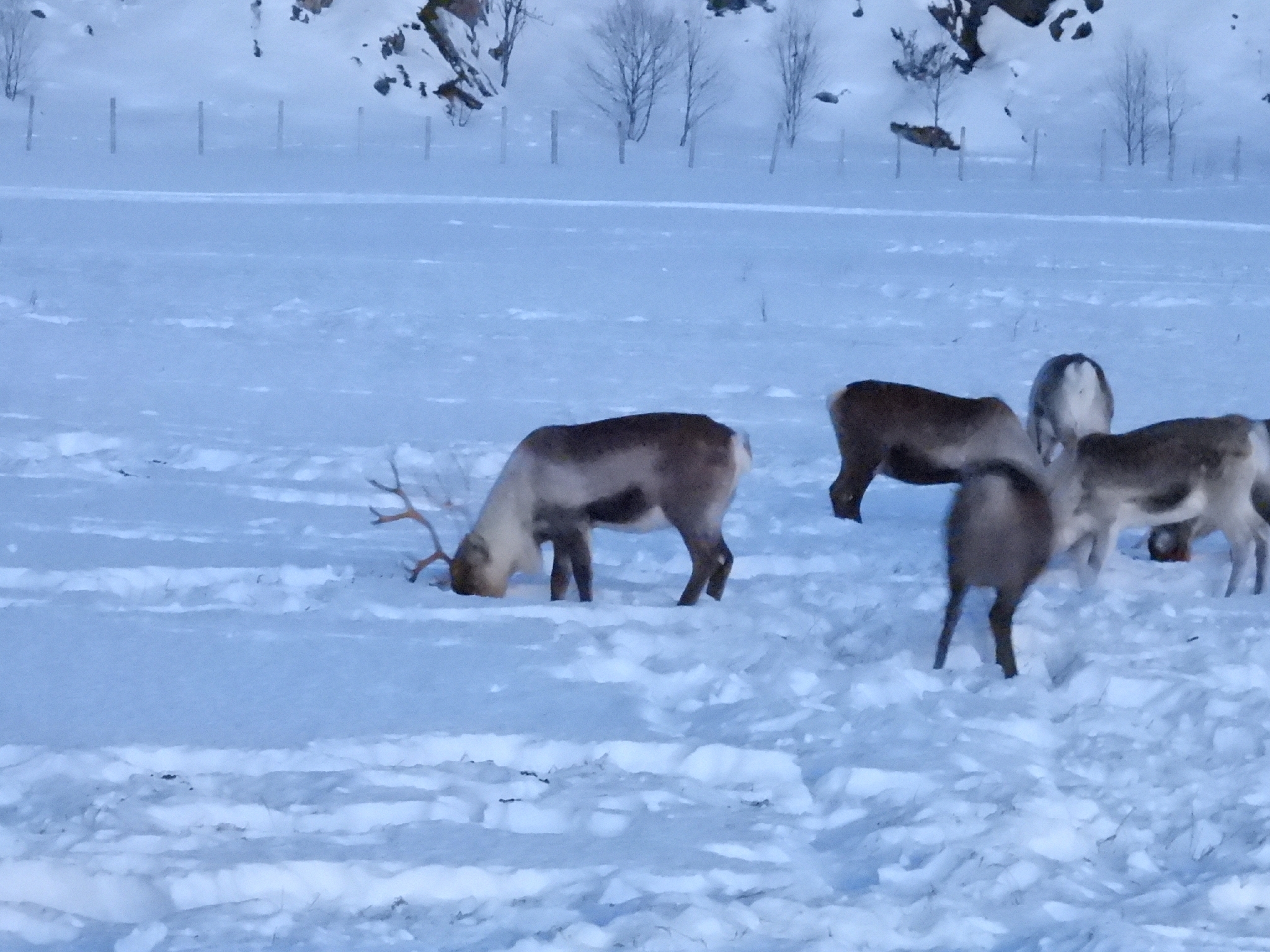
The track is large and round, with two broad, crescent-shaped halves and almost always the print of the dewclaws; the feet spread on snow and in bog. In winter the reindeer digs craters in the snow to reach lichens. The droppings are small, dark pellets. Shed antlers lie on the fjell: males cast them after the rut, females only in spring after calving. On bare ridges run broad, deeply worn migration trails.
In winter coat
Identification
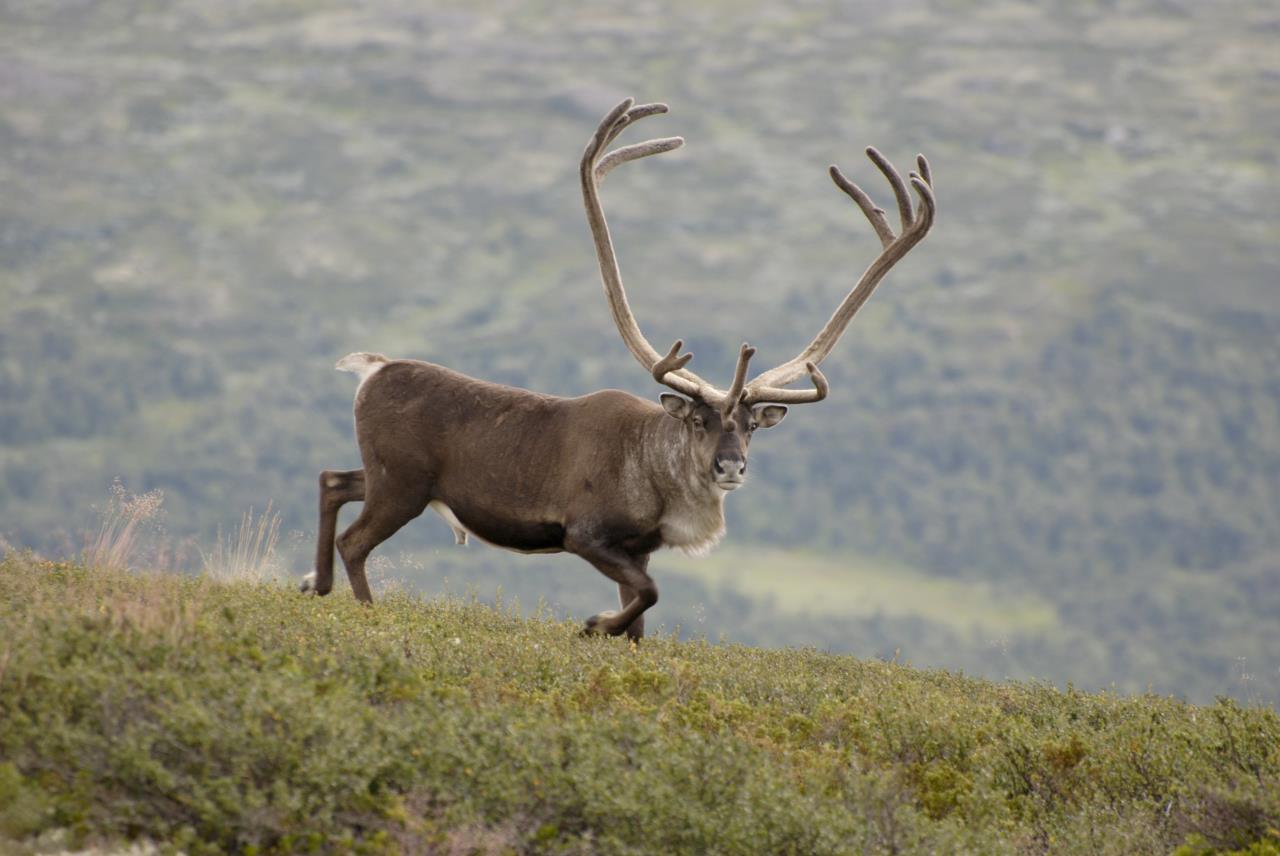
A medium-sized to large deer with a head-body length of 120 to 220 cm, a shoulder height of 87 to 140 cm, a tail of 7 to 21 cm and a weight of 60 to 318 kg; the Svalbard reindeer is the smallest form, with very short legs. The coat is grey-brown, paler and thicker in winter, with a pale neck and mane. The muzzle is hairy. Both sexes carry antlers: in the male up to 130 cm long, with a forward-pointing, often flattened brow tine above the muzzle; in the female 23 to 50 cm. The hooves are broad, with large dewclaws. When walking the legs make an audible clicking sound. The forest reindeer is larger and longer-legged than the mountain reindeer and has narrower, more V-shaped antlers.
Similar species
Wild and semi-domesticated reindeer belong to the same species. Tame animals are often piebald or white, carry ear marks or collars and allow closer approach; in herding areas a wild animal usually cannot be recognised with certainty in the field. The moose is much larger and darker, with an overhanging upper lip and, in the bull, palmate antlers. The red deer has a reddish-brown coat, a pale rump patch and no antlers in the hind. The muskox on the Dovrefjell is darker and more massive and carries horns.
Habitat
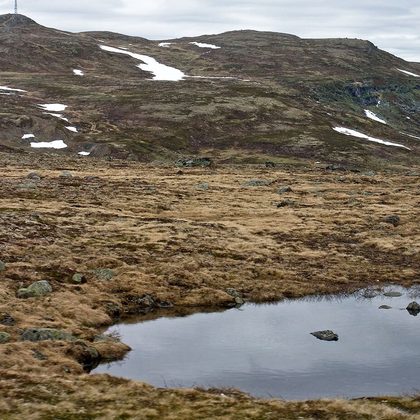
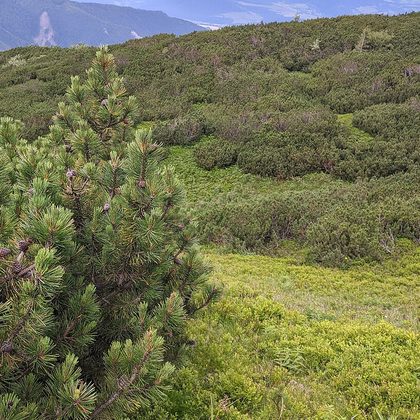
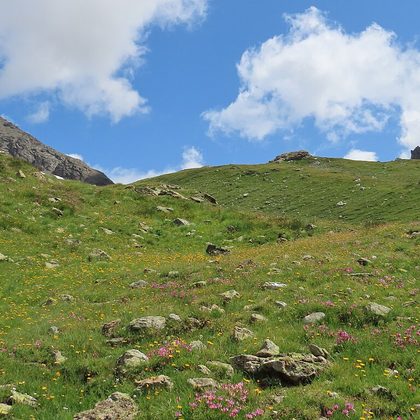
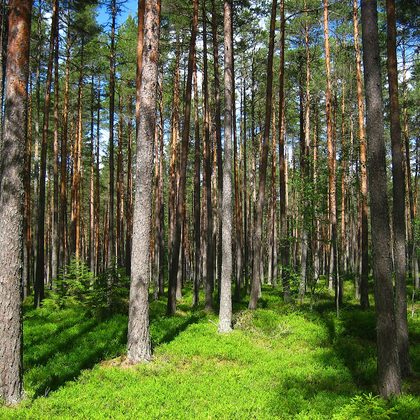
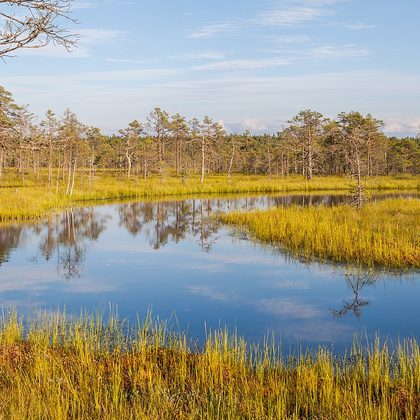
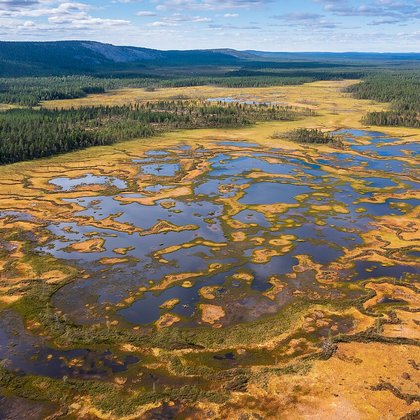
Tundra and alpine plateaus above the treeline with lichen-rich dwarf-shrub heath, bogs and snowfields, and for the forest reindeer coniferous forest with open bogs. In summer mountain reindeer seek out snowfields and high ridges, where there are fewer insects.
Where the animal is most at home, classified with EUNIS — the European standard for habitats.
Distribution
The reindeer lives around the North Pole, in Europe, Asia and North America, where it is called caribou. In Norway about 20,000 wild mountain reindeer (R. t. tarandus) live, most of them on the Hardangervidda; other populations live in Snøhetta, Rondane and Nordfjella, among others. The Finnish forest reindeer (R. t. fennicus) was almost exterminated in Finland by the end of the nineteenth century, returned from Russia and was reintroduced in 1979–1980; in 2013, 793 animals were counted in Kainuu, and about 1,000 live in Suomenselkä. From 2019 forest reindeer were released in Lauhanvuori and Seitseminen National Parks. Russian Karelia holds the eastern continuation of this population. The Svalbard reindeer (R. t. platyrhynchus) is native to Svalbard. In Iceland reindeer were released on four occasions between 1771 and 1787; only the population in the east of the island has survived. In the Cairngorms in Scotland a herd has been kept since 1952.
- Native
- dark = core range, pale = thinly spread
Way of life
Reindeer live in herds that can number thousands during migration, and cover great distances between summer and winter ranges. In winter the food is mainly lichens, in summer grasses, sedges, herbs, the leaves of willows and birches, and fungi. The rut runs from late September to early November; gestation lasts 228 to 234 days, and a single calf is born in May or June that follows its mother within hours. Reindeer can live for twenty years.
Where and when to look
On the Hardangervidda, the Dovrefjell and in Rondane wild reindeer are shy; scan the plateau and the snowfields with a telescope from a high point, and keep your distance, because a herd that scents people flees for kilometres. On Svalbard reindeer are common around Longyearbyen and not very shy. In eastern Iceland they are found at lower altitudes in winter. The Finnish forest reindeer is best seen in Kainuu, on open bogs in late winter. The Cairngorm herd can be visited on a guided walk.
Conservation status
Vulnerable (VU, 2016), for the species as a whole, mainly because of the steep decline of caribou in North America. In Norway chronic wasting disease (CWD), a prion disease, was found in wild reindeer at Nordfjella in 2016; between November 2017 and February 2018 all 1,407 known animals in the infected zone were culled, 17 of which proved infected. Further threats are fragmentation of the habitat by roads, railways, cabins, power lines and wind farms. The Finnish forest reindeer is Near Threatened (NT) because of hybridisation with semi-domesticated reindeer and predation by the wolf.
Scientific name
Rangifer tarandus | (Linnaeus, 1758)
Linnaeus described the species in 1758 as Cervus Tarandus; because it was later moved to another genus, the author and year stand in brackets. Rangifer is the medieval Latin name for the reindeer, already used by Albertus Magnus; it probably goes back to a Sámi word such as raingo, though this is not certain. tarandus goes back to Greek tarandos, the name of a northern animal in Aristotle and Theophrastus that was later referred to the reindeer; the further origin of the word is unknown, and it may be a borrowing from a Scythian tongue. The specimen the first description was based on came from Sweden, Lapland.