All species › Even-toed ungulates › Deer › Reeve's muntjac
Reeve's muntjac | Muntiacus reevesi
Muntjak | Muntiacus reevesi
Reeve's muntjac (Muntiacus reevesi) is a small deer from south-eastern China and Taiwan. It was brought to England at the end of the nineteenth century and released into the wild there from 1901. It now occurs over much of England and Wales and is also recorded in Ireland, Belgium and the Netherlands. Since 2016 the species has been on the European Union's list of invasive alien species of Union concern.
Tracks
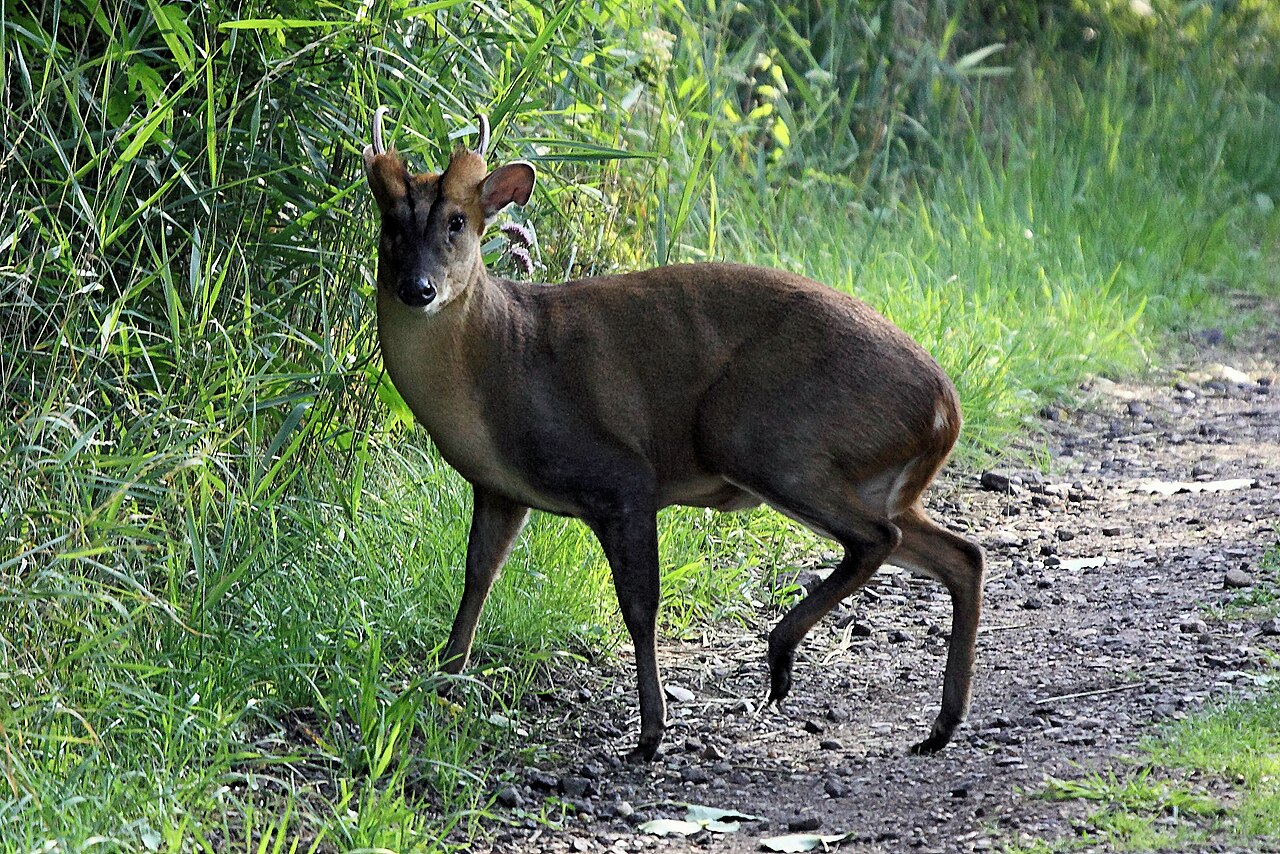
The slot is small, about 3 cm long, and the two halves are often of unequal size. The droppings are small, black, shiny pellets, often at fixed latrine sites. The most conspicuous sign is the bark: a short, loud, dog-like call repeated at intervals of a few seconds, sometimes for half an hour or longer, also at night. Where muntjac are numerous the woodland field layer is browsed bare up to about a metre and woodland flowers such as bluebell are missing over large areas. The buck marks tree trunks and branches with the glands on his forehead.
Identification
A small, compact deer with a head-body length of 77 to 91 cm, a shoulder height of 45 to 52 cm and a weight of 10 to 17 kg. The rump stands higher than the shoulder, so the animal moves with a hunched posture. The coat is reddish-brown to ginger; chin, throat and the underside of the tail are creamy white. Two dark stripes run over the face and in the buck continue into the long, hair-covered pedicles; large preorbital glands lie in front of the eyes. The buck carries short, slightly hooked antlers, usually under 10 cm, and long, protruding upper canines. The doe has small bony knobs instead of pedicles and a dark patch on the forehead. The tail is 13 to 18 cm long and is held up in flight, showing the white underside.
Similar species
The roe deer is larger and longer-legged, has no visible tail and a white or pale rump patch. The Chinese water deer, which in England locally shares the same areas, is slightly larger and plain brown, without facial stripes or antlers, with rounded ears and, in the buck, long canines. The southern red muntjac is larger and has no free-living population in the guide area; a muntjac in Europe is almost always this species. In the dark a muntjac in a garden or at a wood edge can be taken for a fox or a small dog; the hunched posture and the raised tail decide.
Habitat
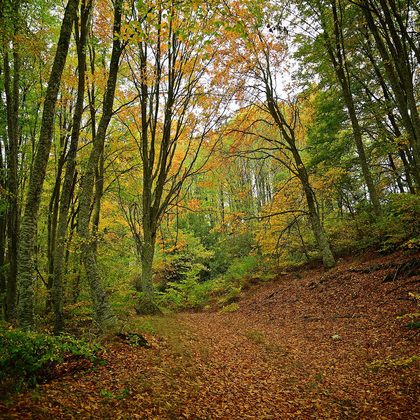
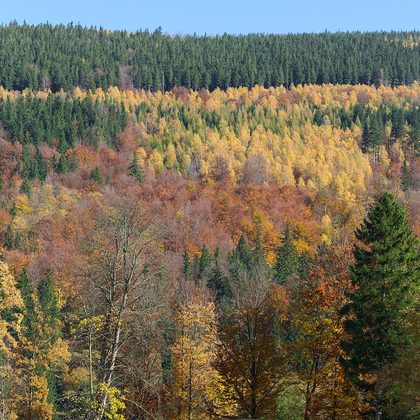
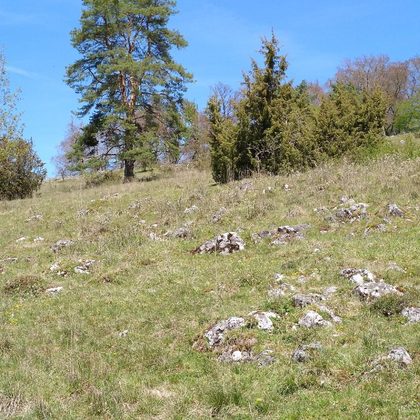
Broadleaved and mixed woodland with a dense shrub or field layer, coppice, conifer plantations with undergrowth, bramble thickets, hedgerows and hedges. In England the muntjac also lives in parks, churchyards and gardens in villages and on the edges of towns.
Where the animal is most at home, classified with EUNIS — the European standard for habitats.
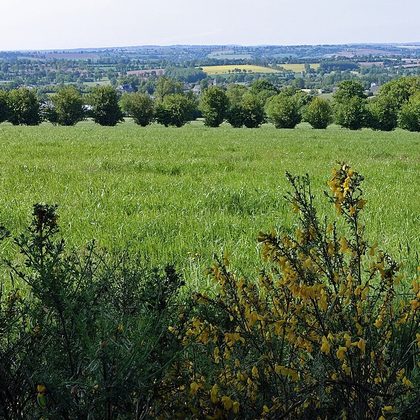
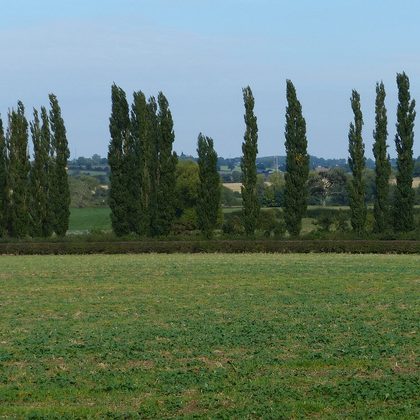
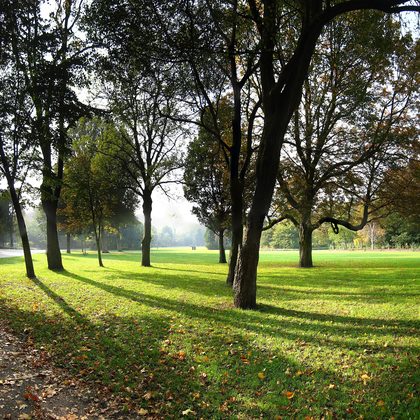
Distribution
The natural range lies in south-eastern China and on Taiwan. In England the first animals arrived in the park of Woburn Abbey in 1894; in 1901 eleven animals were released into the surrounding woods. Through further releases and escapes from the 1930s onwards the species became established at several places in south-eastern and central England. By its own spread the muntjac advances about a kilometre a year; the number of occupied 10 × 10 km squares rose from 59 in 1970 to 417 in 1993. The population in England was estimated at 52,000 in 1995 and 104,000 in 2008. The species also occurs in Wales, is becoming established in Ireland and is recorded in the Netherlands and Belgium. Outside Europe it has been introduced to Japan.
- Established introduction
- dark = core range, pale = thinly spread
Way of life
The muntjac is active mainly at dusk and dawn and lives alone, in pairs or in small family groups; both sexes defend small territories. It eats herbs, buds, young shoots, bramble, flowers, fruit, seeds, nuts and fungi, and occasionally carrion and eggs. Breeding is not tied to a season: the doe can conceive again shortly after giving birth, gestation lasts about 210 days, and a doe produces on average about three young every two years. Young animals are sexually mature within their first year. Muntjac can live up to seventeen years.
Where and when to look
At dusk in a broadleaved wood in southern or central England, listen for the bark; it often goes on for a long time and gives the direction. Walk slowly along wide rides and clearings and look low into the shrub layer: a muntjac is often no more than a reddish-brown back with a raised tail darting away. In gardens and parks on the edge of villages muntjac are often less shy. In the Netherlands and Belgium every record is of interest; a photograph showing the facial stripes or the tail is enough for identification.
Conservation status
Least Concern (LC, 2016) in its natural range. In Europe the muntjac has been on the Union list of Regulation (EU) 1143/2014 on invasive alien species since 2016; member states must prevent introduction and spread and detect and remove new populations early. In England the species causes browsing damage to coppice and to the field layer of broadleaved woods, with consequences for woodland flowers and for birds of the shrub layer.
Scientific name
Muntiacus reevesi | (W. Ogilby, 1839)
W. Ogilby described the species in 1839 as Cervus Reevesi; because it was later moved to another genus, the author and year stand in brackets. Muntiacus goes back through Dutch muntjak to Sundanese mencek, the animal's name in western Java. reevesi honours John Reeves (1774–1856), tea inspector of the East India Company at Canton, who sent Chinese animals and plants to London. The specimen the first description was based on came from China.