All species › Hedgehogs, shrews and moles › Moles and desmans › Pyrenean desman
Pyrenean desman | Galemys pyrenaicus
Pyrenese desman | Desmán Ibérico
The Pyrenean Desman is a mole that lives in fast mountain streams and hunts underwater for the larvae of mayflies, stoneflies and caddisflies. It is endemic to the Pyrenees and the north and centre of the Iberian Peninsula, and it is one of the two surviving desmans; the other, the Russian Desman, lives more than 2500 km to the east. In recent decades the Pyrenean Desman has declined sharply across much of its range. The IUCN has assessed it as Endangered since 2021, and in 2025 Spain formally declared the species to be in a critical situation.
Tracks
The most useful sign is the dropping. A desman deposits its droppings on stones projecting above the water, on roots and in crevices in the bank, often at fixed spots. They are small, dark, often musky-smelling, and contain the remains of aquatic insect larvae. Because water shrew droppings lie in the same places and look very similar, a dropping can be assigned with certainty only by DNA analysis. That method has become the basis of surveys in France and Spain: in the French Pyrenees, 900 genetically tested droppings confirmed presence in 250 stream sections of 500 m each, and the DNA also revealed diet and the movements of individuals. Footprints are rarely found and are not diagnostic. Nests and burrows are no help either: the desman does not dig but rests in existing cavities among stones and roots in the bank.
Identification
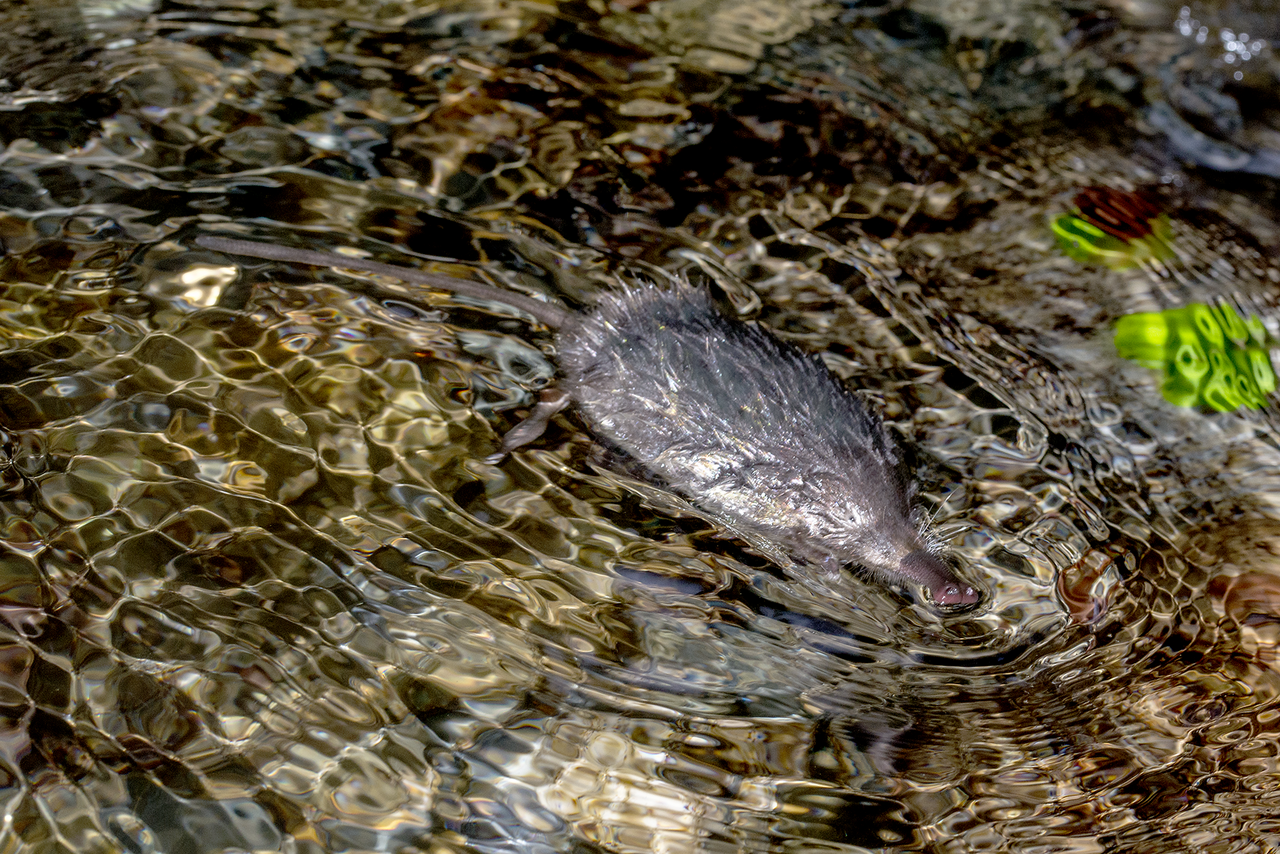
A small, streamlined animal with a long, flattened, mobile, trunk-shaped snout two to three centimetres long, with the nostrils at the tip and many tactile whiskers. The eyes are tiny and there are no external ears. The fur has two layers, a dense underfur and longer guard hairs, and is dark brown above and silvery grey below; wet, the animal looks almost black. The hind legs are long, with large webbed feet fringed with stiff hairs that provide propulsion in the water. The tail is longer than head and body, round at the base and laterally flattened towards the tip, and is used for steering when swimming; scent glands at its base give a musky smell. Head-body 10.8 to 14.5 cm, tail 12.3 to 16.0 cm, hind foot 31 to 38 mm, weight 44 to 80 g; males and females are the same size.
Similar species
Together with the Russian Desman (Desmana moschata) this is the only aquatic mole in Europe, and the two ranges do not overlap anywhere: the Russian Desman is more than five times as heavy and lives in the basins of the Volga, Don and Ural. Within its own range the Pyrenean Desman cannot be confused in the hand, thanks to the trunk-like snout, long tail and large hind feet. Confusion arises with a brief view in the water or with signs. The Water Shrew and Cabrera's Water Shrew, which live in the same streams, are much smaller, have a pointed but not a flattened, mobile snout, and a tail shorter than the body. A swimming Southern Water Vole or brown rat is larger, blunt-snouted and rides high in the water. The American mink is much longer, with a bushy tail. Confusion is most likely with droppings: those of desman and water shrews cannot be told apart by eye.
Habitat
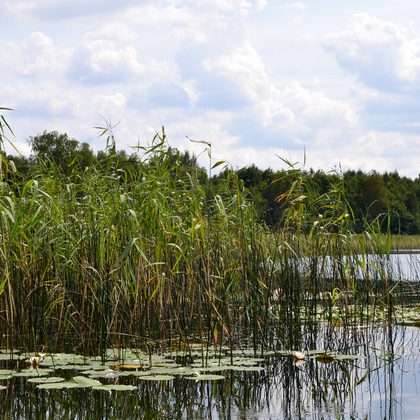
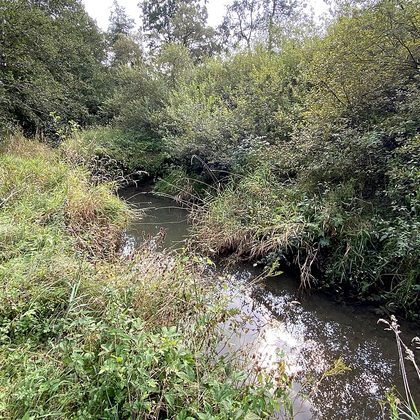
Fast, cold, well-oxygenated streams and rivers with clear water and a bed of stones and gravel, rich in the larvae of mayflies, stoneflies and caddisflies and in freshwater shrimps. It occurs from near sea level to about 2700 m, preferring streams above about 400 m. Important features are banks with crevices, stones and tree roots for resting, and a current that keeps the bed free of silt. Reservoirs, sluggish and heavily polluted stretches and streams that dry out in summer are avoided.
Where the animal is most at home, classified with EUNIS — the European standard for habitats.

Distribution
Endemic to northern Iberia and the Pyrenees, in Spain, Portugal, France and Andorra. The range covers both sides of the Pyrenees, the Cantabrian Mountains and the Basque Country, Galicia and northern Portugal, and also the Iberian System and the Central System with the Sierra de Gredos and the Serra da Estrela. Within that area the distribution is highly fragmented, and in much of the Central and Iberian Systems the populations have become small or disappeared; the occupied area has also contracted in the Cantabrian Mountains and the Pyrenees. In France it occurs in almost all Pyrenean river basins. Genetic work in the French Pyrenees shows low genetic diversity and a division into western, central and eastern groups.
- Native
- dark = core range, pale = thinly spread
Way of life
Mainly nocturnal, with a main peak around 11 pm and a second period of activity in the early morning, nine to ten hours a day in total. The desman forages on the stream bed, probing under stones with its snout; it stays underwater for up to about a minute. The food is chiefly benthic invertebrates: freshwater shrimps and the larvae of mayflies, caddisflies and stoneflies; each day it eats a fifth to two-thirds of its body weight. Home ranges are linear and cover 350 to 2300 m of stream, averaging just over 500 m; in good streams there are a few to more than ten animals per kilometre. Individuals can also move longer distances: animals have been tracked travelling 5 km upstream in a month and 18 km in a year. Breeding begins in January; a litter of one to five young follows a gestation of about 30 days, and the young breed the following year. A desman lives two to four years.
Where and when to look
A live desman is almost never seen in practice: it is small, nocturnal and shy, and its streams are hard to watch at night. The few sightings are of an animal working along the bed of a shallow stream at dusk or by torchlight. Droppings on projecting stones betray its presence, but only DNA confirms the species. Because it is strictly protected, collecting droppings and disturbing resting sites in France, Spain and Portugal are permitted only within recognised research programmes. A desman seen alive or found dead can be reported, with a photograph and a precise location, to the regional nature conservation authority.
Conservation status
Endangered (EN, 2021). The decline across the whole range is estimated at about half in ten years, and in Spain's first national Red List using the IUCN method (2026) the species is listed as Critically Endangered. Since May 2025 all Spanish populations have been in the category 'en peligro de extinción' of the Spanish catalogue of threatened species, and a 'critical situation' has been declared for the species, allowing recovery measures to be fast-tracked; previously only the Central System population was listed as endangered and the rest as vulnerable. In Portugal the species is also listed as endangered. The causes lie in the water: water abstraction for agriculture and artificial snow, dams and hydropower plants that fragment streams and alter flow regimes, pollution, erosion and siltation, bank works, drought and climate change, predation by otters and by introduced American mink, and inbreeding in small, isolated populations. National action plans and several LIFE projects are under way in France and Spain.
Scientific name
Galemys pyrenaicus | (É. Geoffroy Saint-Hilaire, 1811)
É. Geoffroy Saint-Hilaire described the species in 1811 as Mygale pyrenaica; because it was later moved to another genus, the author and year stand in brackets. Galemys is Greek, from galē, 'weasel', and mys, 'mouse'. pyrenaicus means 'of the Pyrenees', from where Geoffroy Saint-Hilaire described the animal. The specimen the first description was based on came from France, Pyrenees.