All species › Rodents › Mice and rats › Meriones shawi
Meriones shawi | Meriones shawii
Shawwoestijnmuis | Meriones shawi
Shaw's Jird is a large jird of North African cereal country. The species lives not in open desert but in the transition from steppe to farmland, where it reaches densities that make it an agricultural pest in Algeria. It is also one of the two main reservoir hosts of the desert form of cutaneous leishmaniasis, and is therefore studied in agronomy, medicine and mammalogy.
Tracks
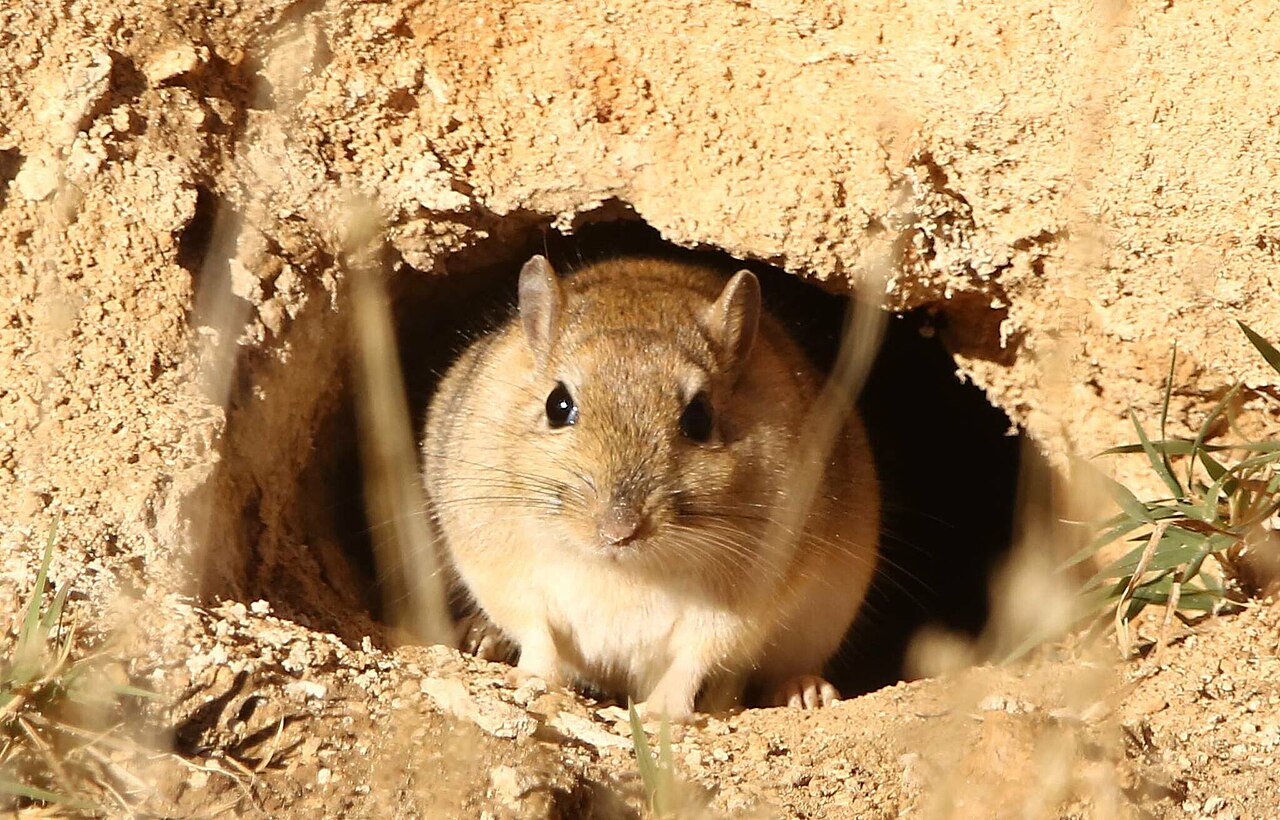
The species makes large, conspicuous burrow systems. It digs in soft ground, such as cereal fields, garden soil and banks between plots, a network with many entrances. Because it lives in colonies, such a system covers many square metres, with dozens of openings, fresh heaps of soil in front of them and worn paths a few centimetres wide between the entrances and out to the crop. The clearest sign is the store: grain is stored in the burrow chambers, and ploughing an infested field brings those chambers to the surface; clean threshed grain in a tunnel points to this species. Clipped straw, empty ears and chaff lie at the entrances, and in summer insect remains. The droppings are black, spindle-shaped, four to six millimetres long, in heaps at the openings. Prints show well in dusty field soil: four toes in front, five behind, about two centimetres long, with a tail drag at a walk. As in other jirds, foot-drumming is part of the alarm behaviour, together with short calls.
Head close-up
Identification
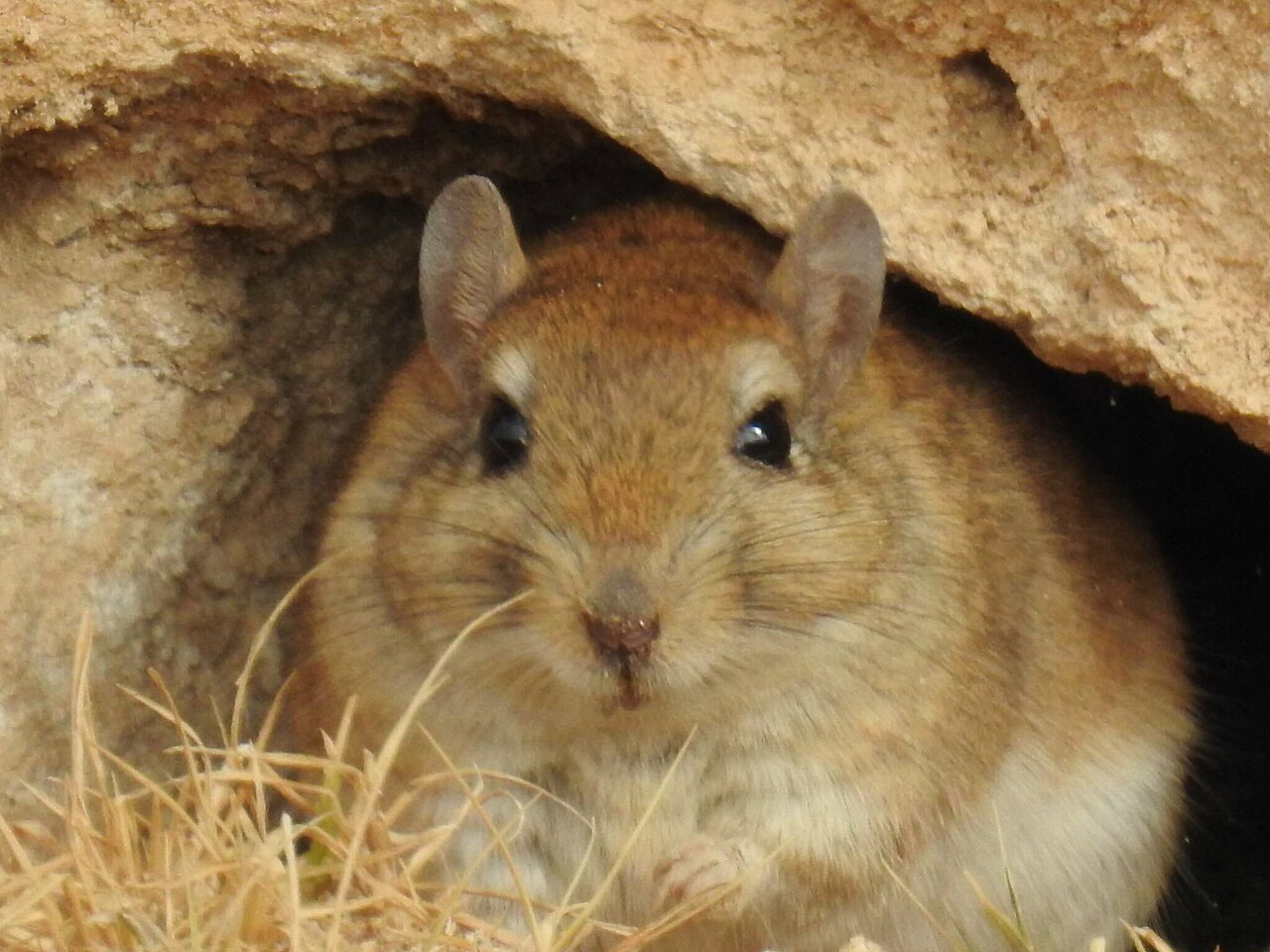
A large, solid jird with a warm tawny brown back and a white belly; the colour separates it from the grey desert species. Head-body measures 125 to 180 millimetres, the tail is slightly shorter than head and body (about 95 per cent) and ends in a small brush of black hairs, much smaller than the tuft of the Libyan Jird. The soles of the hind feet are partly haired and the claws are white. Ears measure 14 to 22 millimetres, hind foot 31 to 37. Weight ranges from 70 to 180 grams. Females have four pairs of nipples. In the field the animal is heavy, rufous and short-tailed, in contrast to the pale, long-tailed jirds of the open desert.
Similar species
In Maghreb farmland the species is usually the only large jird; on the southern edge two others occur. Sundevall's Jird (Meriones crassus) is smaller and lighter (55 to 158 grams), grey rather than tawny, with ivory-white claws and a pale tail base carrying a dark brush, and lives in open desert and hamada rather than in fields. The Libyan Jird (Meriones libycus) has a much heavier, darker tail tuft. The Fat Sand Rat (Psammomys obesus) is diurnal, has a shorter tail and darker claws, and lives among the halophytes of the sebkha rather than in cereal fields. A Black Rat or Brown Rat in the same sheds and gardens has a naked, scaly tail without a tuft, large bare ears and a more pointed muzzle. The Moroccan animals outside the east of the country, from the Atlantic plains into the Atlas, formerly included in this species have been treated as a separate species, Meriones grandis, since a revision by Pavlinov (2000).
Habitat
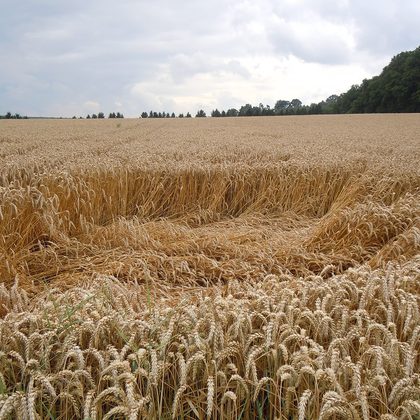
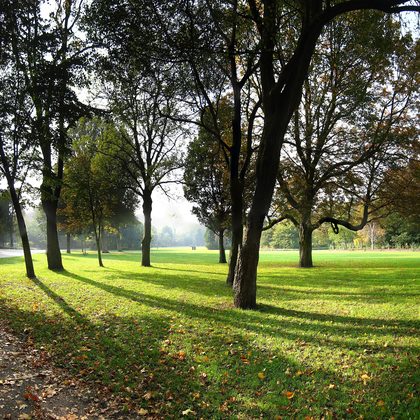
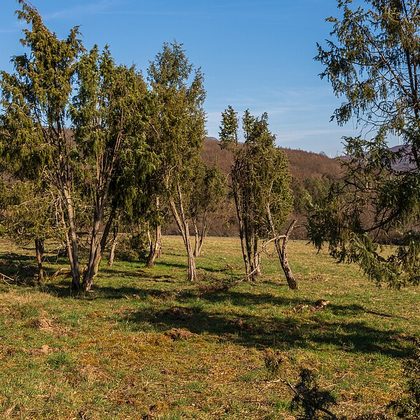
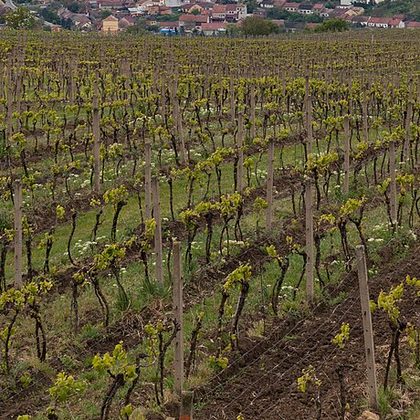
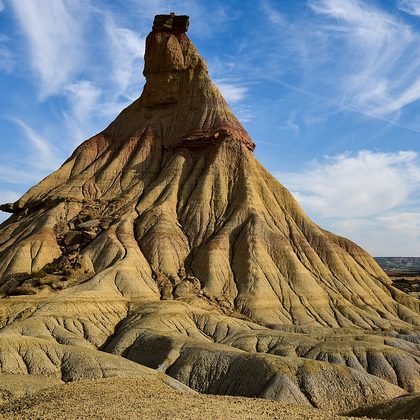
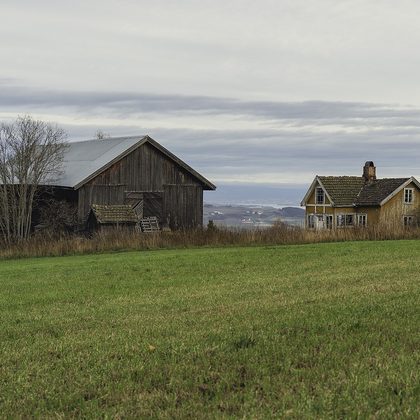
Semi-arid country, and within it above all cereal land with soft soil and oases: palm gardens, vegetable plots and orchards. The species reaches two thousand metres in the Atlas and on the high plateaus, where it has been found among rocks on sheltered slopes in grazing land. In Tunisia it lives in jujube scrub and along field edges hedged with prickly pear, dense thorny margins that give cover beside a rich crop. Around farms, yards and stores it lives close to people, but not inside buildings.
Where the animal is most at home, classified with EUNIS — the European standard for habitats.
Distribution
The coastal regions of North Africa, from eastern Morocco east to Egypt west of the Nile: the area of Maghreb arable farming, the high plateaus and the northern Saharan fringe. The whole range lies within the guide area. The species is monotypic: forms formerly recognised have been raised to species, as M. grandis in Morocco, or set aside as unvalidated, as the form trouessarti. A full revision of the entire range is still lacking.
- Native
- dark = core range, pale = thinly spread
Way of life
Mainly nocturnal, but also seen in the morning. A burrowing ground-dweller that lives in colonies; males hold larger territories than females, and communication is by foot-drumming and calls. The diet is almost entirely vegetable and shifts with the season: in spring and summer more than half consists of cereal grain, in the other months of legumes, composites, mallows and a variety of stems, flowers and leaves; in summer arthropods are occasionally eaten. Stores are laid up in the burrow. Breeding is seasonal, peaking after the rainy season; gestation is twenty-one days and the litter numbers three to eight, on average five. The species neither hibernates nor keeps a winter rest.
Where and when to look
Look for the species where steppe turns into cereal land: drive a field edge with stubble or young cereal on the Algerian or Tunisian high plateau towards sunset and watch the banks and plot margins. By day the burrow systems are easy to find; a network of openings with fresh heaps of soil is visible from twenty metres, and if you sit nearby towards evening you will see the animals emerge. The species also occurs in the palm gardens of the oases: walk along the irrigation channels and earth banks in the last light. In the Atlas it may occur up to two thousand metres, among the boulders of a grazed slope. In farmland it is so numerous that one evening is usually enough.
Conservation status
Least Concern (2016, assessed under the name Meriones shawi). In cereal country the species can reach densities at which it is regarded as a pest. In Algeria the damage has been put at four hundred kilos of wheat per hectare and at two to four hundred thousand hectares of farmland affected per year. It is also, together with the Fat Sand Rat, one of the principal reservoir hosts of Leishmania major, the parasite that causes the desert form of cutaneous leishmaniasis: in southern Morocco it is the main infected animal, and natural infections have also been found in Algeria and Tunisia. For both reasons the species is subject to control. Its abundance is linked to the farmland landscape created by people.
Scientific name
Meriones shawii | (Duvernoy, 1841) (GBIF: Meriones shawi)
Duvernoy described the species in 1841 as Gerbillus Shawii; because it was later moved to another genus, the author and year stand in brackets. Meriones is the name of Meriones, the Cretan hero of the Iliad; the name itself belongs with Greek mēros, 'thigh'. Why Illiger gave it to a jird he does not say. shawii honours the English clergyman and traveller Thomas Shaw (1694–1751), whose account of the Barbary coast long remained the standard work on North Africa. The specimen the first description was based on came from Algeria, Oran.