All species › Bats › Horseshoe bats › Mediterranean horseshoe bat
Mediterranean horseshoe bat | Rhinolophus euryale
Paarse hoefijzerneus | Murciélago Mediterráneo de Herradura
The Mediterranean Horseshoe Bat is a medium-sized horseshoe bat of southern Europe, North Africa and south-west Asia, with a forearm of 43 to 51 millimetres. The Dutch name, meaning purple horseshoe bat, refers to the faint reddish to lilac tinge the grey-brown upperparts can show. The species roosts mainly in large caves in limestone country, forms winter colonies of up to 2000 animals and is, among the European horseshoe bats, the hardest to separate from Mehely's Horseshoe Bat.
No photograph of a living wild animal of this species with a suitable Creative Commons licence exists. Do you have one that meets the rules? Send it in.
Tracks
The species is mostly seen as a colony: clusters of grey-brown horseshoe bats on the ceiling of a large, warm cave, deeper inside in summer and closer to the entrance in winter. Droppings lie beneath the roosting spots. Prey is usually carried to a night roost, such as a group of trees, and eaten there; moth wings can collect beneath such places. On a bat detector the call is a long constant-frequency tone between 100 and 109 kHz with short frequency-modulated start and end sweeps and a mean interpulse interval of 84.5 milliseconds (Greece).
Identification
Medium-sized, with a forearm of 43 to 51 mm and a weight of 7.5 to 17.5 g. The back is grey-brown with a faint reddish, lilac or yellowish tinge; the belly is paler but never close to white. Juveniles are grey. Around the eyes there is at most a faint dark marking. The ears are short (about 42 per cent of the forearm) and lack a tragus. The nose-leaf: a straight-sided lancet, triangular with a blunt tip; a narrow, forward-curving, pointed connecting process; a sella with almost parallel sides and a broad top; a narrow horseshoe of 6.5 to 7.5 mm without lateral leaflets. The lower lip has three distinct grooves. The wings are pale brown. Flight is slow and agile, with short spells of hovering. Echolocation is FM/CF/FM with a constant frequency of 100 to 109 kHz: mean 104.8 kHz in Greece, 104 to 106 kHz in Bulgaria, 102.3 kHz in France, 100 to 104 kHz in Italy and 102.4 kHz in Tunisia. Calls in Greece last 53.8 milliseconds on average.
Similar species
According to the Handbook of the Mammals of the World, Mehely's Horseshoe Bat (Rhinolophus mehelyi) is very difficult to distinguish from this species. Mehely's is on average slightly larger (forearm 48–56 mm), has a pure white or nearly white belly with a clear boundary against the back, a dark patch around or below each eye, a lancet with a narrowed upper half and a subtriangular connecting process that is not pointed and curved forward. Call frequencies overlap: Mehely's averages around 109 kHz (104–112 kHz). Blasius's Horseshoe Bat (R. blasii) is the same size but has a connecting process shaped as a high, narrow horn, a wedge-shaped sella narrowing upwards, and calls lower, around 94 kHz on average in Europe. The Lesser Horseshoe Bat (R. hipposideros) is smaller (forearm 35–42.5 mm), has a low, rounded connecting process and calls around 110 kHz. The Greater Horseshoe Bat (R. ferrumequinum) is larger (forearm 51–61 mm) and calls around 82 kHz. In a cave the roosting posture is a pointer: active Mediterranean Horseshoe Bats hang in small clusters in body contact, as Mehely's do, but unlike Lesser and Greater Horseshoe Bats.
Habitat
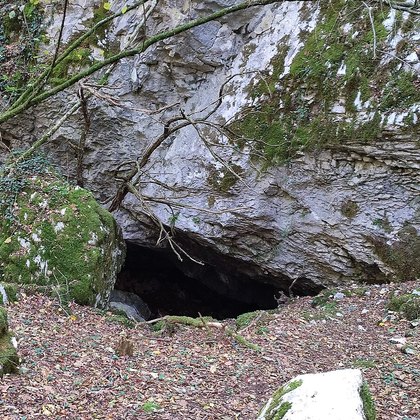
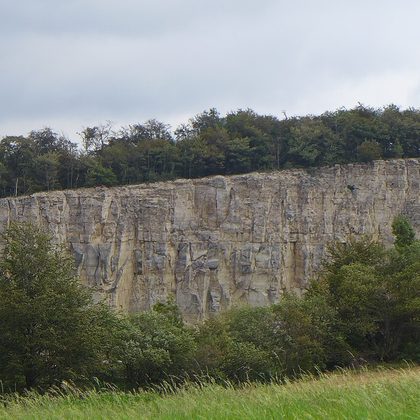
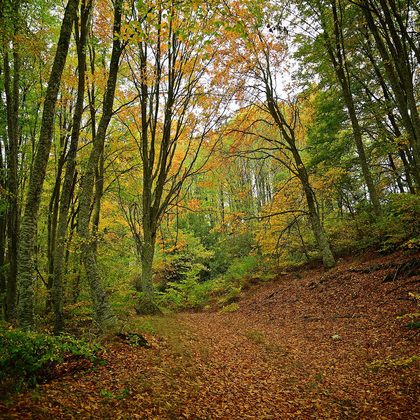
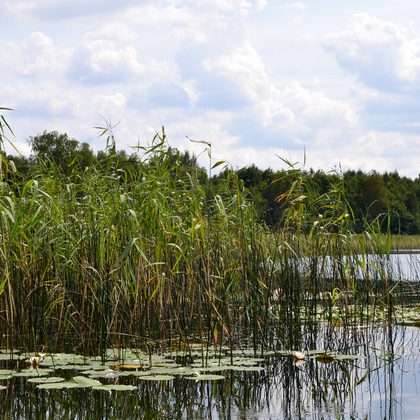
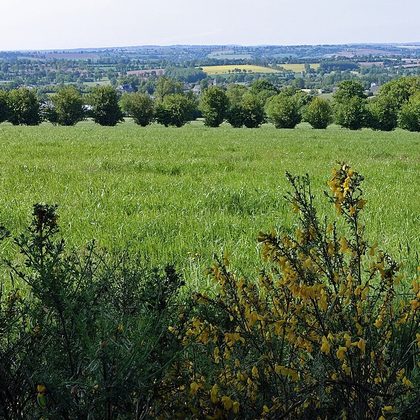
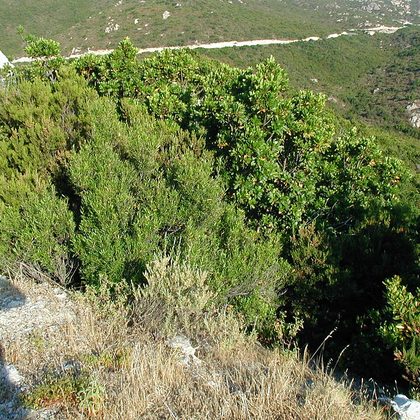
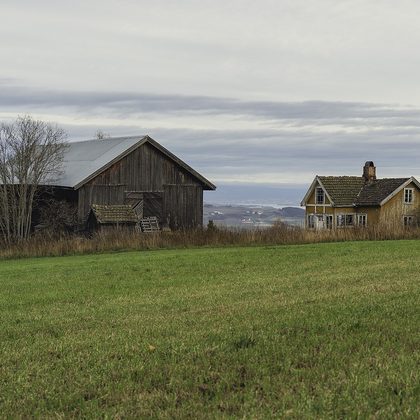
Mediterranean and sub-Mediterranean scrub and woodland from sea level to about 1360 m. In Italy it prefers to forage in broadleaved woodland and riparian vegetation and avoids conifer forest and scrub; in Spain it is tied to edges: hedgerows, woodland margins and isolated trees. In North Africa it has been found in Mediterranean sclerophyllous forest, semi-desert grassland and scrub. The species occurs mainly in limestone areas with many caves and water nearby. Roosts are usually large caves; colonies in buildings have also been found in Europe.
Where the animal is most at home, classified with EUNIS — the European standard for habitats.
Distribution
Southern Europe from the Iberian Peninsula and central and southern France to the whole Balkan Peninsula, including Corsica, Sardinia, Sicily and Rhodes, with isolated populations in southern Slovakia and northern Hungary. Further, North Africa (northern Morocco, northern Algeria, Tunisia) and south-west Asia: Turkey, the Caucasus, the Levant, northern and western Iran and northern Iraq. A single specimen from Cyprus is assigned by most authors to Mehely's Horseshoe Bat; Turkmenistan is also uncertain. The species is regarded as extirpated in Switzerland and Gibraltar. The handbook treats it as monotypic; the former subspecies judaicus belongs with Mehely's Horseshoe Bat on the evidence of the type specimen, and the Levantine populations may form a still unnamed subspecies.
- Native
- dark = core range, pale = thinly spread
Way of life
Nocturnal; the bats leave the cave late in the evening. They hunt in slow flight, from a perch and probably also by gleaning prey from foliage and the ground. Throughout the year the diet consists mainly of small to medium-sized moths (5–11 and 25–40 mm long), supplemented with crane flies, other flies, beetles and other insects; in Spain moths made up 68 to 99 per cent of the diet, and chafers of the genus Rhizotrogus mattered before breeding. On the Iberian Peninsula bats foraged on average 1.3 km from the roost (at most 4.2 km); lactating females on average 4.3 km (at most 9.2 km). Mating probably takes place before hibernation; gestation is about 90 days and a single young is born in June-July. Males mature between 15 months and 2.2 years, females at 2 to 3 years; an age of about 13 years has been reported. Winter colonies hold up to 2000 animals, maternity colonies 50 to 400. In hibernation torpor is deep, but the bats arouse regularly and then leave the cave. Summer and winter roosts in the Carpathian region lie 0.5 to 16.7 km apart; the longest recorded movement is 134 km.
Where and when to look
Emergence at a known colony in limestone country in southern France, the Iberian Peninsula, Italy or the Balkans gives the best chance. On a detector, a call between 100 and 104 kHz largely rules out Mehely's in most regions; between 104 and 109 kHz no secure assignment is possible. A conclusive identification needs a photograph of the face and nose-leaf: check the connecting process, belly colour and the markings around the eyes. Caves with colonies should not be entered during the hibernation and maternity periods; in many countries this is regulated by law.
Conservation status
Near Threatened globally (NT, 2016), with a declining overall population. In the central and eastern Balkans the species is stable and common; in Portugal and Italy, where populations are already small, it is declining. In France numbers fell by about 70 per cent between 1940 and 1980 and have been stable since the 1980s; large declines have also been reported from Spain. Caves in Iran that held thousands of bats of several species thirty years ago are now empty. Causes cited are habitat loss to urbanisation and intensive agriculture, fragmentation, roost destruction and, in France, organochlorine pesticides. The species is listed in Annexes II and IV of the Habitats Directive.
Scientific name
Rhinolophus euryale | J. H. Blasius, 1853
J. H. Blasius described the species in 1853 and placed it straight away in the genus where it still stands. Rhinolophus is Greek, from rhis, genitive rhinos, 'nose', and lophos, 'crest', after the nose-leaf. euryale is Euryale, one of the three Gorgons, the sisters of Medusa; it stands as a proper noun in apposition to the genus name. The specimen the first description was based on came from Italy, Milan.