All species › Carnivores › Mustelids › Marbled Polecat
Marbled Polecat | Vormela peregusna
Gevlekte bunzing | Turón Búlgaro
The marbled polecat is a small mustelid of steppe and semi-desert, from south-eastern Europe through the Middle East and Central Asia to Mongolia and northern China. Within the area of this guide it lives in two separate populations: in the Balkans and north of the Black Sea.
Tracks
The marbled polecat digs its own burrows or uses the burrows of other rodents. The sleeping chamber lies 60 to 100 cm from the entrance and is lined with grass in winter. At night it covers up to 1 km. Detailed descriptions of track and scat were not found in the sources of this guide.
Identification
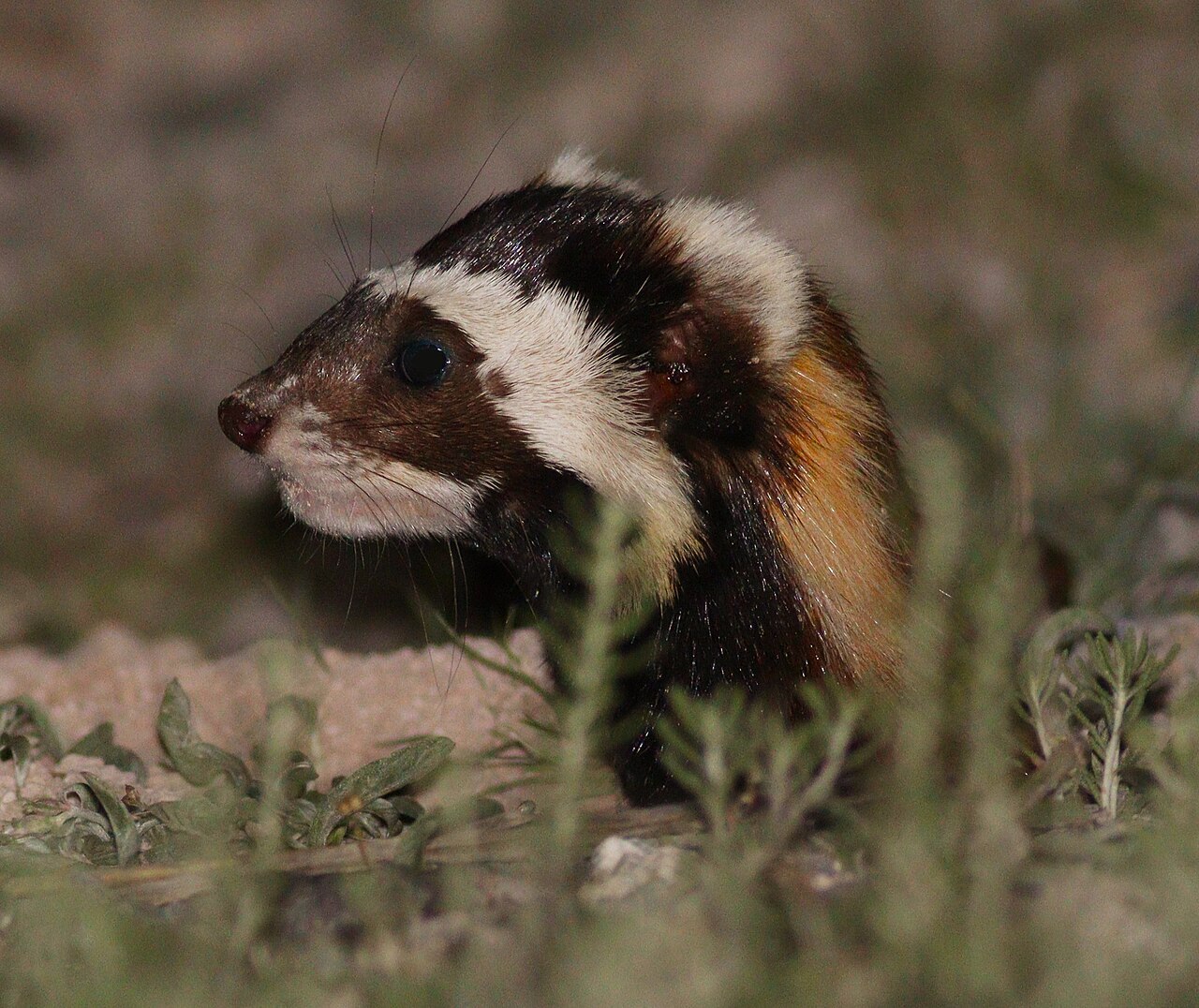
An elongated, short-legged mustelid with a yellow coat marbled with reddish-brown or brown blotches. The head is black with a white band across the forehead above the eyes; the eyes sit in a black mask. The ears are large and white. The tail is bushy, with black and white hairs. Head-body 29 to 48 cm, tail 15 to 20 cm; females weigh 295 to 600 g, males 320 to 715 g. When threatened it raises its fur, arches its back, raises its tail and hisses; it may release a strong-smelling secretion from the anal glands.
Similar species
The pattern makes confusion in good light unlikely. The steppe polecat also has a pale body, but plain yellowish-white to grey, without blotches, against dark legs, chest and tail. The European polecat is dark brown to black with pale underfur and a silvery-white mask between eye and ear. On a camera-trap image at night, where the colours are lost, the large white ears, the white forehead band and the pale, blotched back decide it.
Habitat
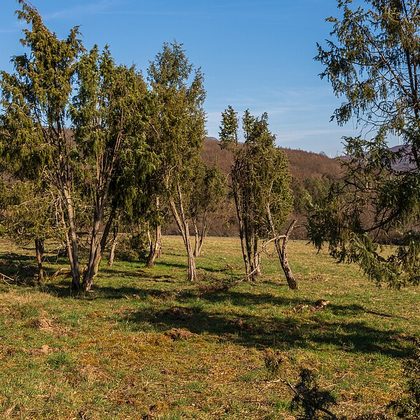
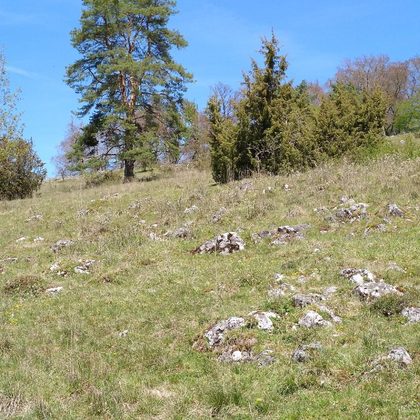
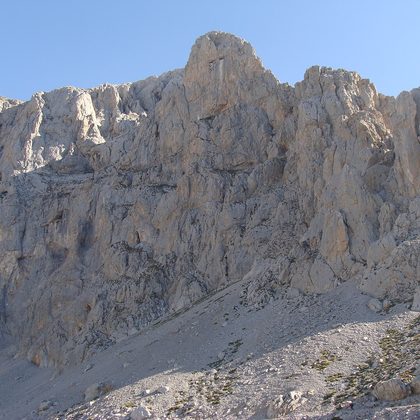
Dry, open landscapes: steppe, semi-desert and desert, dry rocky valleys in hills and mountains, and dry subtropical scrub. In Europe steppe with scattered hawthorn and blackthorn bushes. In Central Asia also oases, riverine woodland (tugai), dunes with bushes, clay steppe and salt marsh.
Where the animal is most at home, classified with EUNIS — the European standard for habitats.
Distribution
South-eastern Europe, the Caucasus, Asia Minor, the Middle East, Central Asia, Mongolia and northern China. In Europe there are two populations. The Balkan population lives in Romanian Dobruja, Bulgaria, European Turkey, northern Greece, North Macedonia, Serbia, southern Dalmatia, Montenegro and probably Albania. The population north of the Black Sea lives in south-eastern Ukraine and in the European part of southern Russia. Within the area of this guide the species also occurs in Turkey, the Levant and Egypt.
- Native
- dark = core range, pale = thinly spread
Way of life
Mainly active at night and at dusk and dawn, sometimes by day. Solitary; animals may meet, but hunt and rest alone. Eyesight is weak and the species relies mainly on smell. The diet consists of small mammals — ground squirrels, dwarf hamsters, gerbils and jirds, mice, voles and rabbits — and also of birds, reptiles, amphibians, snails, insects and fruit. In Israel mole crickets made up 66% of the summer diet, while rodents dominated in winter. Mating from March to early June. Because of delayed implantation total gestation lasts 243 to 327 days; depending on the region the young are born in February or March, four to eight per litter. The eyes open at 38 to 40 days, the young are weaned at 50 to 54 days and disperse at 61 to 68 days. Females reach sexual maturity at three months, males at one year. A captive animal lived 8 years and 11 months.
Where and when to look
The chances are best in the remnants of natural steppe in Dobruja and the steppe areas of south-eastern Ukraine, where ground squirrels live. Search at dusk and at night along grassland with ground-squirrel colonies. A road casualty with a marbled coat and white ears can be reported with photograph and locality.
Conservation status
Vulnerable (VU, 2016) globally; also Vulnerable in the European assessment. In Europe the species has declined substantially with the loss of steppe: a reduction of at least 30% is suspected. The main cause is the conversion of natural steppe and semi-desert to farmland, which also reduces prey. Secondary poisoning by rodenticides is a possible further cause.
Scientific name
Vormela peregusna | (von Güldenstädt, 1770)
Von Güldenstädt described the species in 1770 as Mustela peregusna; because it was later moved to another genus, the author and year stand in brackets. Vormela is German Würmlein, 'little worm', an old vernacular name for the polecat and its kin: a long, low animal that works its way through holes like a worm. peregusna is the animal's country name on the South Russian and Ukrainian steppe, perehuznia, which Güldenstädt took over unchanged as the specific name. The specimen the first description was based on came from Russia.