All species › Carnivores › Mustelids › Common otter
Common otter | Lutra lutra
Otter | Nutria
The otter is a mustelid of fresh water and rocky coasts that is seldom seen but occurs over much of Europe. Its presence can usually be established without seeing the animal: the spraint, a scent mark, is left at fixed places such as a boulder in mid-stream or the dry ledge beneath a bridge. In the second half of the twentieth century the species disappeared from large parts of western and central Europe; since then it has returned, partly unaided and partly through reintroduction.
Tracks
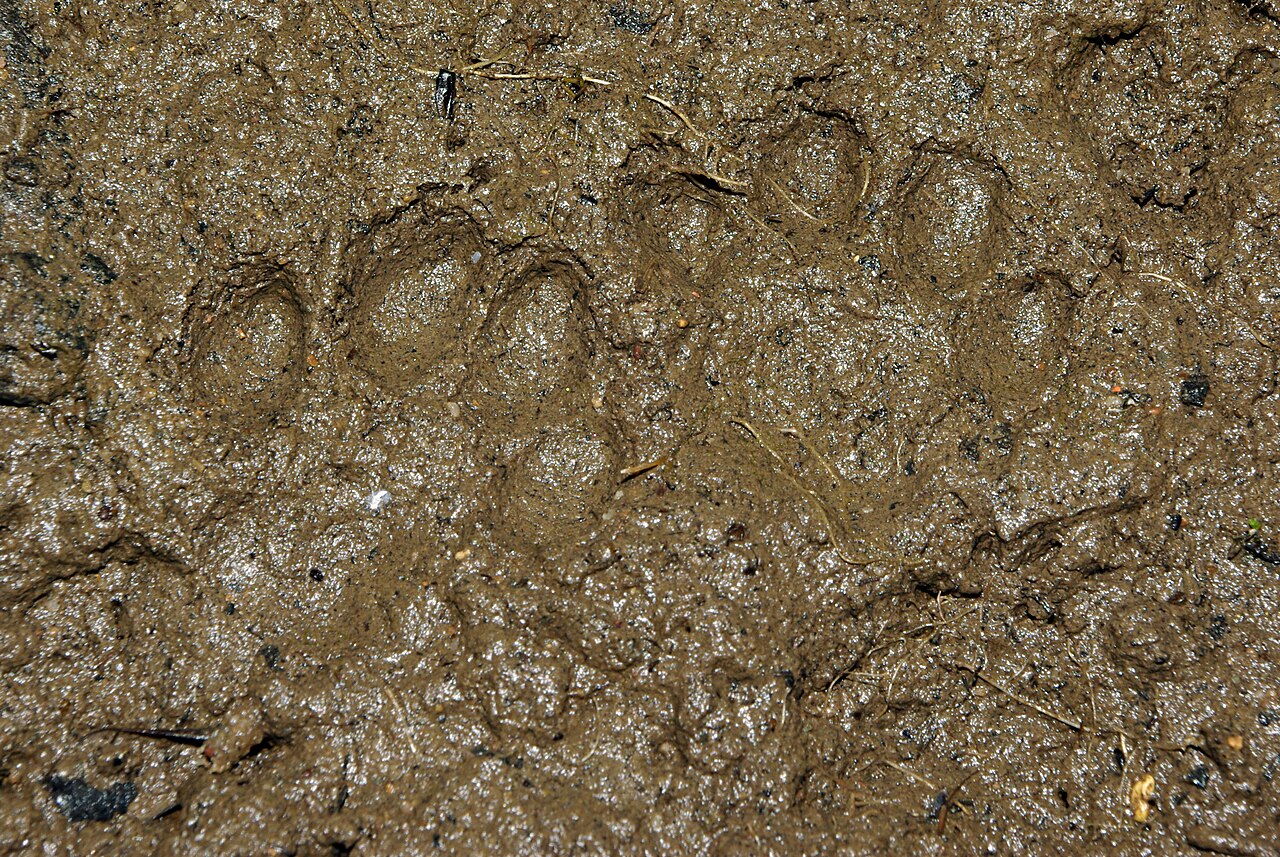
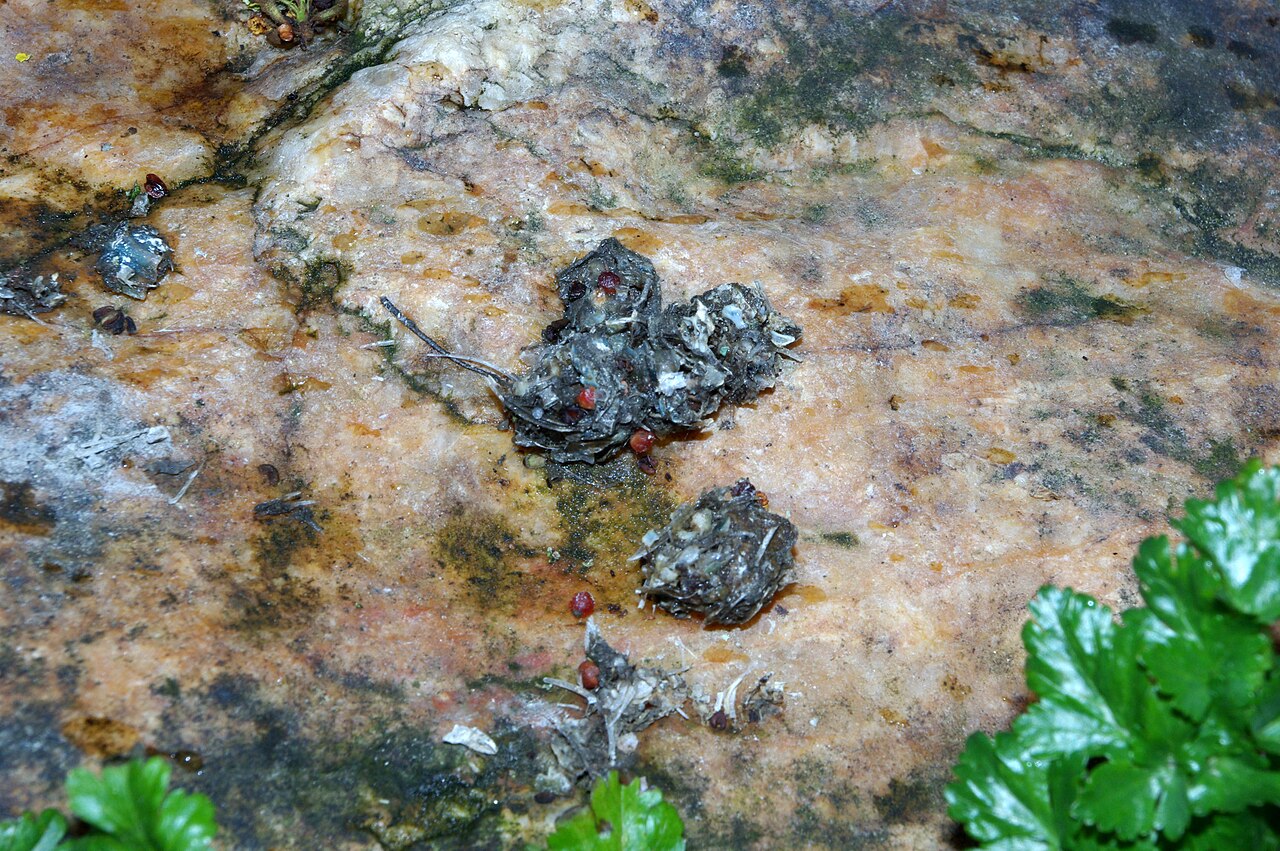
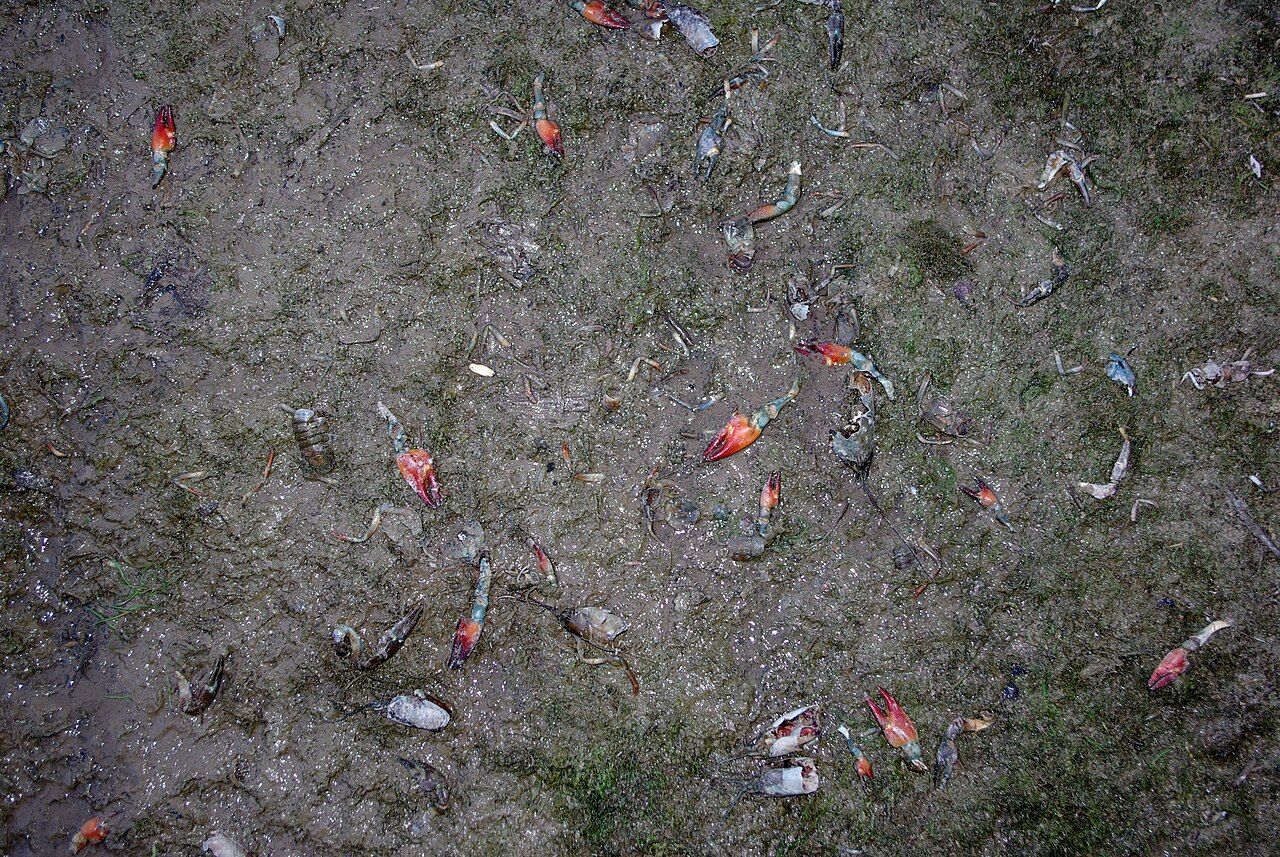
The main sign is the spraint: not ordinary droppings but a scent mark, placed in a conspicuous spot. It is 3 to 10 cm long and 1 to 1.5 cm thick, blackish green and glossy when fresh, grey and crumbling to a heap of loose remains within days. Rubbed apart, it contains fish bones, small jaws and shiny scales, blue-white fragments of crayfish shell, frog bones and occasionally a feather. The smell is decisive: sweetish, described as similar to jasmine tea, new-mown hay or fish oil, and never the sharp ammonia smell of a mink scat. The sites are fixed: a boulder in the stream, a post, a tussock at the water's edge, a fallen trunk and above all the dry ledge under a bridge, throughout Europe the first place to look. Often the animal scrapes together a small heap of sand, grass or leaves, the sign heap, and deposits the spraint on top; sometimes only a drop of clear, jelly-like anal secretion is left. The print shows five toes in a shallow arc around a broad, squat pad, is 5 to 7 cm wide and 6 to 9 cm long, with small pointed claw marks; in wet silt and fine sand the webbing shows as a thin rim between the toes, which is conclusive. Often only four toes register; then use the spread and the broad pad. In snow and mud the tail leaves a drag mark between the prints. The slide is a worn chute 20 to 40 cm wide running from a steep, muddy or snowy bank straight into the water and used repeatedly. Other signs are haul-outs with flattened vegetation, fixed runs across a spit of land, gaps under fences, and the holt: a resting place under a root plate, in a bank or beneath a rock pile, often with the entrance under water. Prey remains lie on the bank: a fish is eaten from the head, leaving the tail and hind body, and crayfish leave their claws.
In its habitat
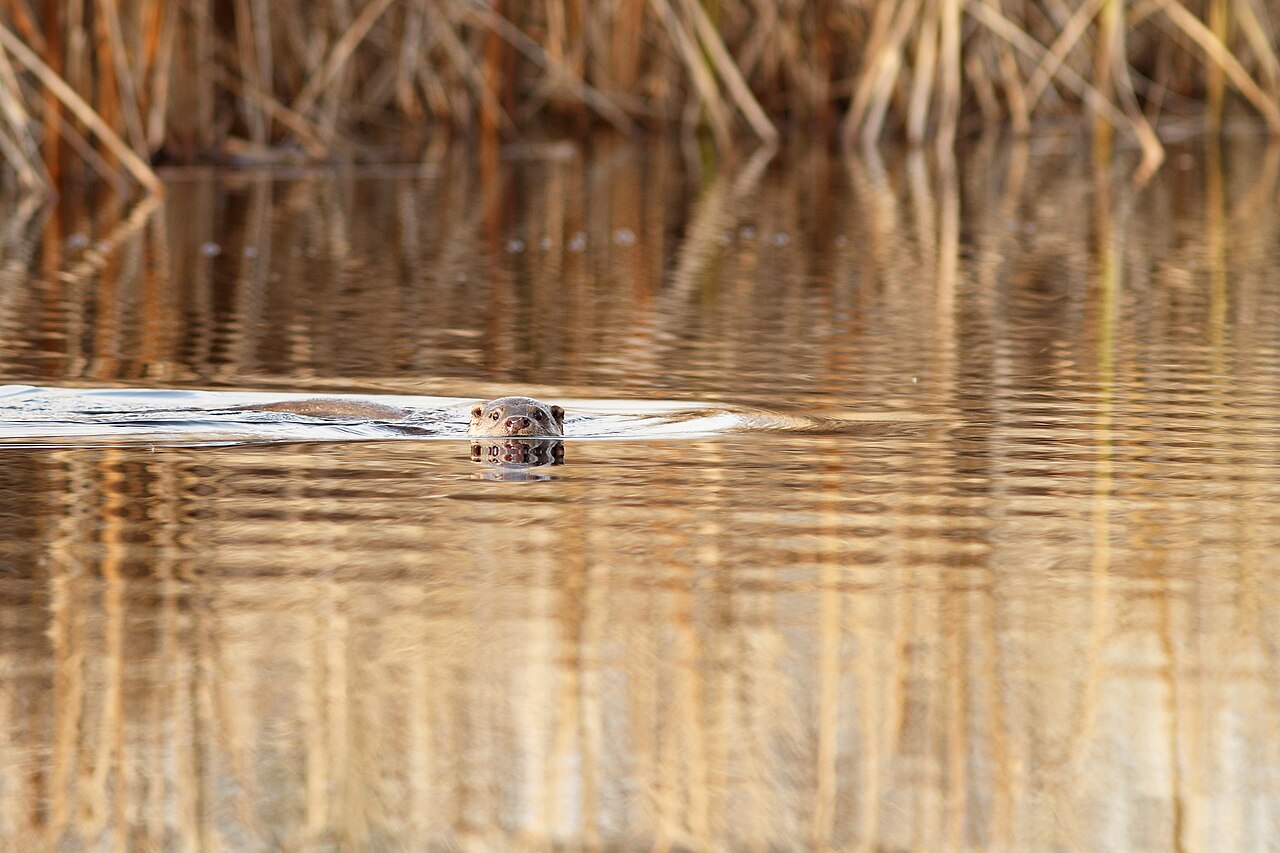
Head close-up
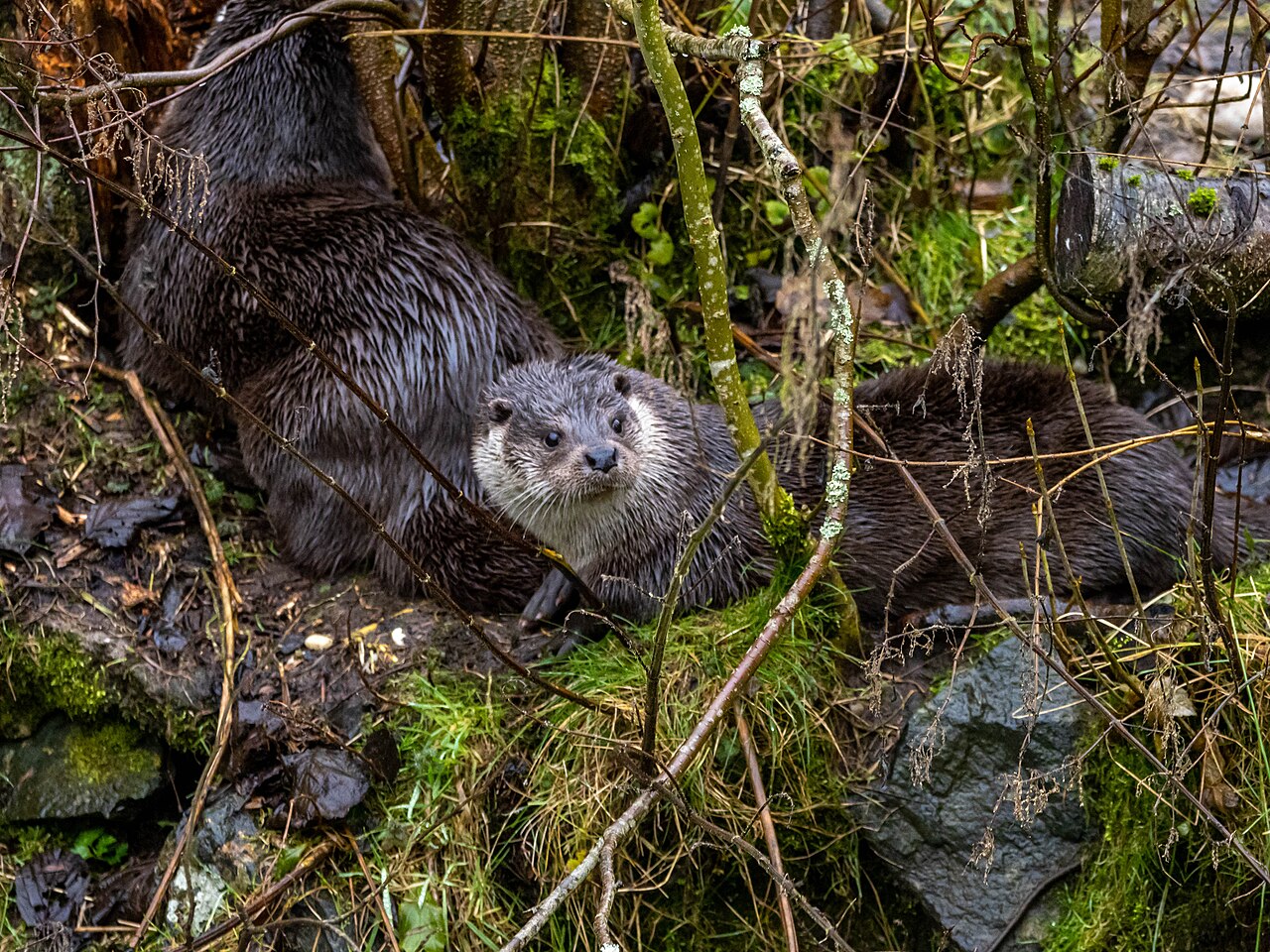
The young
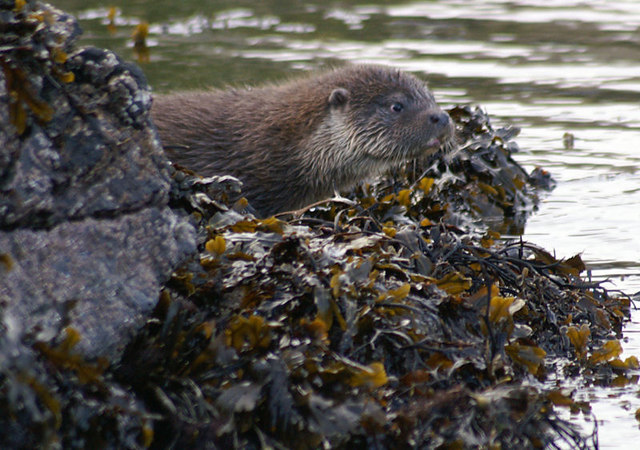
Identification
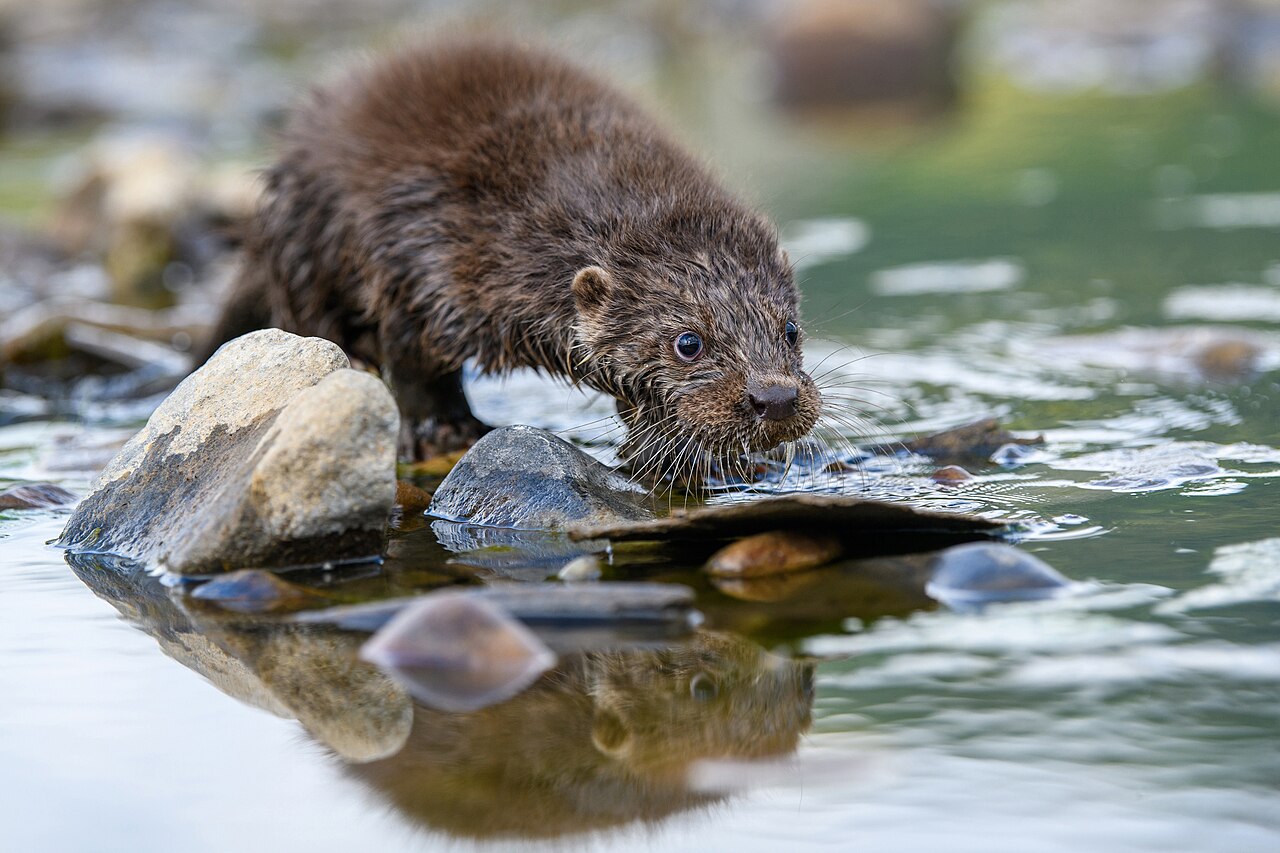
Long and low, with a spindle-shaped body. Head-body 57 to 95 cm, with a thick tail, round at the base and tapering gradually to the tip, 35 to 45 cm long, nearly half the body length; because of the thick tail base a swimming otter looks longer than it is. The fur is dark brown, glossy blackish brown when wet, with a paler, often dirty-white throat and chin whose pattern differs between individuals. The head is broad and flat, with a blunt muzzle, a wide grey nose pad, short stiff whiskers and small round ears that are closed under water. The eyes are set high on the head. The legs are short, with five toes and full webbing. At the surface three humps are visible — head, back and tail tip — and it dives without a splash, in a rolling movement. On land it moves with an arched back and low head, in a short bounding gait.
Similar species
In the water confusion with other species is common. The Beaver is much larger and heavier, blunt-headed, with a broad, flat, scaly tail; it swims with only the head and part of the back above water and slaps the water with its tail when alarmed; an otter dives silently. The Coypu has a round, thin, almost naked tail, white whiskers, a pale muzzle and orange incisors, and swims high in the water with a humped back. The Muskrat is much smaller, with a laterally flattened tail that moves visibly from side to side when swimming. The American Mink has the same shape but is half the length, much darker, and has a sharply defined white patch on chin and lower lip only, a more pointed muzzle and a thin, furry tail without a thickened base. The European Mink has a white patch on both upper and lower lips. When in doubt, the tail decides: thick and tapering in the otter, thin and evenly furred in the minks.
Habitat
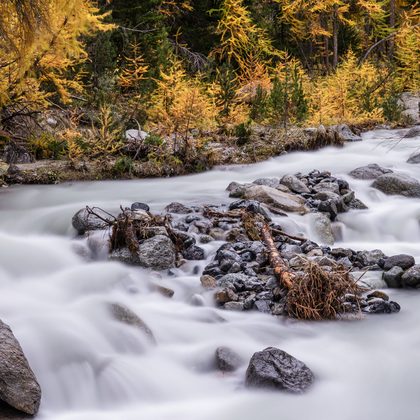
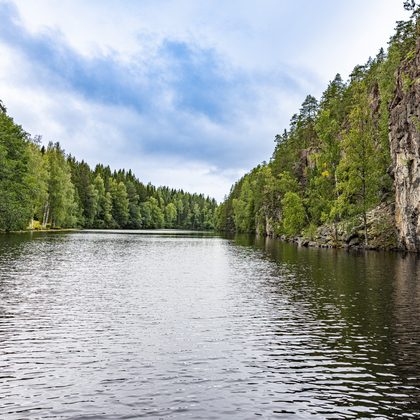
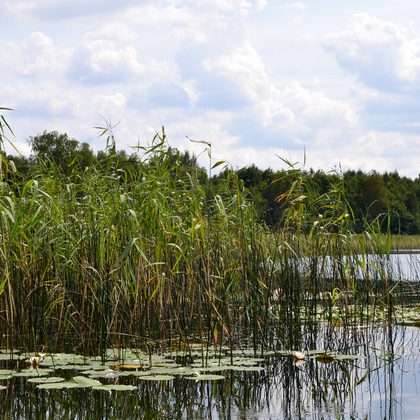
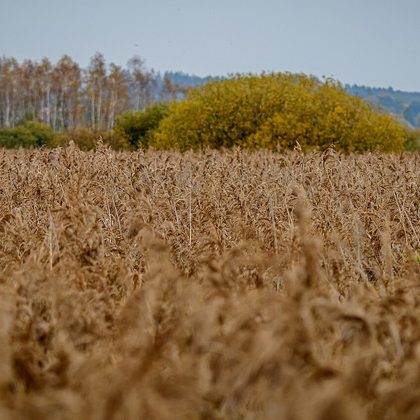
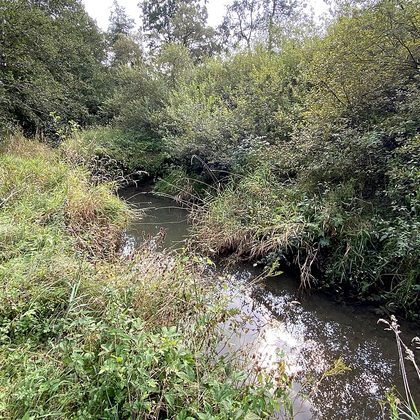
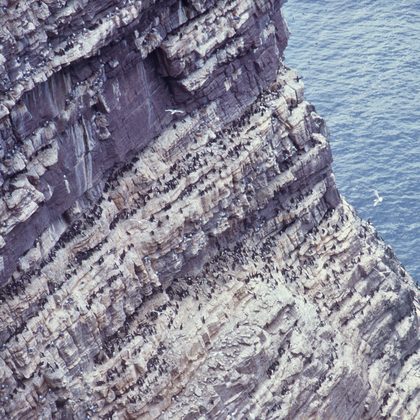
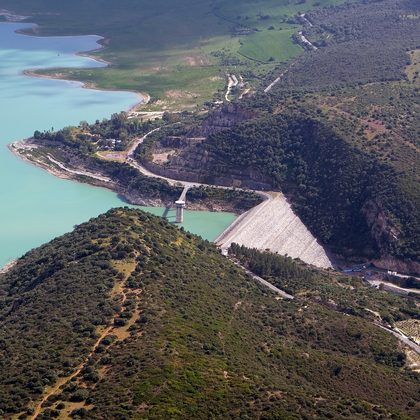
Water with plenty of bank: streams, rivers, old river channels, marshes, peat cuttings, lakes, wide ditches and ditch networks in low fen country. What matters is not water depth but cover along the bank — reed, sedge, rank herbage, willow scrub and overhanging root plates — and sufficient fish. It avoids bare, revetted water and cold, fast mountain streams without bankside vegetation. In Scotland, Ireland and Norway it lives on rocky coasts and hunts in the sea among the kelp, but needs fresh water there to rinse its fur, which otherwise loses its insulating properties. Artificial waters — reservoirs, fish ponds and canals — are used as soon as there is cover.
Where the animal is most at home, classified with EUNIS — the European standard for habitats.
Distribution
From Ireland to the Pacific and from Lapland to North Africa, Israel and South-East Asia; one of the largest ranges of any mustelid, but with many gaps. From the late 1950s the species disappeared from large parts of western and central Europe because of organochlorine pesticides (dieldrin, DDT) and PCBs, pollution, land consolidation, drowning in fyke nets and road traffic. In Britain it vanished from the rivers of England within a decade and remained only in west Wales, the south-west and northern Scotland; after the chemicals were banned and water quality improved it spread again, helped by releases in East Anglia and the Midlands, and by 2011 it had been recorded in every English county. In Ireland the population did not collapse and is among the densest in Europe. In the Netherlands the last animal was killed on a road in Friesland in 1988; reintroduction began in 2002 in the Weerribben and Wieden with animals from eastern Europe, after which the species spread across north-western Overijssel, Friesland, the north of North Holland, the Gelderse Poort, the river district and Utrecht. In Belgium it is returning unaided from Wallonia, Germany and Limburg. On the Iberian Peninsula it disappeared between the 1960s and 1980s from much of central and eastern Spain and survived mainly in the north-west and in Extremadura; since the 1990s it has returned to almost all river basins, from the Miño to the Guadalquivir and from the Duero to the Segura, including Catalonia, the Levant, the Meseta, urban river stretches and reservoirs. In Portugal it never disappeared. It is absent from the Balearics and the Canary Islands. In Scandinavia the species has recovered; in southern and eastern Europe and in Asia it is still declining.
- Native
- Reintroduced
- dark = core range, pale = thinly spread
Way of life
Mainly nocturnal and crepuscular; on the Scottish coast and in Shetland it follows the tide and is therefore also active by day. It is solitary, with a linear territory along the watercourse: a male may use 10 to 40 km of bank, a female much less, and the ranges of the two sexes overlap. Fish is the main food — in north-western Europe among others eel, roach, perch, bullhead and stickleback, in Iberia among others barbel, boga, black bass and chub, and trout in mountain streams — supplemented with crayfish (in Spain mainly the introduced red swamp crayfish), frogs and toads (locally the main food in late winter, when amphibians gather), waterbirds, small mammals and aquatic insects. It hunts by sight and with its touch-sensitive whiskers, which detect the water movement of a fish in turbid water. In Europe young are born in every month of the year; after a gestation of about 63 days two or three blind, densely furred young are born in a holt in the bank. They first enter the water at about ten weeks, have to learn to swim and stay with the mother for about a year. The otter does not enter winter torpor; under ice it uses holes and air pockets, and a prolonged frost quickly puts it in difficulty. In the wild it rarely lives beyond five years.
Where and when to look
Search for spraint first and the animal second. Walk a stream in the morning and check every boulder in the current, every post and above all the dry side under every bridge: a blackish-green, sweet-smelling heap indicates an otter. For the animal itself the first hour after sunrise and the last hour before dark are most suitable, on a quiet, wide watercourse with plenty of bankside vegetation; sit still and watch for the V-shaped wake and the three humps. On the west coast of Scotland, especially Shetland, Skye and Mull, otters forage along the tideline by day and can be watched for long periods from a low position facing into the wind. Other areas are the Weerribben-Wieden and Rottige Meente in the Netherlands, the rivers of Galicia and Asturias, the gorges of Extremadura, the Guadalquivir, the reservoirs of the Meseta at dawn and the Coto de Doñana. Do not stand on the bank directly above a haul-out: an otter that smells or hears you leaves the site and does not return.
Conservation status
Near Threatened (NT, 2022). The category averages two opposite trends. In western and central Europe the trend has been positive since the 1990s: the ban on organochlorine pesticides and PCBs, which suppressed breeding, cleaner water and the construction of wildlife passages have brought the species back to countries where it had almost disappeared, and in the Netherlands it has been reintroduced. In southern and eastern Europe and in the Asian part of the range it is declining because of river engineering, drainage, overfishing and poaching. The known threats persist: road traffic (the main cause of death in the Netherlands, where most known animals have been found dead beside a road), drowning in fyke nets and eel traps, canalisation and revetment of banks, and a persistent load of contaminants that accumulate in the liver. The species is listed in Annexes II and IV of the Habitats Directive; the size of a population depends strongly on the quality of the banks.
Scientific name
Lutra lutra | (Linnaeus, 1758)
Linnaeus described the species in 1758 as Mustela Lutra; because it was later moved to another genus, the author and year stand in brackets. Lutra is the Latin word for 'otter'. The specific name repeats the genus name. The specimen the first description was based on came from Sweden.