All species › Rodents › Voles and hamsters › Lusitanian Pine Vole
Lusitanian Pine Vole | Microtus lusitanicus
Baskische woelmuis | Topillo Lusitano
The Lusitanian Pine Vole is the commonest small mammal of north-western Iberia, but is seldom seen. It lives in tunnels under meadows, hedgebanks and vegetable plots in Galicia, Asturias, León, northern Portugal and the Basque Country, and is detected mainly by the small heaps of earth along field margins. Its digging signs can be found and distinguished from those of the mole, which is seldom the case in related species.
Tracks
The species digs an extensive, much-branched system: shallow foraging tunnels to about 15 cm deep and deeper tunnels to 40 cm with nest and store chambers. Tunnel diameter is very constant at 25 to 35 mm and rarely exceeds 45 mm; a mole tunnel is clearly wider. The spoil lies in small, low heaps of very finely crumbled soil, close together and in winding lines; all entrances are sealed with earth, so that no open holes are visible. A molehill is much larger, tall and conical, built of clods, more widely spaced and thrown up from a vertical shaft. The heap of the water vole is larger and coarser, with the tunnel opening visible at one side and gnawed plant remains beside it. The feeding sign is the second character: the species feeds mainly on underground plant parts: bulbs, tubers, rhizomes and roots, and characteristically eats the stem while the leaves remain untouched. Roots of young fruit and olive trees are peeled just below ground, so that a tree can be ringed in a single winter. Between the heaps short, obliquely cut stems sometimes lie. The droppings are four to six millimetres long, cylindrical with blunt ends, and lie in latrines inside the tunnel, not in the open. Barn Owl and Little Owl take the species in large numbers, and pellet analysis is the most reliable source for the whole group.
Identification
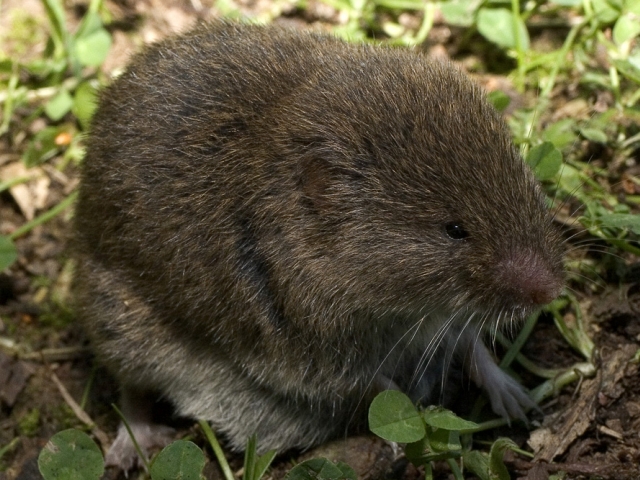
A very small, cylindrical vole, at 7.8 to 10.5 cm head-body length one of the smallest in Europe, with a large head, blunt muzzle, very small eyes and ears that disappear into the fur, and a tail of 1.7 to 3 cm, about a fifth of the head-body length. The coat is short, dense and smooth, dark grey to sepia-brown above and grey below, without a sharp division; juveniles are darker than adults. The legs are short and the fore claws strong. The build is adapted to a burrowing life: ears, eyes and tail are reduced.
Similar species
In the field, and even in the hand, the species cannot be reliably separated from its sister species. The Mediterranean Pine Vole (Microtus duodecimcostatus) is the closest relative and looks identical; the two species share a long contact zone across Spain and Portugal and are separated mainly by soil and climate: the Lusitanian Pine Vole lives on the colder, wetter, acid soils of the north-west and the mountains, the Mediterranean Pine Vole on the warmer, drier, shallower and more calcareous soils of the south and east. Locality is therefore the best clue; in the contact zone only the skull is decisive. The Pyrenean Pine Vole (M. pyrenaicus) replaces the species in the eastern Cantabrian Mountains and the Pyrenees and cannot be distinguished externally either. The Common Vole, Field Vole and Portuguese Field Vole can be distinguished: they have clearly larger eyes, visible ears and a longer tail, and use surface runways rather than tunnels. Cabrera's Vole is clearly larger, with a longer, shaggier coat with yellow hair tips, and lives only in damp, unmown sedge and rush vegetation; the Bank Vole has a red back and large eyes. The mole, with whose digging the species' work is most often confused, is not a rodent and makes a different heap (see signs).
Habitat
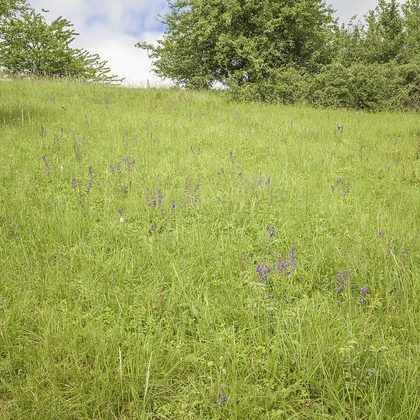
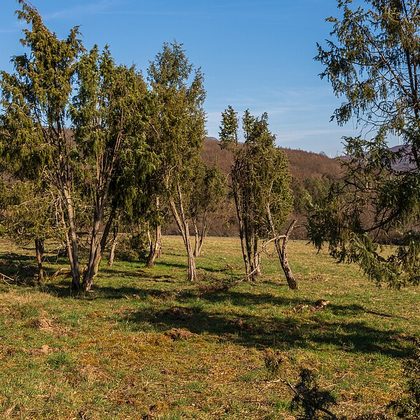
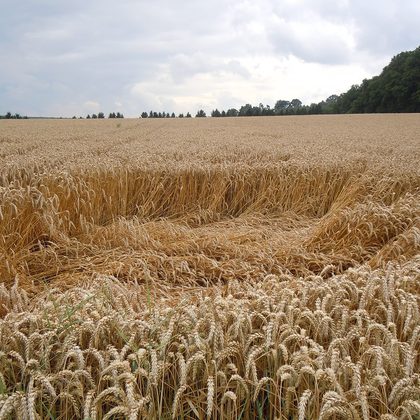
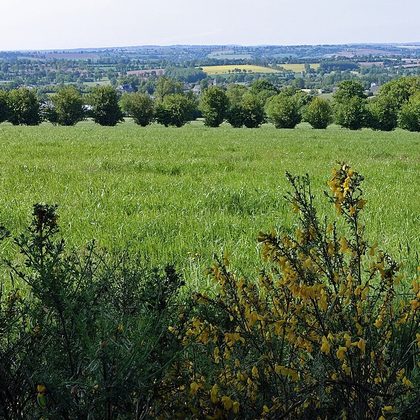
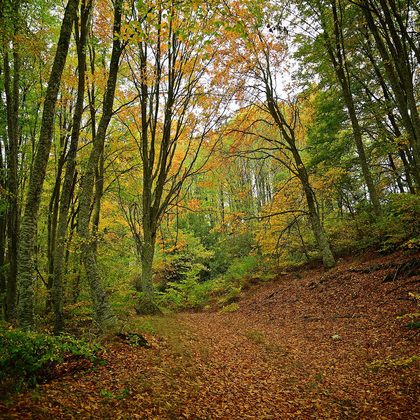
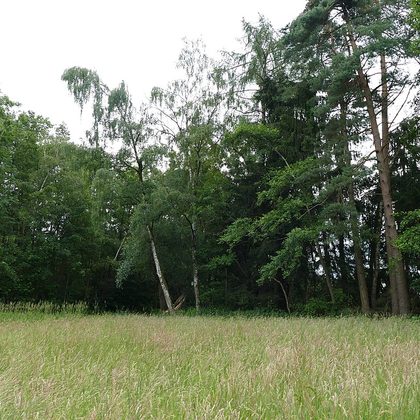
Ground with soft, moist, well-rooted soil and a closed herb layer: hay meadow and pasture, field margins, hedges and hedgebanks of small-scale Atlantic farmland, vegetable plots, orchards, stream banks and the edges of chestnut and oak woodland. The species is strongly tied to the traditional mosaic landscape with small fields and many edges, and declines where fields are amalgamated. From sea level to about 2,000 m, mainly in districts with high rainfall and frequent frost, on acid soils.
Where the animal is most at home, classified with EUNIS — the European standard for habitats.

Distribution
North-western Iberia and the adjacent part of France. In Spain from Galicia, Asturias and Cantabria through León, Zamora and Salamanca to the Sierra de Gata, Gredos and Guadarrama, and east through La Rioja, Soria, Navarre and Huesca to the Basque Country. In Portugal from the north southwards to the Serra da Estrela and on to Setúbal, south of Lisbon. In France the western Pyrenean foothills and the adjoining Aquitaine lowland. With more than six thousand georeferenced records the species is not rare within its range, but it is seldom seen. It is absent outside this area, including the British Isles and the Low Countries.
- Native
- dark = core range, pale = thinly spread
Way of life
Active mainly at night and at dusk, in short bouts spread over day and night, and spending most of its time underground. Almost entirely herbivorous with a preference for geophytes: leaves and shoots in winter and spring, bulbs, tubers, rhizomes and seeds in summer and autumn, which are stored in chambers. The species lives in small family groups in a shared tunnel system, with a home range averaging about 950 square metres and daily movements of around 73 metres. Breeding continues all year and decreases only slightly in winter; after a gestation of 22 to 24 days one to five young are born, usually two or three, naked, blind and weighing about one and a half grams. Females are fertile at five weeks, males at seven. There is no winter rest.
Where and when to look
Search for the earth heaps. Walk along an old meadow, a field margin or a vegetable plot in Galicia, Asturias or northern Portugal early in the morning after a wet night and look for lines of small, fine heaps of fresh earth without an open hole. Carefully expose a tunnel beside a heap with a knife and measure its diameter: twenty-five to thirty-five millimetres points to this species group. In a vegetable plot, check potatoes, carrots and bulbs for smooth gnawing from below. The animal itself is seen almost only in trapping studies: it comes briefly to the surface at night and disappears at the slightest movement. Collect pellets under a Barn Owl roost; they quickly give an overview of the vole species in a valley.
Conservation status
Least Concern (LC, 2024) and locally very numerous in north-western Iberia. In apple and cherry orchards, vineyards and vegetable plots the species is regarded as a pest; it is controlled with poisoned grain based on anticoagulants, which also poisons the Barn Owls, Little Owls, weasels and foxes that regulate its numbers. Together with the Mediterranean Pine Vole the species is associated with outbreaks of tularaemia on the Spanish meseta. Where the landscape is amalgamated into large, herb-poor fields without hedges, it disappears; the small-scale farmland on which it depends is declining throughout north-western Iberia. Buffer strips, hedge restoration and raptor perches are cited as alternatives to poison.
Scientific name
Microtus lusitanicus | (Z. Gerbe, 1879)
Z. Gerbe described the species in 1879 as Arvicola (Microtus) lusitanicus; because it was later moved to another genus, the author and year stand in brackets. Microtus is Greek, from mikros, 'small', and ous, genitive ōtos, 'ear', after the small ears hidden in the fur. lusitanicus means 'Lusitanian', after Lusitania, the Roman province covering roughly present-day Portugal. The specimen the first description was based on came from Portugal.