All species › Rodents › Squirrels and marmots › Little Ground Squirrel
Little Ground Squirrel | Spermophilus pygmaeus
Dwerggrondeekhoorn | Spermophilus pygmaeus
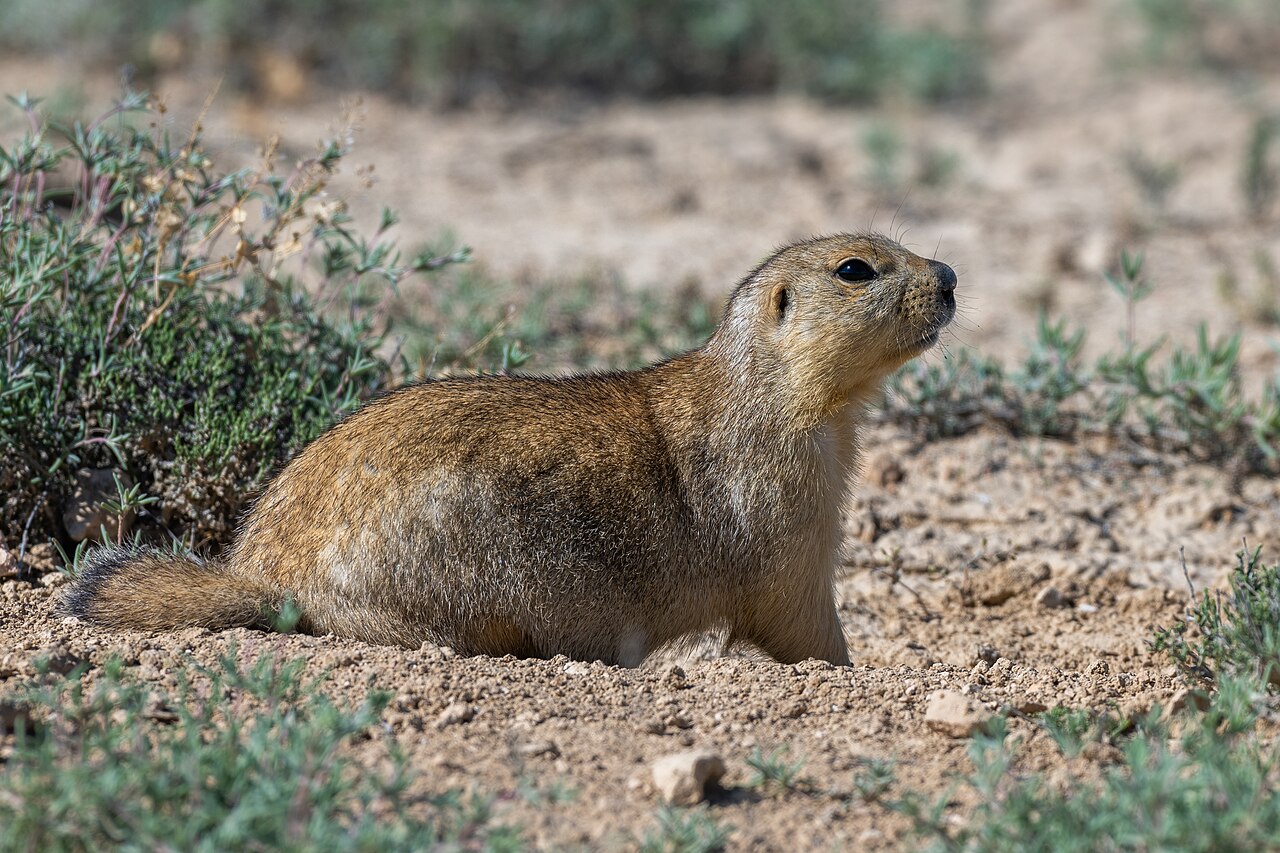
The Little Ground Squirrel (Spermophilus pygmaeus) is a souslik of dry steppe and semi-desert east of the Volga, on salt steppe and drifting sand where the vegetation has dried out by June. It is the smallest and shortest-tailed of the European sousliks. It is above ground for less than a hundred days a year; the rest of the year it spends in summer dormancy that passes without a break into hibernation. In Europe it occurs only in the far east.
Tracks
The main sign is the colony, which is visible from a long distance in the open landscape. The burrow entrances are small, 4 to 7 cm, and run almost vertically into the ground. In front of each lies a low fan of paler excavated sand. Colonies are large and the entrances lie close together, usually hundreds per hectare. Around each entrance the vegetation is grazed away to bare ground, surrounded by a ring of shorter, differently coloured grass; on salt steppe this produces a pattern of pale rings. For much of the year the burrows are plugged with earth from within and show only as a plug of soil just below the surface; in August and September a colony therefore shows no activity above ground. Droppings are small, dark and dry, and lie scattered. The alarm call is a short, sharp whistle.
Identification
Head-body 17.5 to 26 cm, tail 2.5 to 5 cm, weight around 235 g. A small, thickset souslik with the shortest tail in the genus, about a sixth to a fifth of the head-body length. The back is brownish grey washed with ochre and yellow, finely speckled by pale hair tips but without spots; the head is distinctly darker and warmer ochre than the back, which is the most useful character at a distance. Flanks and belly are pale yellowish white, the eye-ring is inconspicuous. The tail is light greyish buff with a pale tip and no black fringe. The ears are very small and rounded, the eyes large and black. In fresh summer coat the species is paler than in spring; adults at the end of the active period are heavy and slow because of their fat reserves.
Similar species
Distribution is the decisive character. Since the 2024 revision this species comprises only the populations east of the Volga: the trans-Volga steppe of Russia and western and central Kazakhstan as far as the Aral region. West of the river, in the steppe between Volga and Dnieper and in the Crimea, lives S. musicus, formerly included in this species and barely separable from it even in the hand; the Volga forms the boundary. North and west of that lives the Speckled Ground Squirrel, with distinct white spots, and further west S. odessanus and the European Souslik. East and south-east of the range two related species occur: the Yellow Ground Squirrel (S. fulvus) of the Kazakh deserts is two to four times heavier and much larger, and the Red-cheeked Ground Squirrel (S. erythrogenys) is stouter, with rusty cheeks and a longer tail. Outside the genus the Bobak Marmot is much larger, and the steppe lemming and the hamsters are smaller, not active by day in open ground and shorter in the neck.
Habitat
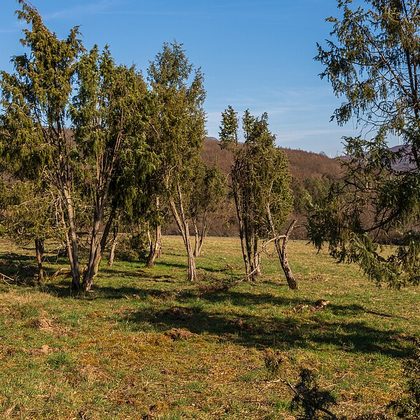
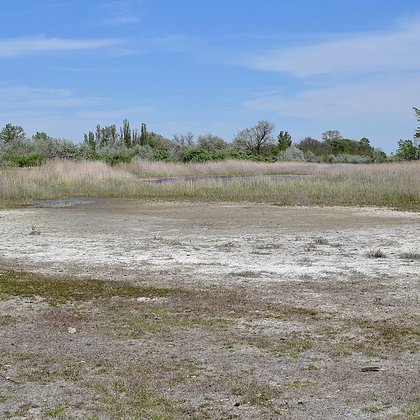
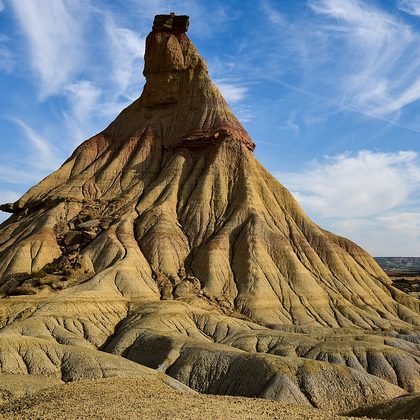
Dry grasslands: feather-grass and wormwood steppe, salt steppe, semi-desert and the edges of drifting sand, on light, sandy and saline soils. Also field margins, fallow, grazed slopes and road and railway verges. Tall and wet vegetation is avoided; the species needs sparsely vegetated, dry, easily dug ground with an open view. Up to about 500 m. In the southern half of the range the vegetation dries out by June; the annual cycle with a short active period matches this.
Where the animal is most at home, classified with EUNIS — the European standard for habitats.

Distribution
The range begins east of the Volga and extends east across the trans-Volga steppe of Russia and over western and central Kazakhstan to the Aral region and the Mangyshlak Peninsula on the Caspian Sea. The species does not occur in western or central Europe. In the nineteenth and twentieth centuries the species was defined more broadly, including the Crimea and the whole south Russian steppe; those western populations have been assigned to S. musicus since 2024, which has greatly reduced the European part of the range. Over the last two decades the northern and western edges of the range have contracted.
- Native
- dark = core range, pale = thinly spread
Way of life
Exclusively diurnal. Of the European mammals this species has the shortest active period per year: in the south of the range it is active for only 80 to 100 days a year. It emerges in March or April, mates within a few weeks and after a gestation of 25 to 26 days gives birth to two to twelve young, on average six to eight, which appear above ground at three weeks. Adult males go underground as early as the second half of July or in August; summer dormancy passes without a break into hibernation, which lasts until March, five to eight months in total. The burrow is plugged from within. The species lives in dense colonies in which each adult has its own burrow system. Food consists of grasses, herbs, bulbs, tubers and seeds, in summer also cereal grain from adjacent fields, supplemented with grasshoppers and beetles. Predators are steppe polecat, fox, corsac, stoat and above all Steppe Eagle and Saker Falcon, which locally feed largely on this species. It seldom lives beyond three years.
Where and when to look
The best period is April and May, in the morning. Search a grazed or fallow plain in the trans-Volga steppe or western Kazakhstan for the pattern of bare patches with a pale collar of earth, and wait. Dense colonies are not rare; the animals then sit upright in many places at once. From mid-June activity decreases rapidly and by August almost all animals are underground. Photograph the short tail and the dark ochre head, the two most useful characters, and record the exact locality: west of the Volga the animal is S. musicus.
Conservation status
Least Concern (LC, 2016), with a large population over a large area, but with a declining trend. In Soviet times the species was poisoned on a large scale as a pest of cereals and as a plague vector; those campaigns lowered densities permanently. Since the 1990s opposing causes have been added: where arable land was abandoned, the grass grew tall and the colonies disappeared, and where livestock numbers rose, pastures became overgrazed. Desiccation is a further factor: in parts of the Caspian lowland the vegetation has become so sparse that colonies no longer survive a dry summer. The 2016 assessment still refers to the broad species concept, including the populations now assigned to S. musicus; an assessment of the species in the narrow sense has not yet been made. Several European edge populations have disappeared in the last thirty years.
Scientific name
Spermophilus pygmaeus | (Pallas, 1779)
Pallas described the species in 1779 as Mus citillus varietas pygmea; because it was later moved to another genus, the author and year stand in brackets. Spermophilus is Greek, from sperma, 'seed', and philos, 'loving': the seed-lover, after the food the animal carries to its burrow in its cheek pouches. pygmaeus is Latin pygmaeus, from Greek pygmaios, 'dwarfish', literally 'a fist high', from pygmē, 'fist'; this is the smallest of the European ground squirrels. The specimen the first description was based on came from Kazakhstan, Indersk.