All species › Rodents › Voles and hamsters › Gray Red-backed Vole
Gray Red-backed Vole | Craseomys rufocanus
Craseomys rufocanus | Craseomys rufocanus
Craseomys rufocanus is a red-backed vole that is no longer placed in Clethrionomys but in a genus of its own, Craseomys. It is the largest of Europe's three red-backed voles and the commonest rodent of the Scandinavian birch forest and the block fields above it. Voles among rocks in northern Norway and Finnish Lapland usually belong to this species; in the peak years of the four-year cycle it is very numerous.
Tracks
The species lives at the surface, so its signs lie in rather than under the turf. In birch forest and on block fields runways three to four centimetres wide can be found passing under dwarf birch, bilberry and crowberry and disappearing between the stones, and round holes three to four centimetres across under a boulder, at the foot of a birch or under a root plate. The nest is a ball of grass, moss and birch bark fifteen to twenty centimetres across, in summer under a stone or in a cavity and in winter in the snowpack; after snowmelt in June these nests lie on the ground, surrounded by the remains of the winter runs: strands of grass across the ground. There are also bitten-off bilberry and crowberry stems, peeled twigs and in winter ring-barking at the base of young birches and willows. In peak years a whole birch forest has brown crowns in June because the bark has been eaten under the snow; this is the clearest sign of this species. Droppings are four to six millimetres long, cylindrical with blunt ends, dark green to black, in small piles along the runway. Under the roosts of Tengmalm's, Hawk and Great Grey Owls the rodent species of the area can be found in pellets.
Head close-up
Identification
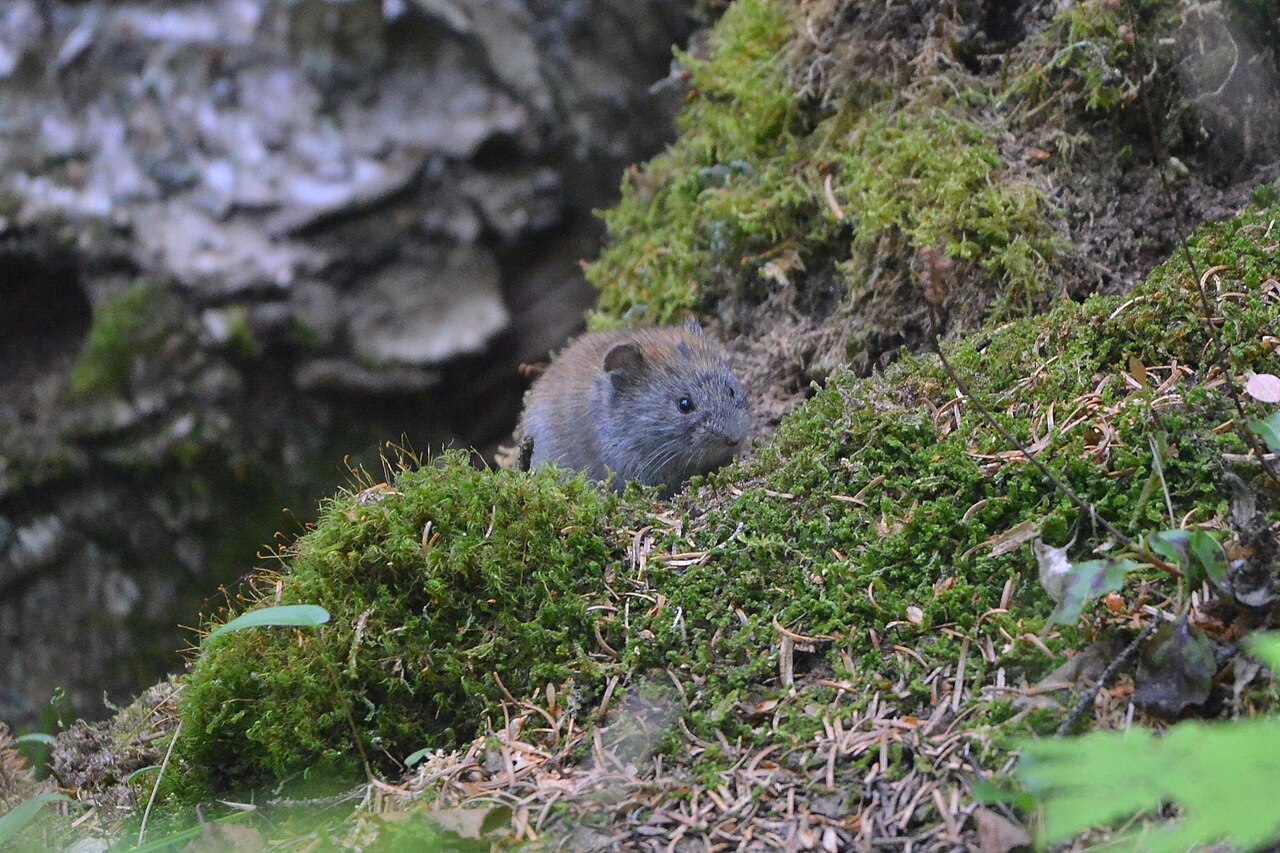
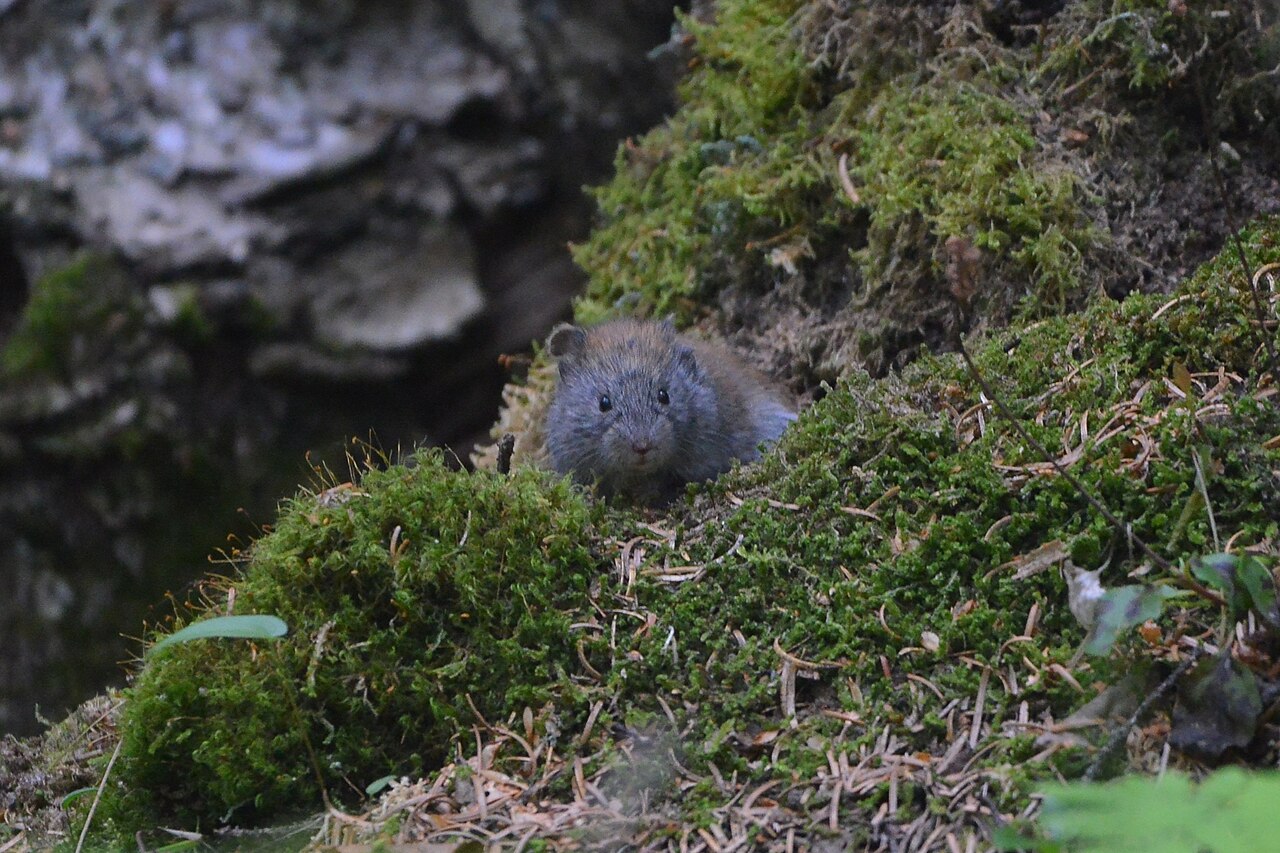
A large, grey vole with a narrow red dorsal mantle sharply set off against the grey flanks; this contrast, not the colour itself, is the character. Head-body length is 10 to 14.2 cm and weight 27 to 52 grams, considerably larger than the Bank Vole and the Northern Red-backed Vole. The tail is 2.7 to 6.3 cm, about forty per cent of head-body length, and furred. The ears are large and project clearly from the fur and the eyes are large; the species lives mainly above ground. The coat is long and fairly coarse, and the colour varies strongly with season and region: greyer in winter, more reddish-brown on the back in summer, and strikingly dark in the northernmost part of the range. Belly and underparts are greyish white.
Similar species
In Fennoscandia three red-backed voles occur side by side; with experience they can be distinguished. The Bank Vole (Clethrionomys glareolus) is smaller, chestnut over back and flanks without a sharp boundary, with smaller ears and a longer tail (about half the head-body length). The Northern Red-backed Vole (C. rutilus) is distinctly smaller, with a bright rusty, broad mantle and a shorter tail of about a third of head-body length. This species is distinguished from both by the combination of size, large projecting ears, grey flanks and a narrow red back; in the field the impression is mainly grey, in the other two species mainly red. In the north the Wood Lemming (Myopus schisticolor) also occurs, slate-grey with a rusty saddle and a very short tail, which can resemble this species at a distance; the Wood Lemming is smaller, with a shorter tail and smaller ears. The Norway Lemming is blotched yellow and black and cannot be confused. This species is still listed in many datasets as Myodes rufocanus or Clethrionomys rufocanus; it is the same species.
Habitat
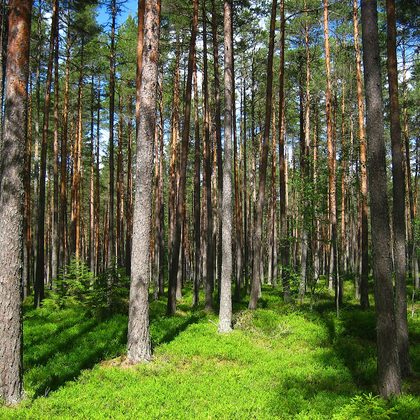
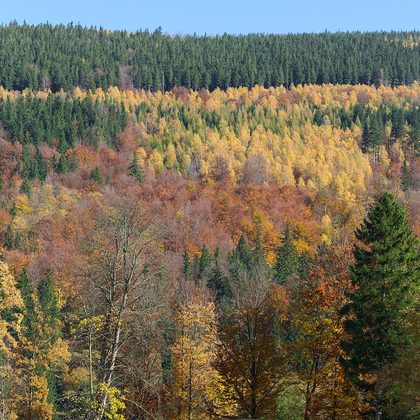
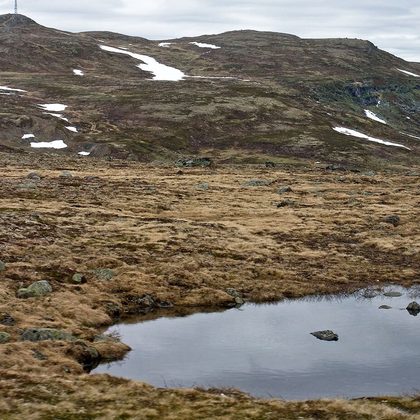
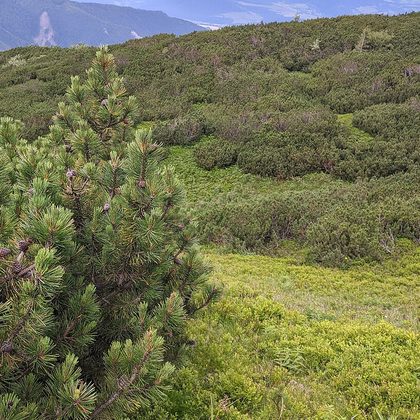
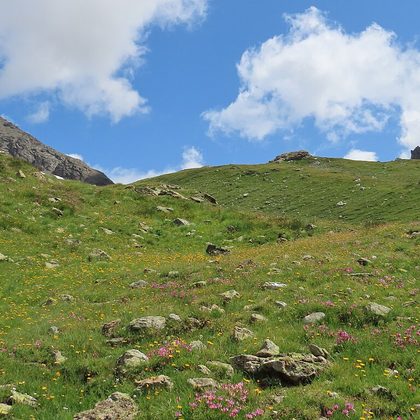
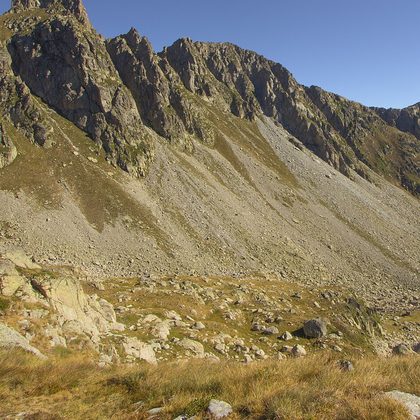
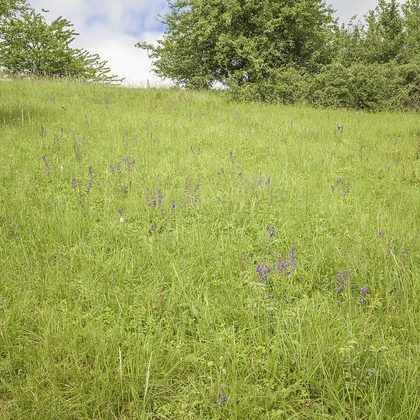
Coniferous and birch forest of the northern taiga, especially the stony and boulder-rich places within it: scree, rock ribs, old walls and stony stream valleys. The species is nonetheless a generalist and also occurs in meadows, scrub, plantations, mixed forest and into alpine tundra; in Asia up to about 3,000 m. In Scandinavia it is the characteristic vole of the birch belt above the conifer limit and of willow scrub along streams. Cover at ground level, such as stones, dead wood or a dense dwarf-shrub layer, is more important than a particular forest type.
Where the animal is most at home, classified with EUNIS — the European standard for habitats.
Distribution
From Fennoscandia east across Siberia to the Pacific, Kamchatka, Sakhalin and Hokkaido, south to the southern Urals, Mongolia, northern China and Korea; in total about thirteen million square kilometres. In Europe the range covers the Scandinavian mountains from southern Norway to Finnmark, northern Sweden, Finnish Lapland and the Kola Peninsula; of the three red-backed voles this species extends furthest into the Norwegian uplands. The species does not occur in central and western Europe, including the Low Countries, Britain and Ireland and the Iberian Peninsula.
- Native
- dark = core range, pale = thinly spread
Way of life
Polyphasic and mainly nocturnal, but in summer, when it does not get fully dark in Lapland, mainly crepuscular. The species is largely herbivorous: green plant parts usually make up more than half the diet, in summer herbs and grasses, in winter leaves of evergreen dwarf shrubs and lichens, supplemented by berries, seeds and fungi. Mating is promiscuous: a single litter may be sired by more than one male. The breeding season lasts five and a half months, from March or April to October or November, with two to four litters per season; gestation is eighteen to twenty days and a litter contains one to thirteen young. Home ranges measure four hundred to thirteen hundred square metres in males and two hundred to six hundred in females; females remain at their birthplace and dispersal is by males. There is no winter dormancy; the species spends the winter under the snow. In tundra and birch forest numbers fluctuate on a three- to five-year cycle, with outbreaks in which the forest can be eaten bare.
Where and when to look
The best place is the birch belt just above the conifer limit in northern Sweden, Finnish Lapland or Norway, and within it a slope with boulders and dwarf birch. Sit by a block field in the early morning or in the light night of June and wait: this is one of the few northern voles that is regularly seen above ground, and the large ears and grey coat with red dorsal stripe are easy to see with binoculars. If possible go in a peak year; locally it is usually known when that is. In such years the animals are numerous and Hawk Owls, Tengmalm's Owls and stoats are also present. Bark ringed at snow height on young birches in June indicates feeding in the previous winter.
Conservation status
Least Concern (LC, 2016), with a range of thirteen million square kilometres and common throughout almost all of it. In Fennoscandia, however, a change has been recorded: since the 1980s the three- to four-year cycle of the northern rodents has flattened in many places, and outbreaks in which birch forest was eaten bare have become rarer. The probable cause is milder, more variable winters: where the snow remains thin or thaws and refreezes during the winter, the space between snow and ground in which these animals overwinter disappears. Snowy Owl, Hawk Owl, stoat and Arctic Fox also depend on this cycle; where the peaks fail, they decline as well.
Scientific name
Craseomys rufocanus | (Sundevall, 1847) (GBIF: Myodes rufocanus)
Sundevall described the species in 1847 as Hypudaeus rufocanus; because it was later moved to another genus, the author and year stand in brackets. Craseomys is Greek: the second element is mys, 'mouse', and the first is read as krasis, genitive kraseōs, 'mixture'; Miller gave no explanation of the name. rufocanus is Latin for 'red-and-grey', from rufus, 'reddish brown', and canus, 'grey', after the rufous back against the grey flanks. The specimen the first description was based on came from Sweden, Lapland.