All species › Hedgehogs, shrews and moles › Shrews › Eurasian Least Shrew
Eurasian Least Shrew | Sorex minutissimus
Kleine dwergspitsmuis | Musaraña Menuda
At 1.4 to 4 g the Eurasian Least Shrew (Sorex minutissimus) is one of the smallest species of the genus Sorex. Its range spans the whole northern coniferous forest belt, from Norway across Siberia to Hokkaido and Alaska; in Europe it lives only in Fennoscandia, Estonia and the north and centre of European Russia. Where it occurs it is usually one of the scarcest shrews, making up a small share of the shrew community in trapping samples. Much of what is known about the species comes from studies in Russia, Siberia and Japan.
No photograph of a living wild animal of this species with a suitable Creative Commons licence exists. Do you have one that meets the rules? Send it in.
Tracks
No signs are specific to the Eurasian Least Shrew. Droppings, runs and footprints are so small that they are barely findable in the field and cannot be separated from those of the Pygmy Shrew. Most records come from pitfall trapping, in which the species seldom appears in numbers. In owl pellets it is scarce, in line with its low densities. Jaws and skulls with red-brown tooth tips are recognisable by their tiny size and short snout, but a reliable identification needs a specialist key.
Identification
A very small Sorex with a short snout and a short tail no longer than half of head-body length. The fur is two-toned: greyish-brown back and pale grey belly, without the paler flank band of the Common Shrew group. The tail is also bicoloured, dark above and pale below, with scattered protruding hairs. The tooth tips are red-brown, as in all Sorex. Pregnant females exceed three grams. The karyotype differs between populations: 2n = 38 has been found in Finland and 2n = 42 in Siberia and Japan. Head-body 3.0 to 5.3 cm, tail 1.7 to 3.3 cm, hind foot 7 to 9 mm, weight 1.4 to 4 g.
Similar species
The most similar species is the Eurasian Pygmy Shrew (Sorex minutus), which shares its range. It is larger on average and has a much longer, thick tail of about 70 to 80 per cent of head-body length, against at most half in the Least Shrew; its hind foot is also longer than the 7 to 9 mm of this species. Laxmann's Shrew (Sorex caecutiens) is clearly heavier, with a longer tail that is sharply bicoloured in adults. The Common Shrew (Sorex araneus) and the Equal-toothed Shrew (Sorex isodon) are much larger; even their young outweigh an adult Least Shrew. In the field a shrew of this size cannot be identified to species. In the hand, weight, tail ratio and hind-foot length decide, and in case of doubt the skull with a specialist key.
Habitat
The species uses a wide range of habitats, but is found mainly in marginal zones that are less suitable for other shrews: forest edges, transitions from forest to bog, raised bogs, unvegetated screes, coastal dunes and shores. Productive floodplains are avoided. In the taiga it lives in coniferous and mixed forest with a layer of moss or litter, often in the wet and poor patches within it.
Where the animal is most at home, classified with EUNIS — the European standard for habitats.
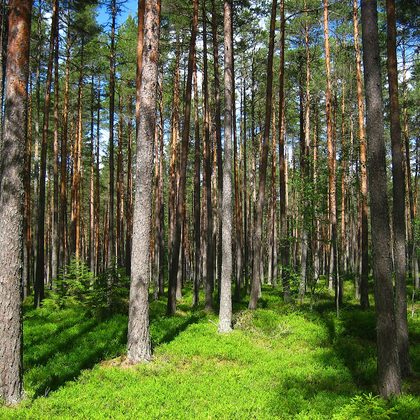
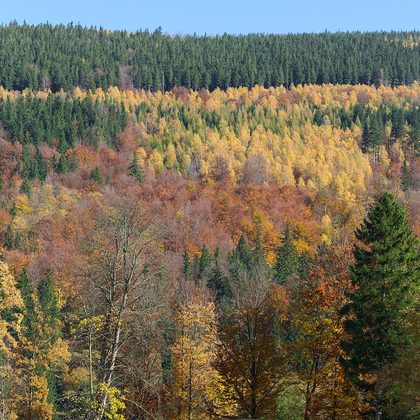


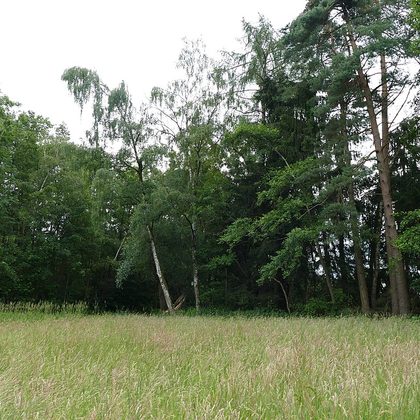
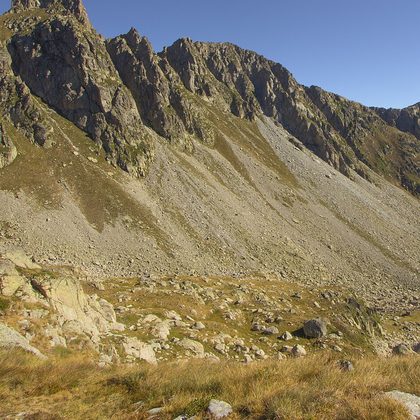

Distribution
From Fennoscandia east through the whole taiga of Russia and Siberia to the Pacific, south to Kazakhstan, the Altai, Mongolia, north-eastern China and the Korean Peninsula, and further to Sakhalin, Hokkaido and Alaska. Eleven subspecies are recognised. In Europe it occurs in Norway, Sweden and Finland, in Estonia and in the north and centre of European Russia, including Karelia and the Kola Peninsula. Finnish animals differ in their chromosomes from Siberian ones, which points to a separate history for the European populations; how this relates to the subspecies has not been resolved. Few records are known from large parts of the European range, so the limits of its distribution are uncertain.
- Native
- dark = core range, pale = thinly spread
Way of life
Like other shrews, the Eurasian Least Shrew alternates between activity and rest around the clock. The share of daytime activity varies by region: in the Russian Far East up to 60 per cent of activity falls in daylight. Its food consists of very small invertebrates, the mix differing by region: in Karelia mainly small adult beetles and arachnids, in western Siberia small beetles, especially leaf beetles, in the Far East arachnids and centipedes. Earthworms and fly larvae are absent from its diet everywhere. It does not hibernate. In western Siberia breeding runs from May to mid-August, with an average of four to five embryos per female; in north-eastern European Russia four to nine embryos have been counted. Females born the same year also breed, and there are at least two litters per season. No data exist on individual home ranges or social organisation.
Where and when to look
In the field the Eurasian Least Shrew cannot be identified: a very small shrew seen along a bog edge or among stones in the Fennoscandian taiga can only be recorded as a Sorex. The species is recorded by trapping studies, mostly with pitfall traps, which require a licence in almost every country. If you handle a shrew of about two grams in such a study, measure the tail and hind foot and take a photograph showing the tail alongside the body: a tail of at most half the head-body length points to this species. Records from Estonia and from the southern part of the Scandinavian range add to knowledge of its distribution.
Conservation status
Least Concern (LC, 2016) on the IUCN Red List, because of its very large range. Numbers are low everywhere, and it is usually one of the least numerous members of the shrew community. In Russia the species is on eighteen regional Red Lists. Because records are scarce and often come from targeted trapping, little is known about changes in numbers. It is listed on Appendix III of the Bern Convention.
Scientific name
Sorex minutissimus | E. A. W. von Zimmermann, 1780
E. A. W. von Zimmermann described the species in 1780 and placed it straight away in the genus where it still stands. Sorex is the Latin word for a shrew. minutissimus is Latin for 'smallest', the superlative of minutus, 'small'. The specimen the first description was based on came from Russia, Siberia.