All species › Carnivores › Mongooses › Egyptian mongoose
Egyptian mongoose | Herpestes ichneumon
Egyptische ichneumon | Meloncillo
The Egyptian mongoose is the only mongoose occurring naturally in Europe, in the south-west of the Iberian Peninsula; beyond that it lives in much of Africa and the Levant. It is the most diurnal carnivore in Spain. How it reached Iberia is disputed: across the Strait of Gibraltar in the Late Pleistocene, with the Romans, in the Moorish period, or by several of these routes. Since the late 1980s it has been spreading northwards.
Tracks
The print averages 34.7 mm wide and 37.6 mm long (excluding the heel) and is asymmetrical: the main pad is trapezoid, extending further back on the outer side. There are five toes with non-retractile claws and a four-lobed main pad. Because the animals often walk in a group, one behind the other, prints overlap and are hard to read. The scat is cylindrical, averaging 13.9 cm long and 1.5 cm thick, dark and glossy, and sometimes contains the animal's own hair with its characteristic alternating white and black bands. Scats are deposited at latrines of 4 to 10 droppings near resting and breeding sites; latrines are used most in the mating season (February–March) and after breeding (September–October). Holes dug at rabbit warrens indicate the excavation of young rabbits.
Identification
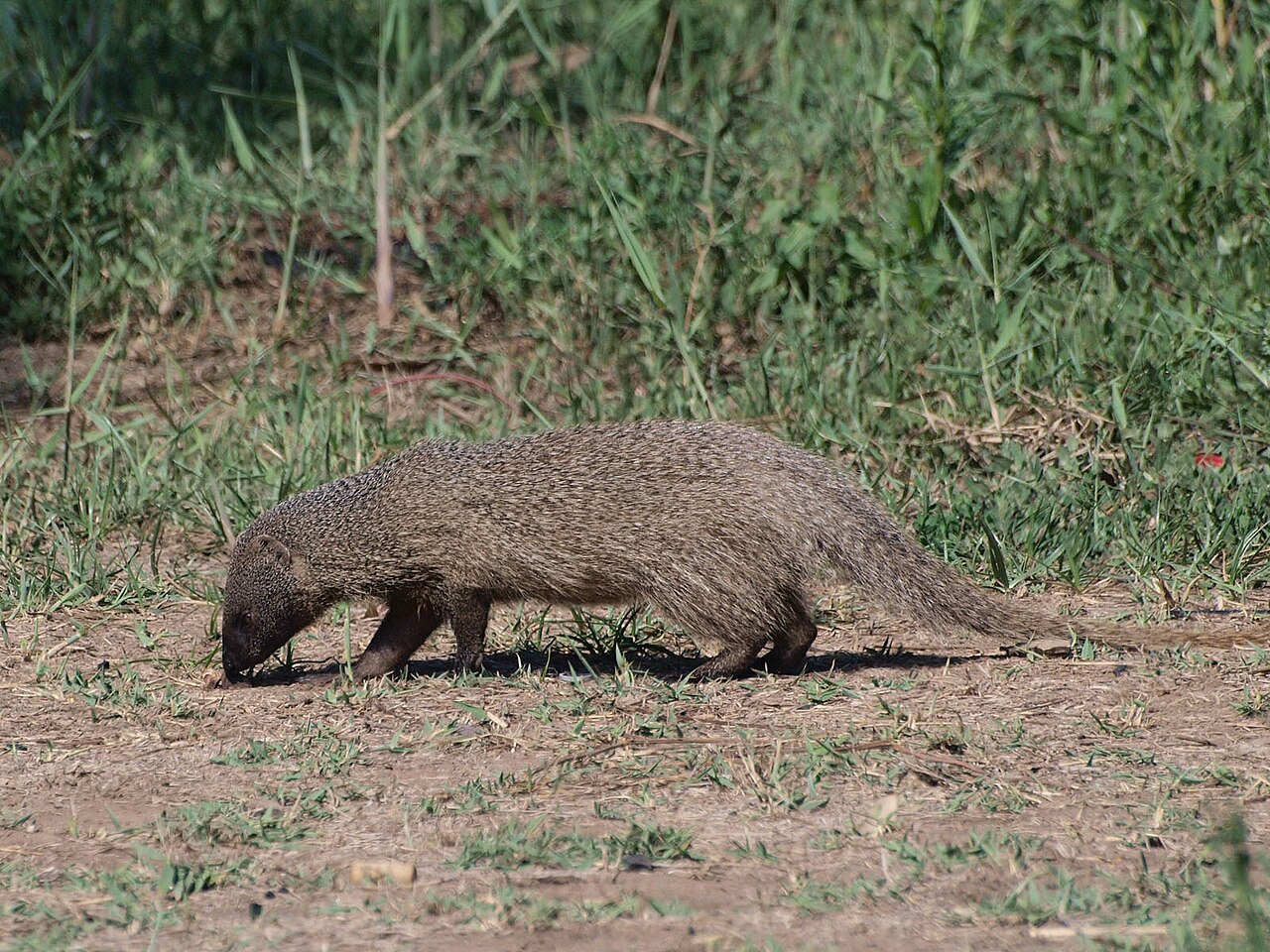
An elongated, low-slung mongoose with short, thin legs, a pointed head and a long tail, broad at the base and ending in a black tuft. The coat is grizzled grey: black hairs with creamy yellow tips or brown hairs with silvery grey tips, banded white and black. The feet have five toes with non-retractile claws. The pupil is horizontal, which is unusual among carnivores.
Similar species
There is no other mongoose in Iberia. Stone marten and pine marten have a brown, ungrizzled coat, a bushy tail without a black tuft and a pale throat patch. The small Indian mongoose of the Adriatic coast is much smaller (25–37 cm head-body, 305–662 g) and lacks the black tail tuft; the two do not meet in the guide area.
Habitat
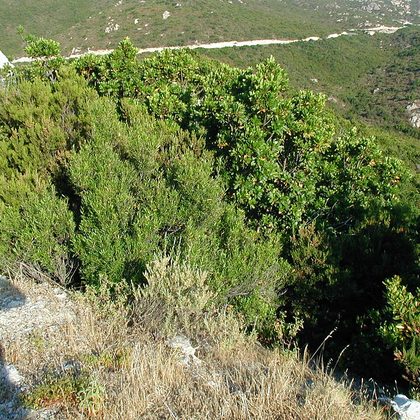
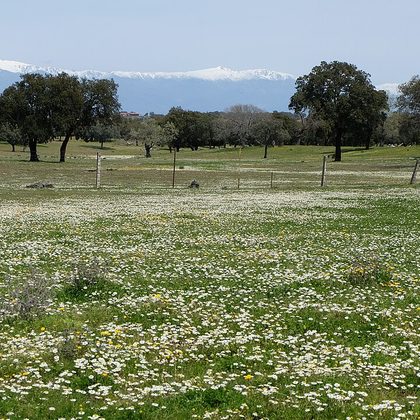
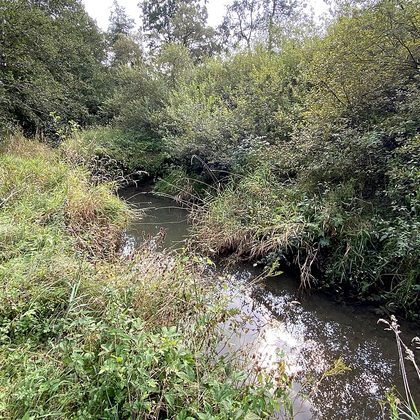
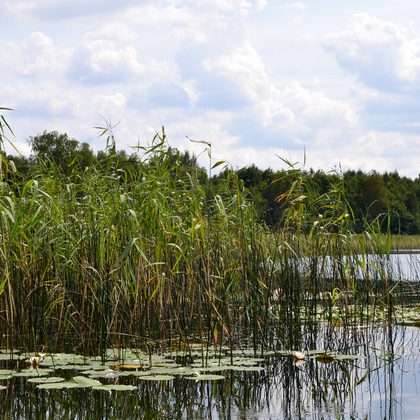
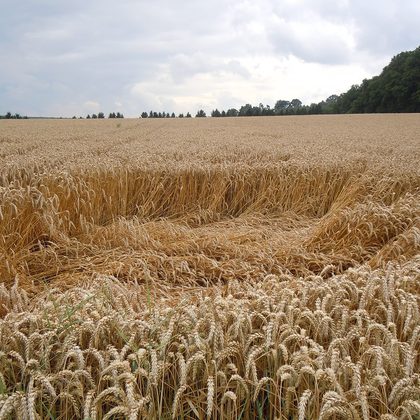
Mediterranean scrub with holm and cork oak, riverine woodland, and farmland with bank vegetation. It uses soft soils along vegetation edges, paths and scrub for cover. Rest sites are in burrows, hollow logs, tree cavities and rock crevices.
Where the animal is most at home, classified with EUNIS — the European standard for habitats.

Distribution
Much of Africa, the Levant and the Iberian Peninsula; within the guide area also Morocco, Algeria, Tunisia, Egypt, Israel, Syria, Jordan and southern Turkey. In Iberia it is most numerous in the Algarve, Sierra Morena and Doñana. In Portugal it was confined to the area south of the Tagus until the late 1980s; it then spread rapidly north, and by about 2010 occupied almost all of Portugal except the far north-west. In Spain animals have been found as far as the Arribes del Duero. Land abandonment with scrub recovery and a warming climate are named as causes of the spread; roads and urbanised coasts slowed it.
- Native
- dark = core range, pale = thinly spread
Way of life
The most diurnal carnivore in Spain, most active around midday and in the afternoon. Egyptian mongooses are not strictly solitary: they hunt separately by day but spend the night in family groups in burrows. Young follow the mother in a line. In a two-year study group size ranged from one to seven. The diet is varied: invertebrates, fish, amphibians, reptiles including snakes, birds, eggs, mammals, carrion of deer and wild boar, and occasionally fruit; in parts of Iberia young rabbits, dug out of the warren, are preferred. Mating is in spring; after a gestation of about eleven weeks 2 to 4 young are born in summer and stay with the mother for about a year.
Where and when to look
Because it is active by day, it can be seen in south-western Iberia in the afternoon, mainly along scrub edges, on sandy tracks and along bank vegetation. A group of animals crossing a road one behind the other is typical. Latrines along paths near dense scrub indicate a regular resting place.
Conservation status
Least Concern (LC, 2016). On the Iberian Peninsula it is increasing and spreading. Some hunters kill it illegally as a competitor for rabbits, and the Iberian lynx is one of its natural predators. Its origin is still debated: remains from Muge in Portugal are dated to the period of the Emirate of Córdoba (756–929 AD), genetic work also allows a natural colonisation in the Late Pleistocene, and a 2021 review proposes multiple introductions from prehistory to the early Middle Ages and questions whether the species should be regarded as alien in Iberia.
Scientific name
Herpestes ichneumon | (Linnaeus, 1758)
Linnaeus described the species in 1758 as Viverra Ichneumon; because it was later moved to another genus, the author and year stand in brackets. Herpestes is Greek herpēstēs, 'creeper', from herpein, 'to creep'. ichneumon is Greek ichneumôn, 'tracker', from ichneuô, 'to track': the name the Greeks gave this animal, which was said to hunt out crocodile eggs. It stands as a noun in apposition to the genus name. The specimen the first description was based on came from Egypt.