All species › Bats › Vesper bats › Cryptic Myotis
Cryptic Myotis | Myotis crypticus
Myotis crypticus | Myotis crypticus
The Cryptic Myotis is one of the species into which Natterer's Bat (M. nattereri) has been split on the basis of DNA over the past twenty years. The form was first referred to in the literature as Myotis sp. A; Ruedi, Ibáñez, Salicini, Juste and Puechmaille described it formally in 2019, with a type locality in a cave in La Rioja, northern Spain. Forearm 36.3 to 42 mm. It is the closest relative of Natterer's Bat in the strict sense and lives in the mountain forests of northern Spain, south-eastern France, the Alps and Italy. Externally it cannot be reliably told from Natterer's Bat.
No photograph of a living wild animal of this species with a suitable Creative Commons licence exists. Do you have one that meets the rules? Send it in.
Tracks
There are hardly any external signs. Maternity colonies of a few dozen bats are in hollow trees and abandoned buildings, unlike M. escalerai, which is tied to caves. At certain swarming sites at 200 to 1500 m, in Switzerland, France, Spain and Italy, large numbers gather in autumn; trapping at such sites, combined with DNA analysis, provides most of the data.
Identification
Head-body 40 to 50 mm, tail 32 to 46 mm, ear 14.1 to 17.1 mm, forearm 36.3 to 42 mm, weight 5 to 12 grams. A medium-sized Myotis with the characters of the Natterer's Bat complex: a fringe of stiff hairs along the rear edge of the tail membrane and a long, S-shaped calcar. The upperparts are brown to grey, the underparts pale grey to whitish; the hairs are long and shaggy, with dark bases and pale tips. The ears are relatively long, reach beyond the tip of the nose when laid forward and have several folds on the outer edge. The tragus is pointed and longer than half the ear. The face is bare and pink, especially around the eyes, with a narrow, long muzzle. The feet are small, shorter than half the tibia. The wing is attached at the base of the toe. No call measurements for this species on its own have been published in the sources consulted; within the complex as a whole the call is short and strongly frequency-modulated, with a very broad frequency range.
Similar species
All measurements overlap completely with those of the other species of the Natterer's Bat complex; according to the description the species can be separated statistically only by a combination of many skull and body measurements. From Natterer's Bat (M. nattereri in the strict sense), its sister species, it cannot be told apart externally; it is on average slightly smaller, with a narrower skull, but these differences overlap. Where the ranges meet, in the Alps and France, DNA is required. From Escalera's Myotis (M. escalerai), with which it co-occurs in the mountain forests of the northern half of the Iberian Peninsula, it differs in the hand: in M. crypticus the edge of the tail membrane carries one row of short, outward-pointing hairs, in M. escalerai one row pointing inward and a shorter row pointing outward; in M. crypticus the wing is attached at the base of the toe, in M. escalerai at the metatarsus. On Corsica lives M. nustrale, which has a dark chin spot. The species of the complex cannot be separated by their calls. Other Myotis species lack the fringe of stiff hairs on the tail membrane.
Habitat
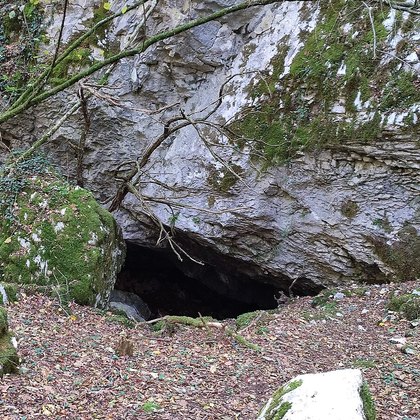
Mountain areas, probably various forest types such as oak and beech forest, clearings used for grazing and alpine meadows, up to about 2000 m. The species hunts close to vegetation in dense, cluttered habitat. Roosts are in tree cavities and buildings; swarming sites are underground.
Where the animal is most at home, classified with EUNIS — the European standard for habitats.






Distribution
Northern and central Spain, south-eastern France, Italy including Sicily, and south-western Austria. Genetic studies also confirm the species in the western Alps, including Switzerland. The northern limit of the range is unknown. The handbook mentioned a possible occurrence on Corsica and Sardinia; the Corsican population was described in 2023 as M. nustrale. Because older records of Natterer's Bat in this area are not based on DNA, the actual range is incompletely known.
- Native
- dark = core range, pale = thinly spread
Way of life
The species probably gleans its prey from surfaces, hunting close to vegetation and in confined spaces where high manoeuvrability is required. Prey are probably invertebrates such as spiders and caterpillars, taken from leaves or from the ground. In the maternity period females roost in hollow trees and abandoned structures, in colonies of a few dozen bats. In autumn the bats swarm in large numbers at fixed sites. Few data on reproduction, hibernation and longevity have been published for this species on its own; much of the literature from before 2019 does not distinguish it from Natterer's Bat.
Where and when to look
A bat with a fringe of stiff hairs along the tail membrane belongs to the Natterer's Bat complex; within the complex the locality determines which species are possible, and DNA which one it is. In northern Spain the wing attachment and the rows of hairs on the tail membrane are the characters to check. Capturing and handling bats requires a licence throughout the European Union.
Conservation status
Near Threatened (NT) on the global Red List, assessed in 2023. The describers pointed out that three of the four species into which the complex was then divided have restricted ranges and need conservation measures. Distribution and population size are largely unknown, and the forests in which the species lives are under pressure from human use. In the European Union it falls, like all bats, under Annex IV of the Habitats Directive.
Scientific name
Myotis crypticus | Ruedi, Ibáñez, Salicini, Juste, & Puechmaille in Juste, Ruedi, Puechmaille, Salicini, & Ibáñez, 2019
Ruedi, Ibáñez, Salicini, Juste, & Puechmaille in Juste, Ruedi, Puechmaille, Salicini, & Ibáñez described the species in 2019 and placed it straight away in the genus where it still stands. Myotis is Greek, from mys, genitive myos, 'mouse', and ous, genitive ōtos, 'ear': 'mouse-ear'. crypticus is Latin for 'hidden', from Greek kryptos: a cryptic species, long not distinguished from Myotis nattereri. The specimen the first description was based on came from Spain, La Rioja.