All species › Rodents › Old World porcupines › Crested Porcupine
Crested Porcupine | Hystrix cristata
Gewoon stekelvarken | Puercoespín
At 13 to 27 kg the Crested Porcupine is, after the beaver, the largest rodent in Europe. In Europe it occurs only in Italy, where it forages at night in maquis, woodland edges and farmland. When disturbed it rattles the hollow quills at the end of its tail, so the animal is often heard before it is seen. Whether the species is native to Italy or was introduced by people has not been settled after some two hundred years of discussion.
Tracks
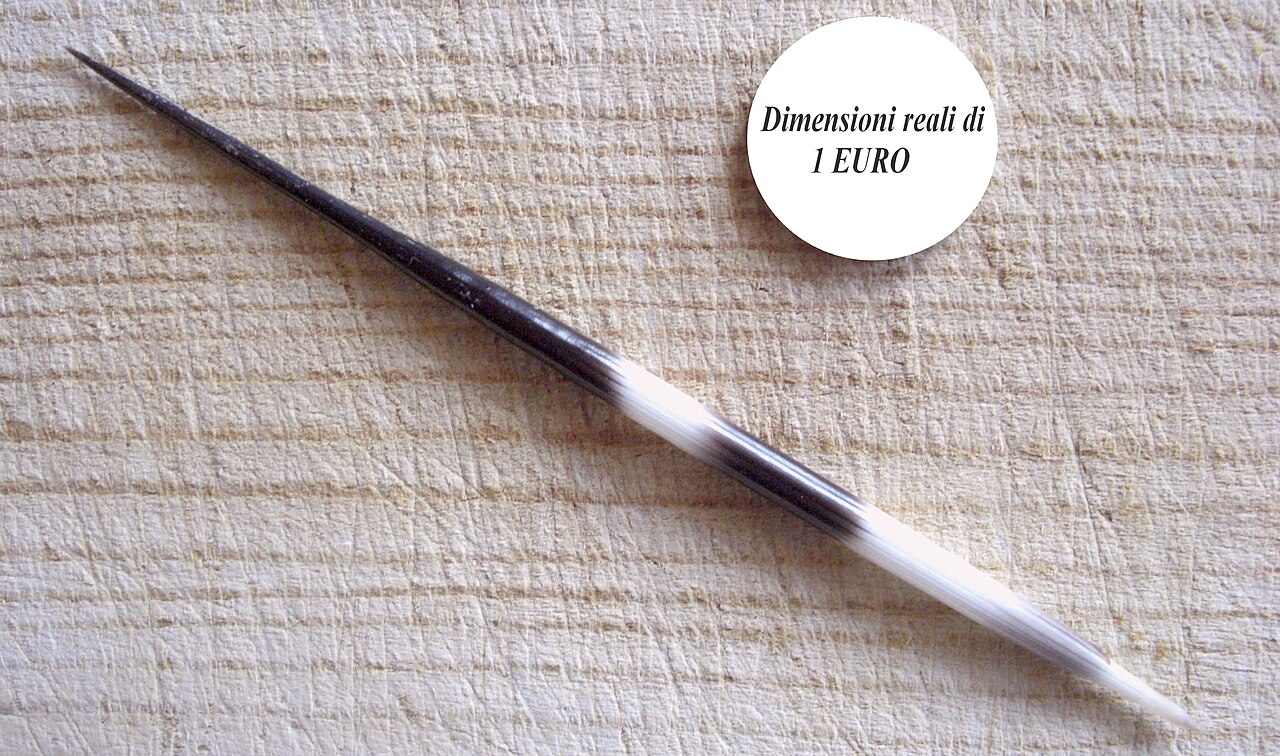
The species is usually recorded by its signs. The clearest are the shed quills: each quill sits loosely in the skin and comes away at a touch, when the animal shakes and in fights, so that dozens lie along the runs and especially in front of the burrow entrance. They are banded black and white, sharp, ten to fifty centimetres long, and bleach to dirty white in the field within a few months. The burrow is a dug tunnel system or an enlarged rock crevice with an entrance 25 to 40 cm across, much wider than high, with a large fan of excavated soil in front and a broad, polished run leading straight away from it; a burrow is used for generations. The dropping is a clump of three to seven cylindrical pellets 2 to 4 cm long stuck together, strongly fibrous, dark brown to black, with visible plant fibres and straw; it often lies at the burrow entrance or in a latrine along the run. The print is broad, with five toes, heavy claw marks on the hind foot and a broad, kidney-shaped sole; it differs from all other European prints. Further signs are digging marks, funnel-shaped scrapes ten to twenty centimetres across where tubers and bulbs have been dug out, and bark stripping on trunks of olive, cork oak and fruit trees, where the bark is gnawed away in broad bands down to the wood. At a fixed place in or near the burrow there are sometimes gnawed bones, which the animal collects and gnaws for minerals.
Identification
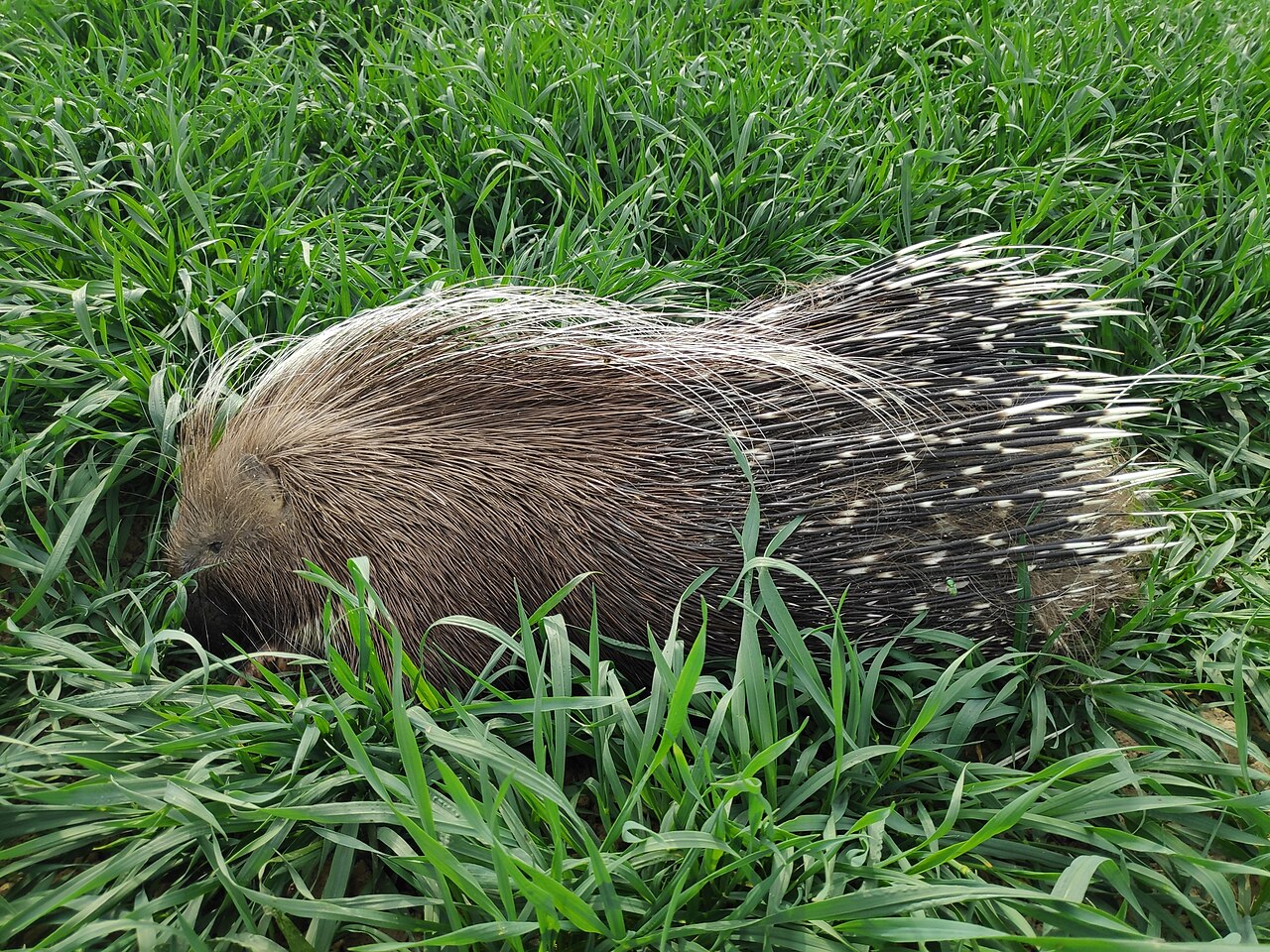
A heavy, low, thickset animal with a blunt head, small eyes, short legs and a coat of quills; in Europe it cannot be confused with any other species. Over the head, nape and back runs a crest of long, flexible white bristles up to 35 cm, which is raised when the animal is excited. The back and flanks carry the true spines: stiff quills with a sharp point and alternating black and white bands, up to half a metre long. The rest of the body is covered in dark, bristly hair. At the end of the short tail are the rattle quills: short, hollow, thin-walled quills with a broadened tip, which vibrate against one another and produce a hissing rattle. The feet have strong digging claws. The animal walks with a shuffle, back arched and head low.
Similar species
No confusion species in Europe. In the Levant and Transcaucasia, where the ranges of the two species almost meet, the Indian Crested Porcupine (Hystrix indica) occurs; it has a much shorter crest or almost none, a longer tail with a white tip, and blacker quills with more sharply defined white bands. In North Africa the two species do not occur together. Confusion with a hedgehog is possible only in the dark and is resolved by size: a hedgehog weighs about 1 kg, a porcupine 13 to 27 kg. Loose quills on a path belong to a porcupine; hedgehog spines are short, smooth, unbanded and at most three centimetres long.
Habitat
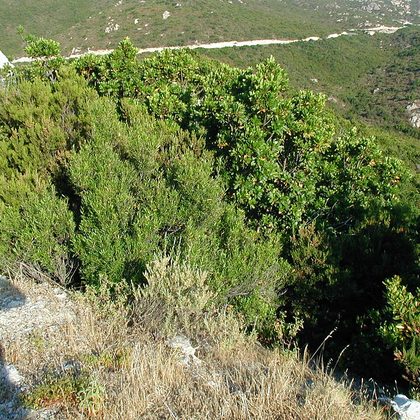
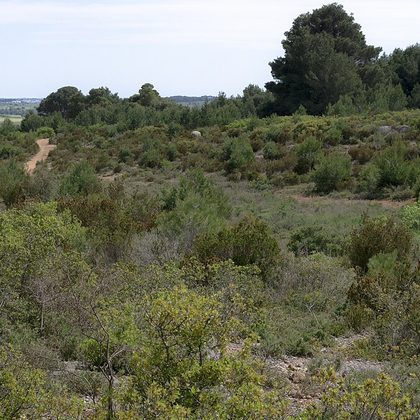
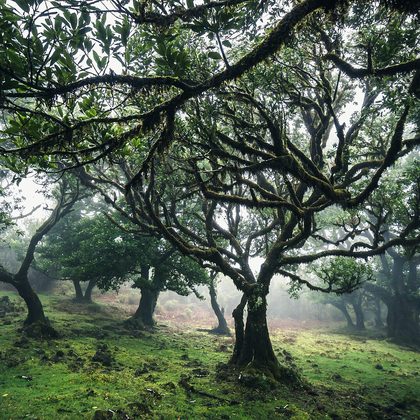
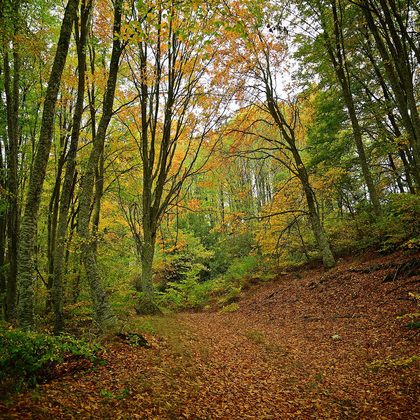
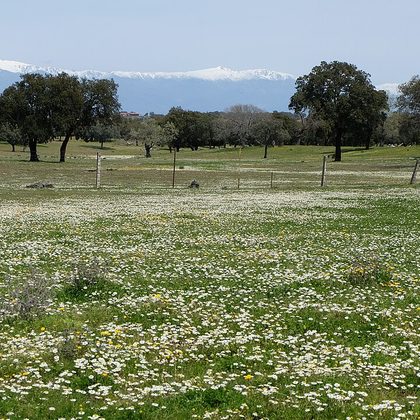
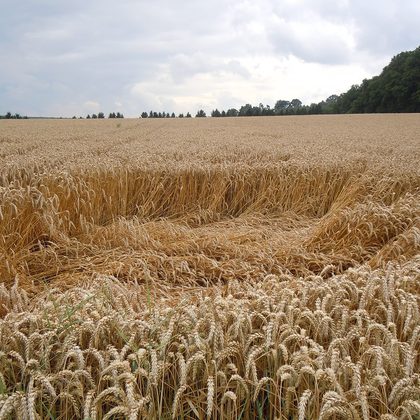
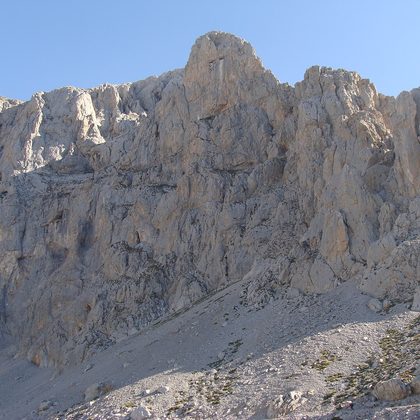
Warm, dry, varied landscapes with diggable soil: maquis and garrigue, cork-oak and holm-oak woodland with clearings, old terrace walls, orchards, olive groves, vineyards and field margins. Three elements are required: a place for a burrow (a slope, a rock crevice, an old wall), cover and tubers. In the Apennines the species occurs up to about 1500 metres, and in recent decades it has also been found on heavier and wetter soils than before.
Where the animal is most at home, classified with EUNIS — the European standard for habitats.
Distribution
In Europe only in Italy, over the whole peninsula from Liguria and Tuscany to Calabria and on Sicily. Over the last thirty years it has spread rapidly northwards: into the Po plain since the 1990s and now into Piedmont, Lombardy and the foot of the Alps. It has appeared only recently on Sardinia. Outside Europe it occurs throughout North Africa from Morocco to Egypt and south through the Sahel to Tanzania. It became extinct in the Balkans in the nineteenth century. It is absent north of the Alps and from the Iberian Peninsula; the population nearest to Iberia lives in Morocco, across the Strait of Gibraltar.
- Native
- dark = core range, pale = thinly spread
Way of life
Strictly nocturnal; in the burrow by day. A herbivore with a preference for underground plant parts: tubers, bulbs, rhizomes and roots, which are dug out with the forefeet, supplemented with bark, fallen fruit, cereals and vegetables from fields. Bones are gnawed for calcium. A pair lives in a lasting pair bond with the young of the year, sometimes up to six animals in one burrow. When attacked the animal does not flee but reverses into the attacker, quills raised and tail rattling; loose quills stay in the attacker. In Africa foxes, dogs and leopards have died of such wounds. After a gestation of about 110 days there is one litter a year of one or two young, born with open eyes, teeth and soft, flexible spines that harden within a week. There is no hibernation, but in frost and snow the animal stays in the burrow for days. In the wild it can live fifteen years.
Where and when to look
In Tuscany, Umbria or the Maremma, drive slowly along an unpaved road through the maquis after sunset and watch the verges; after fox and wild boar the porcupine is the mammal most often seen there in headlights. By day, look for the burrow: a broad entrance in a bank with a fan of soil and quills in front. A camera trap at the entrance almost always produces images. Quills are almost always present along the runs, but leave them: in Italy the species is fully protected and even collecting quills is regulated.
Conservation status
Least Concern (LC, 2016). In Italy the species is increasing: since full protection in 1974 the population has grown and the range has expanded northwards. It is poached for meat and killed as a pest in vegetable gardens and melon fields; traffic is the main cause of death. Whether the species is native to Italy is disputed. The view that the Romans brought it from North Africa rests on one passage in Pliny, who writes that the porcupine occurs in India and Africa; no bone or image has been found at Pompeii. The oldest certain remains in Italy come from the Crypta Balbi in Rome and from San Giovanni di Ruoti in Basilicata and date from the sixth to eighth century, late antiquity or the early Middle Ages; one of them bears butchery marks. Between the extinction of the ice-age porcupines and those finds lies a period of tens of thousands of years without remains. Most researchers therefore assume introduction by people, but after Roman times, probably more than once and from different parts of North Africa; a minority considers it a naturally surviving relict population. The Mammal Diversity Database includes Italy in the natural range; the species is therefore treated here as native, with this note.
Scientific name
Hystrix cristata | Linnaeus, 1758
Linnaeus described the species in 1758 and placed it straight away in the genus where it still stands. Hystrix is the Greek word for 'porcupine', from hys, 'swine', and thrix, 'hair': the animal with a pig's bristles. cristata is Latin for 'crested', from crista, 'crest', after the mane of long pliant quills on the neck and shoulders. The specimen the first description was based on came from Italy, Rome.